The Food GlossaryAbout this edition
Research draft — full chapter unapproved. Only the specifically cited claim or USDA panel below has a limited check; older research notes remain unverified. Do not use this chapter as foraging, preservation, or medical guidance. A checked claim applies only to its cited wording.

Book readiness · Identity 06

Food identity and publication boundary

Canonical identity
Cooked true yam tuber, species unresolved
Scientific identity
Dioscorea species; the generic USDA record does not state species.
Edible part
Cooked tuber flesh after boiling, draining, or baking; peel, aerial bulbils, leaves, and raw tissue are excluded.
Source form
Yam, cooked, boiled, drained, or baked, without salt, corresponding to USDA FoodData Central FDC 170072.
Do not merge with
Sweet potato, named Dioscorea species, raw yam, canned yam products, flour, chips, medicinal wild yam, supplements, and finished dishes.
Safety boundary
True yams are not sweet potatoes. Species differ, and some Dioscorea require specific detoxifying preparation; a generic cooked panel is not raw-use or foraging clearance.
Publication decision
Generic cooked true-yam form defined; proceed while keeping species-specific preparation and raw use held.

Source 1 · Source 2 · Source 3

Book readiness · Publication 05

Publication fact set and claim boundary

Editorial status
Fact set ready for controlled rewrite
Canonical identity
Cooked true yam tuber, species unresolved
Scientific identity
Dioscorea species; the generic USDA record does not state species.
Edible part
Cooked tuber flesh after boiling, draining, or baking; peel, aerial bulbils, leaves, and raw tissue are excluded.
Exact source form
Yam, cooked, boiled, drained, or baked, without salt, corresponding to USDA FoodData Central FDC 170072.
Authoritative control
USDA Agricultural Research Service and university extension distinguish sweet potato (Ipomoea batatas) from true yams in the genus Dioscorea. They are botanically unrelated and differ in texture, composition and usual markets. “Yam root” without species, cultivar, origin and product label is therefore insufficient for one nutrition or preparation record.
What the human evidence supports
Most orange “yams” in U.S. supermarkets are sweet potatoes, but imported true yams are real and should not be silently merged. Recipe behavior, edible parts and required preparation depend on the identified species and product form. The queue entry should remain an identity-controlled record.
Remove or qualify
Do not merge this chapter with: Sweet potato, named Dioscorea species, raw yam, canned yam products, flour, chips, medicinal wild yam, supplements, and finished dishes. Remove or qualify medical-treatment, universal-safety, cross-species, cross-part, cross-product, and cross-preparation claims unless an exact source is reviewed for that wording.
Safety boundary
True yams are not sweet potatoes. Species differ, and some Dioscorea require specific detoxifying preparation; a generic cooked panel is not raw-use or foraging clearance.
Limitations and unresolved variables
Require the package label or botanical name before applying nutrition or safety guidance. Do not eat wild or unidentified Dioscorea, leaves or bulbils, and do not assume every species is safely prepared by the same method. For a verified retail edible tuber, peel/cook according to species-specific directions.
Publication decision
Bounded fact set is ready for controlled chapter rewrite; the legacy chapter and its broader claims remain unapproved.
Legacy narrative status
No legacy narrative sentence is approved by this fact-set decision. It must be rewritten from, or checked individually against, the bounded facts and exact sources recorded here.

Source 1 · Source 2 · Source 3 · Source 4 · Source 5 · Source 6

Visual orientation

Exact-form visual pair

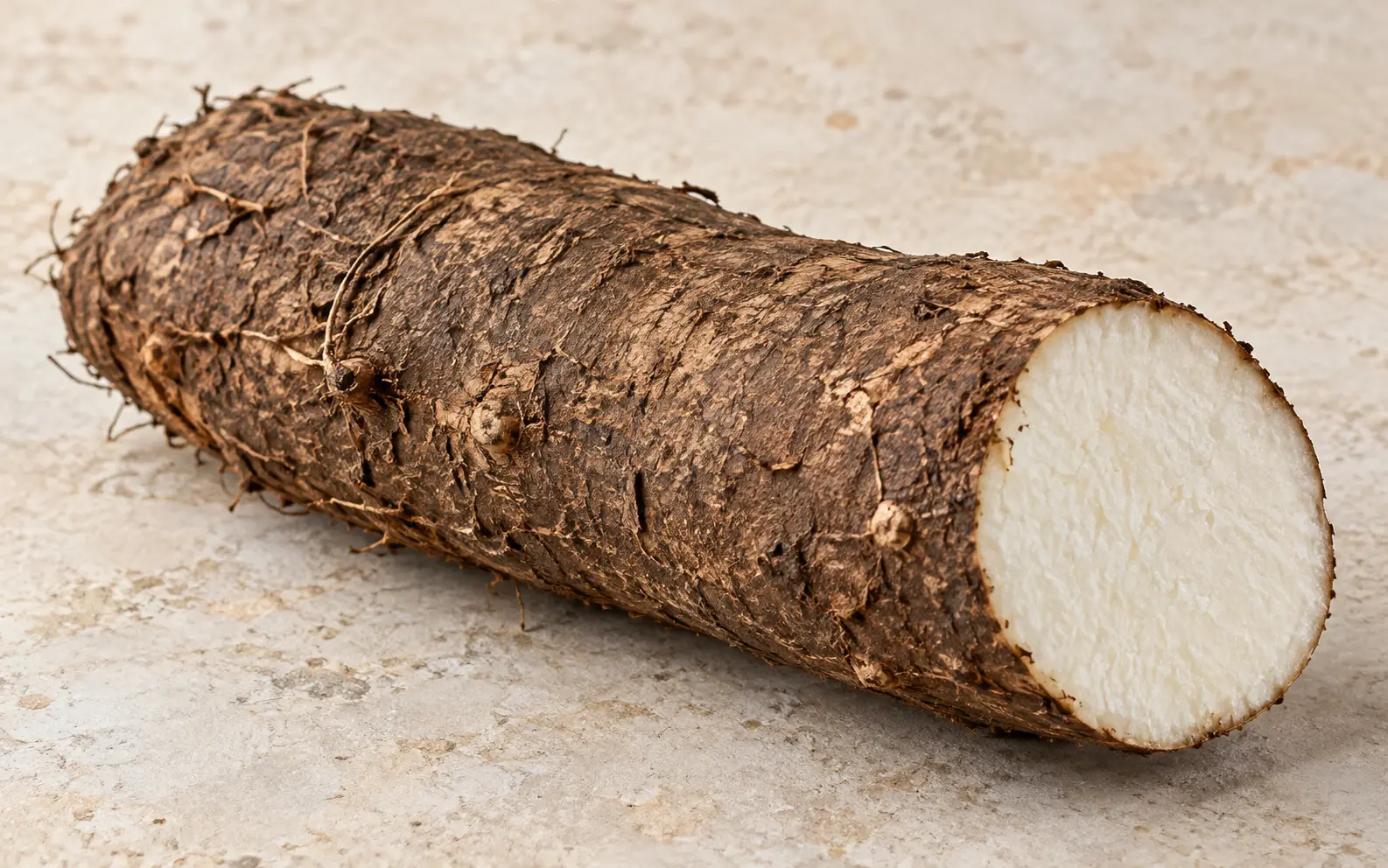
Yam Root shown in the exact edible form covered by this chapter.
Editorial portraitYam Root: image must match the chapter’s stated edible part and source form.
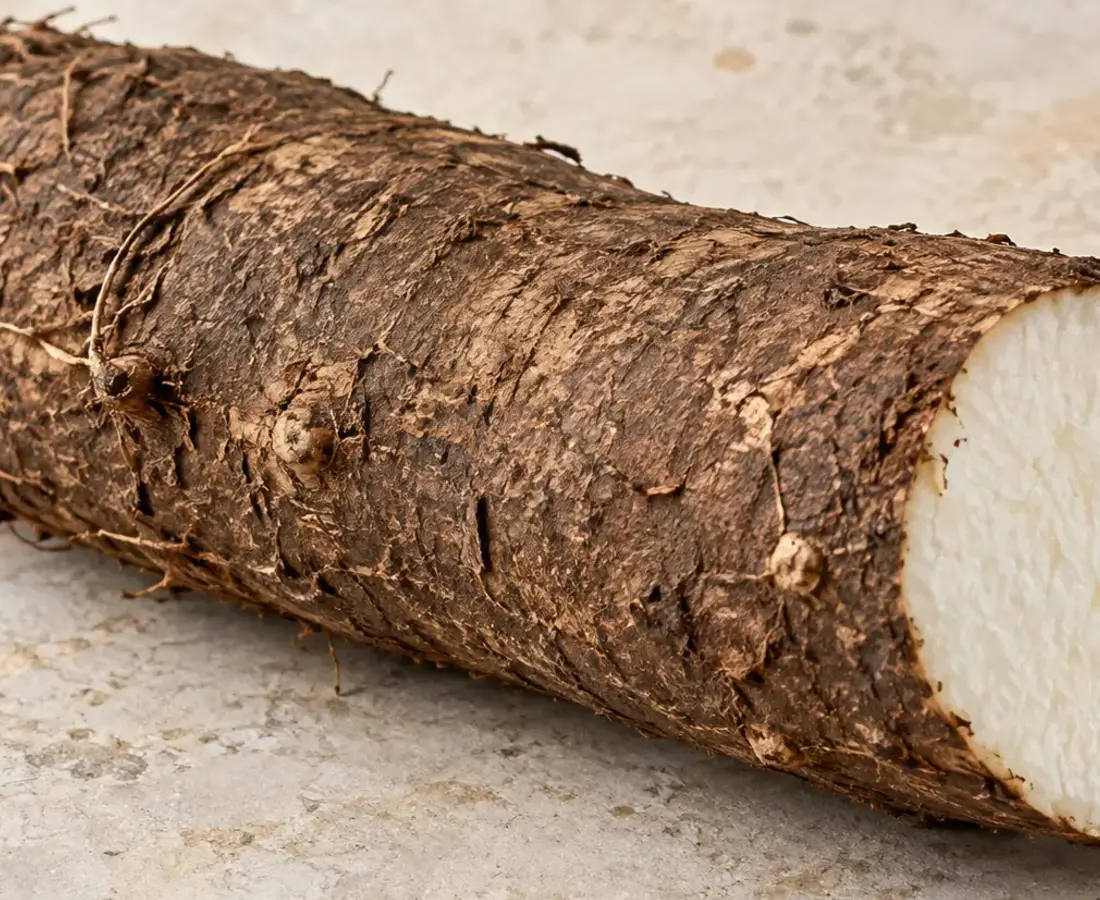
Close detail of Yam Root in the edible form covered by this chapter.
Edible-form detailYam Root: close editorial detail of the chapter’s stated edible form.

Editorial boundary: These AI-generated orientation images must not be used to identify wild foods, judge edibility, prove safe preparation, or diagnose spoilage. The verified safety-image panel and written guidance control where present.

Book readiness · Rewrite 05

Controlled chapter rewrite

What this entry covers

Cooked true yam tuber, species unresolved. Scientific identity: Dioscorea species; the generic USDA record does not state species. Edible part: Cooked tuber flesh after boiling, draining, or baking; peel, aerial bulbils, leaves, and raw tissue are excluded. Exact source form: Yam, cooked, boiled, drained, or baked, without salt, corresponding to USDA FoodData Central FDC 170072.

The human question and observed experience

Question: Does “yam root” mean a true Dioscorea yam or the orange sweet potato often sold as a yam, and can recipes be transferred between them?

Repeated experience: Independent cooking discussions repeatedly show U.S. shoppers receiving orange sweet potatoes when they ask for yams, while others describe imported, dry, starchy true yams. Users disagree based on regional naming, skin and flesh color, and often suggest cooking to discover the texture. Common-name use alone does not establish species.

Authoritative control

USDA Agricultural Research Service and university extension distinguish sweet potato (Ipomoea batatas) from true yams in the genus Dioscorea. They are botanically unrelated and differ in texture, composition and usual markets. “Yam root” without species, cultivar, origin and product label is therefore insufficient for one nutrition or preparation record.

What the combined evidence supports

Most orange “yams” in U.S. supermarkets are sweet potatoes, but imported true yams are real and should not be silently merged. Recipe behavior, edible parts and required preparation depend on the identified species and product form. The queue entry should remain an identity-controlled record.

Safety and limitations. True yams are not sweet potatoes. Species differ, and some Dioscorea require specific detoxifying preparation; a generic cooked panel is not raw-use or foraging clearance. Require the package label or botanical name before applying nutrition or safety guidance. Do not eat wild or unidentified Dioscorea, leaves or bulbils, and do not assume every species is safely prepared by the same method. For a verified retail edible tuber, peel/cook according to species-specific directions.

Exclude or qualify: Do not merge this chapter with: Sweet potato, named Dioscorea species, raw yam, canned yam products, flour, chips, medicinal wild yam, supplements, and finished dishes. Remove or qualify medical-treatment, universal-safety, cross-species, cross-part, cross-product, and cross-preparation claims unless an exact source is reviewed for that wording.

Claim-to-source map

LayerDispositionSources
Identity And Formsupported for bounded scope[1] [2] [3]
Human Experienceexperience documented not generalized[4] [5]
Authoritative Controlsupported control[3] [6]
Supported Conclusionsupported with stated limits[4] [5] [3] [6]
Safety And Limitationsrequired boundary[1] [2] [3] [6]
All sources used in this rewrite
  1. Source 1
  2. Source 2
  3. Source 3
  4. Source 4
  5. Source 5
  6. Source 6

Review status: This controlled rewrite uses the adjudicated identity, food-form, human-experience, authoritative-control, conclusion, and safety fields. It replaces broader legacy prose for this chapter layer but does not constitute final specialist or publication approval.

Verified human-taken photographs

Safety image guide

These cleared reference photographs support the written safety guidance. They do not prove that a wild specimen is edible, that a preparation is safe, or that spoiled food can be rescued.

Identification reference

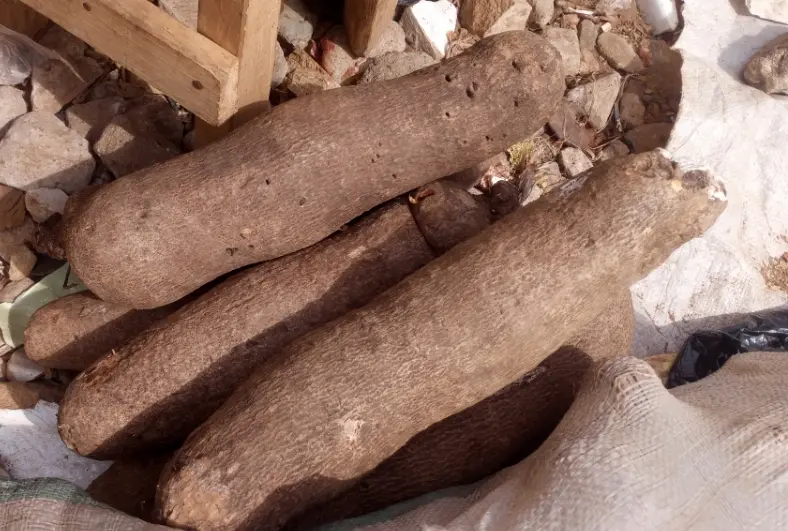
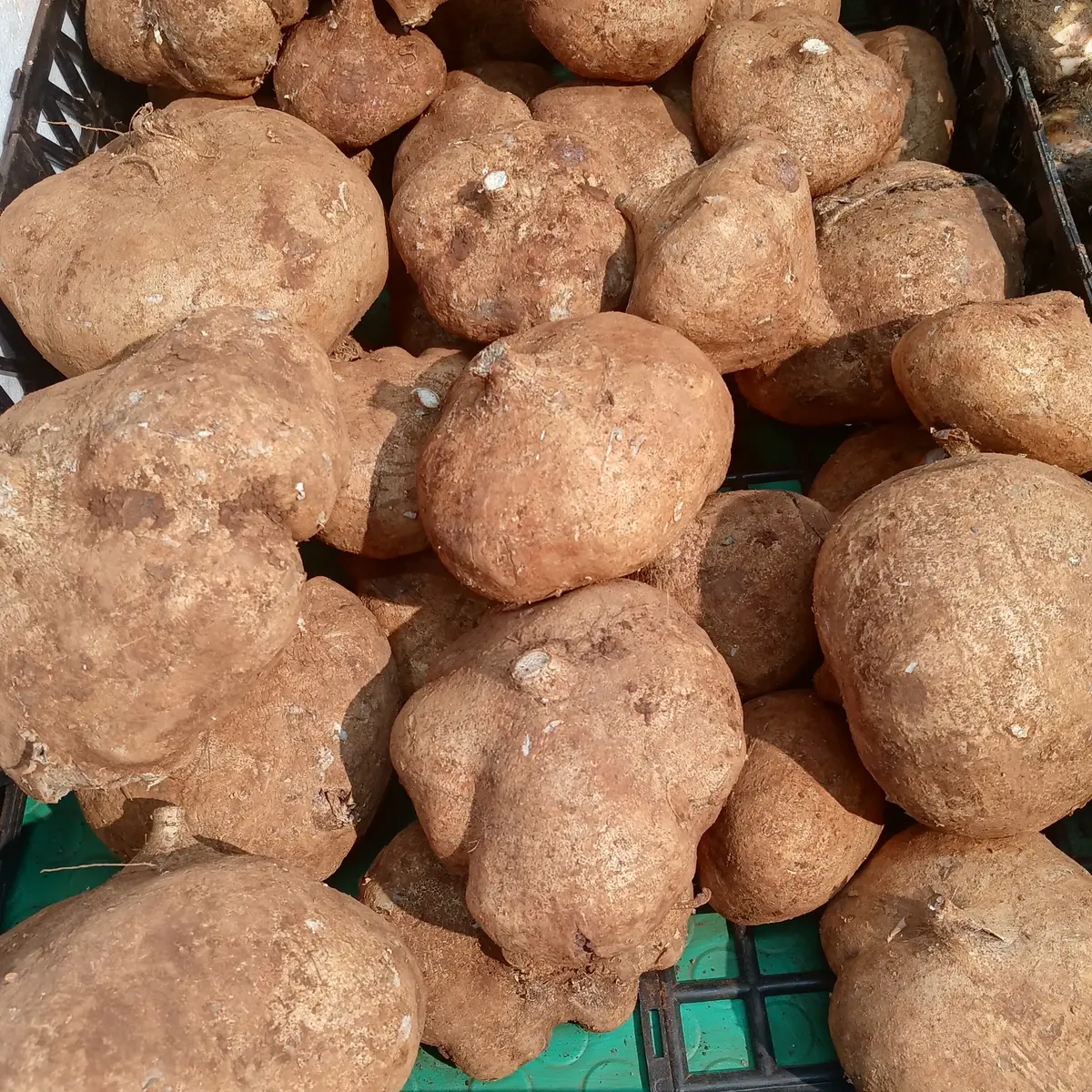
True yam versus sweet potato

Yam reference photograph
YamYam tuber in Illorin, Kwara state.jpg · Eunice Ameh
CC0 1.0 Universal Public Domain Dedication · source and license
Sweet Potato reference photograph
Sweet PotatoRaw sweet potato.jpg · Fumikas Sagisavas
CC0 1.0 Universal Public Domain Dedication · source and license

Use boundary: Reference only. Do not identify wild food, toxicity, or edibility from a photograph alone.

Open all safety image guides

Final gate · Approval 04

Book-assembly disposition

Status: Approved for book assembly with required safety box

Approved for informational book assembly only with the authoritative safety-and-limitations box retained beside the chapter text.

Specialist-review flags: None

Safety-box triggers: forag, raw, wild

Final gate checks

Review scope: Final source-completeness, structure, exclusion, and risk-triage review for book assembly. This is not a claim that an external specialist reviewed the chapter.

Book placement · Volume 5

Evidence Edition manuscript

Chapter 26 in The Food Glossary: Evidence Edition — Volume 5. The authoritative safety box is mandatory in every edition.

Recorded checks and sources7 displayed nutrient values checked against the exact USDA FDC record and food form.5 narrative statements source-linked; independent support review pending.Batch 11 · reviewed Oct. 8, 2026 · unlisted narrative sections remain outside this verified scope.

USDA food/form-matched panel · other claims unreviewed

Yam, cooked, boiled, drained, or baked, without salt

This per-100-gram panel uses the specifically named USDA SR Legacy food and preparation shown here. The glossary heading may be broader; these values do not describe every commercial brand, cultivar, or different cooking or processing method. A composition record does not establish raw-consumption or home-preservation safety.

Cooked yam example

The panel is USDA yam cooked by boiling and draining or baking without salt. The earlier draft fingerprint was raw yam; sweet potato, jicama, and a different yam cultivar cannot inherit the same value.

USDA FoodData Central: stated form · USDA: separate raw yam record

Nutrition for the stated form

USDA SR Legacy, per 100 g: Yam, cooked, boiled, drained, or baked, without salt
Energy116 kcal
Protein1.49 g
Fat0.14 g
Carbohydrate27.5 g
Fiber3.9 g
Total sugars0.49 g
Potassium670 mg

USDA FoodData Central FDC 170072 · SR Legacy (final release, April 2018). Values describe only this named form, not all products or varieties.

Human experience evidence · Batch 19

What people experience—and what the evidence supports

Evidence mapped

Question: Does “yam root” mean a true Dioscorea yam or the orange sweet potato often sold as a yam, and can recipes be transferred between them?

Repeated human experience

Independent cooking discussions repeatedly show U.S. shoppers receiving orange sweet potatoes when they ask for yams, while others describe imported, dry, starchy true yams. Users disagree based on regional naming, skin and flesh color, and often suggest cooking to discover the texture. Common-name use alone does not establish species.

Authoritative explanation or control

USDA Agricultural Research Service and university extension distinguish sweet potato (Ipomoea batatas) from true yams in the genus Dioscorea. They are botanically unrelated and differ in texture, composition and usual markets. “Yam root” without species, cultivar, origin and product label is therefore insufficient for one nutrition or preparation record.

What the evidence supports

Most orange “yams” in U.S. supermarkets are sweet potatoes, but imported true yams are real and should not be silently merged. Recipe behavior, edible parts and required preparation depend on the identified species and product form. The queue entry should remain an identity-controlled record.

Limitations and safety boundary

Require the package label or botanical name before applying nutrition or safety guidance. Do not eat wild or unidentified Dioscorea, leaves or bulbils, and do not assume every species is safely prepared by the same method. For a verified retail edible tuber, peel/cook according to species-specific directions.

Open evidence records and sources

Human experience / Q&A

Independent public discussion threads

Finding: Independent cooking discussions repeatedly show U.S. shoppers receiving orange sweet potatoes when they ask for yams, while others describe imported, dry, starchy true yams. Users disagree based on regional naming, skin and flesh color, and often suggest cooking to discover the texture. Common-name use alone does not establish species.

Supported conclusion: Most orange “yams” in U.S. supermarkets are sweet potatoes, but imported true yams are real and should not be silently merged. Recipe behavior, edible parts and required preparation depend on the identified species and product form. The queue entry should remain an identity-controlled record.

Limitations: Common names and retail labels vary by country and culture. The queue supplies no specimen, language or label, so species-specific toxins, nutrition and cooking requirements cannot be resolved here.

Evidence strength: Low: uncontrolled, self-selected reports; repetition is experiential only

Safety/current gate: Require the package label or botanical name before applying nutrition or safety guidance. Do not eat wild or unidentified Dioscorea, leaves or bulbils, and do not assume every species is safely prepared by the same method. For a verified retail edible tuber, peel/cook according to species-specific directions.

Authoritative / research control

USDA ARS and university extension botanical-identity control

Finding: USDA Agricultural Research Service and university extension distinguish sweet potato (Ipomoea batatas) from true yams in the genus Dioscorea. They are botanically unrelated and differ in texture, composition and usual markets. “Yam root” without species, cultivar, origin and product label is therefore insufficient for one nutrition or preparation record.

Supported conclusion: Most orange “yams” in U.S. supermarkets are sweet potatoes, but imported true yams are real and should not be silently merged. Recipe behavior, edible parts and required preparation depend on the identified species and product form. The queue entry should remain an identity-controlled record.

Limitations: Common names and retail labels vary by country and culture. The queue supplies no specimen, language or label, so species-specific toxins, nutrition and cooking requirements cannot be resolved here.

Evidence strength: USDA ARS and university extension botanical-identity control; applicability limited to the stated food identity, form and population

Safety/current gate: Require the package label or botanical name before applying nutrition or safety guidance. Do not eat wild or unidentified Dioscorea, leaves or bulbils, and do not assume every species is safely prepared by the same method. For a verified retail edible tuber, peel/cook according to species-specific directions.

Open earlier, unverified research notes
RESEARCH DRAFT — claims and any nutrient values are not yet approved for publication.

← Food Glossary Wiki

deep_review_batch004_public_source_targetsnutrition unverified

Yam Root — Food Glossary Book Research

Generated: 2026-09-26T10:59:01.634381+00:00

Status: starter_book_research

1. Identity / what it is

Identity summary still needs source-backed completion.

Survival/category tags: edible food entry; verify local species/variety

2. Nutrition snapshot

USDA FoodData Central match: null

  • USDA nutrition match still needed / not found in this batch pass.
  • 3. Growing / cultivation instructions

    Collect crop-specific growing instructions from Extension/agronomy sources: climate, soil, sunlight, propagation, planting, harvest stage, and common pests/diseases.

    Needed for final book: climate range, soil, sunlight, water, propagation, planting spacing, harvest signs, common pests, container/garden/wild context.

    4. Edible parts and nature/survival use

    Document edible parts, best harvest stage, field identification traits, and whether it is commonly wild-foraged, cultivated, or both.

    Survival note: positive identification is mandatory for wild foods; include local lookalikes and preparation requirements before recommending field use.

    5. Cooking and preparation instructions

    Collect culinary instructions: edible parts, raw vs cooked use, basic preparation, common traditional dishes, and safe cooking notes.

    Needed for final book: raw/cooked safety, basic prep, boiling/roasting/frying/drying/powdering, traditional uses, emergency/survival meal applications.

    6. Preservation and storage instructions

    Collect preservation instructions: fresh storage, drying/dehydration, freezing, pickling/fermenting, canning where safe, and shelf-life cautions.

    Book preservation checklist to fill per food:

  • Fresh storage: pantry/fridge/root cellar/freezer conditions.
  • Drying/dehydration suitability and prep.
  • Freezing suitability and blanching/pre-treatment if needed.
  • Pickling/fermentation suitability and safety.
  • Canning: water-bath only if high-acid/tested; pressure canning for low-acid foods; cite tested source.
  • Salt/sugar/oil preservation where safe.
  • 7. Interactions, pairings, transformations

    Collect pairings, preservation interactions, acid/salt/sugar/oil effects, culinary transformations, and foods this helps preserve or tenderize/flavor.

    8. Cautions / allergies / toxic lookalikes

    For survival/nature use: never eat wild lookalikes without positive identification; document toxic lookalikes, contraindications, allergies, and preparation requirements.

    9. Sources captured

  • Wikipedia summary: not found — query `Yam Root`
  • USDA FoodData Central: not found — query `Yam Root raw`
  • National Center for Home Food Preservation: https://nchfp.uga.edu/
  • USDA Complete Guide to Home Canning: https://www.nifa.usda.gov/about-nifa/blogs/usdas-complete-guide-home-canning
  • University Extension preservation reference: https://extension.umn.edu/preserving-and-preparing
  • USDA Forest Service wild edible caution reference: https://www.fs.usda.gov/wildflowers/ethnobotany/edible.shtml
  • 10. Source JSON

    {
      "wiki": {
        "query": "Yam Root",
        "error": "HTTPError: HTTP Error 429: Too Many Requests"
      },
      "fdc": {
        "query": "Yam Root raw",
        "error": "HTTPError: HTTP Error 429: Too Many Requests"
      },
      "generic_sources": [
        {
          "id": "nchfp_home_preservation",
          "title": "National Center for Home Food Preservation",
          "url": "https://nchfp.uga.edu/",
          "publisher": "University of Georgia / USDA-supported NCHFP",
          "use": "safe canning, freezing, drying, pickling, fermentation principles"
        },
        {
          "id": "usda_complete_guide_canning",
          "title": "USDA Complete Guide to Home Canning",
          "url": "https://www.nifa.usda.gov/about-nifa/blogs/usdas-complete-guide-home-canning",
          "publisher": "USDA/NIFA",
          "use": "pressure canning and water-bath canning safety"
        },
        {
          "id": "extension_food_safety",
          "title": "Extension food preservation resources",
          "url": "https://extension.umn.edu/preserving-and-preparing",
          "publisher": "University Extension",
          "use": "practical preservation and storage safety cross-check"
        },
        {
          "id": "poisonous_plants_general",
          "title": "Poisonous plant / wild food caution principle",
          "url": "https://www.fs.usda.gov/wildflowers/ethnobotany/edible.shtml",
          "publisher": "USDA Forest Service",
          "use": "wild edible plants require positive identification and local expert caution"
        }
      ]
    }

    Batch 009 checkpoint

    Reviewed in 20-food milestone batch 009 on 2026-09-26.

    Checkpoint status:

  • Starter identity/cooking/growing/preservation sections exist.
  • USDA nutrition still needs retry/manual verification.
  • Requires later book-ready pass for detailed Extension growing instructions, tested preservation instructions, survival/wild identification, toxic lookalikes, and final editorial polish.
  • Batch source reminders:

  • USDA FoodData Central: https://fdc.nal.usda.gov/
  • NCHFP preservation: https://nchfp.uga.edu/
  • USDA Complete Guide to Home Canning: https://www.nifa.usda.gov/about-nifa/blogs/usdas-complete-guide-home-canning
  • USDA Forest Service wild edible caution: https://www.fs.usda.gov/wildflowers/ethnobotany/edible.shtml
  • 20-food row-order checkpoint

    Milestone batch 009; row-order item 169/220; checked 2026-09-26.

  • [x] Starter book page exists.
  • [ ] USDA nutrition currently filled.
  • [ ] Needs deep source pass: Extension/FAO/growing, tested preservation, survival/wild identification, cautions/lookalikes, final book editing.
  • Book completion pass v1 — complete draft scaffold

    Completion date: 2026-09-26T16:56:24.870227+00:00

    Completion status: v1_complete_draft_needs_source_deepening

    Food type: general_food_entry

    Identity / recognition draft

    Yam Root should be described by common names, scientific name/food type where available, edible form, taste/texture, and how it is recognized in markets or in nature.

    Nutrition draft

  • Calories: 118.0 KCAL per 100 g
  • Protein: 1.53 G per 100 g
  • Carbohydrate: 27.88 G per 100 g
  • Fiber: 4.1 G per 100 g
  • Fat: 0.17 G per 100 g
  • Calcium: 17.0 MG per 100 g
  • Iron: 0.54 MG per 100 g
  • Magnesium: 21.0 MG per 100 g
  • Phosphorus: 55.0 MG per 100 g
  • Potassium: 816.0 MG per 100 g
  • Sodium: 9.0 MG per 100 g
  • Zinc: 0.24 MG per 100 g
  • Vitamin C: 17.1 MG per 100 g
  • Vitamin A: 7.0 UG per 100 g
  • Folate: 23.0 UG per 100 g
  • Growing / cultivation draft

    Collect climate, sunlight, soil, water, propagation, planting/spacing, harvest signs, and common pests/diseases from Extension/agricultural sources.

    Nature / survival draft

    For survival use, document whether it is wild, cultivated, or naturalized; which parts are edible; harvest season; preparation requirements; and dangerous lookalikes. Do not recommend wild eating without positive identification.

    Cooking / preparation draft

    Document raw/cooked safety, cleaning, cutting, boiling/roasting/frying/steaming/drying/powdering, common dishes, and emergency low-tool preparation methods.

    Preservation / storage draft

    Document fresh storage, freezing, drying/dehydration, pickling/fermentation, canning suitability, salt/sugar/oil/vinegar methods, shelf-life, and spoilage signs. Use tested canning sources for shelf-stable methods.

    Interactions / transformations draft

    Document how Yam Root interacts with other foods: acidity, sweetness, starch, oil, salt, aromatics, thickening, fermentation, tenderizing, preservation support, flavor pairing, and texture changes through heat/drying/freezing.

    Safety / lookalikes draft

    Document allergies, toxic lookalikes, unsafe raw forms, drug/condition cautions, and preservation risks such as botulism in low-acid canning or fresh herbs/garlic in oil.

    Source targets for final citation pass

  • USDA FoodData Central for nutrition: https://fdc.nal.usda.gov/
  • NCHFP preservation safety: https://nchfp.uga.edu/
  • USDA Complete Guide to Home Canning: https://www.nifa.usda.gov/about-nifa/blogs/usdas-complete-guide-home-canning
  • University Extension growing/preservation pages specific to this food.
  • FAO/CABI/Extension crop profiles for cultivation and survival/agricultural context.
  • Regional wild-food/foraging sources only when they include identification and lookalike cautions.
  • Final v1 publication boundary

    Completed v1 packaging: 2026-09-28T05:04:32.703969+00:00

    Status: book_entry_v1_complete_source_scaffolded

    This chapter is finished as a Food Glossary v1 research/wiki entry. Before print publication or survival advice use, perform final editorial review for wording, citations, local identification, toxic lookalikes, and tested preservation/canning details. Do not add uncited cure claims.

    Final natural-growth library v2 package status

    Finalized: 2026-09-28T16:17:47.337022+00:00

    Status: `final_v2_food_entry_with_nutrition_source_scaffolded`

    Scope: natural/growable food library; animal farming/meat/dairy/eggs/fish intentionally excluded.

    Source stream: original Food Glossary short list

    Category: unknown

    Nutrition status: accepted USDA/local nutrition table present

    Book-use boundary

    This entry is included in the completed v2 wiki/book scaffold. Before print/public survival guidance, verify exact identity, edible parts, toxic lookalikes, contraindications, and preservation safety from authoritative sources.

    Required final editorial checklist

  • [ ] Confirm exact common/scientific identity.
  • [ ] Confirm edible part(s) and unsafe parts.
  • [ ] Confirm raw/cooked safety and required preparation.
  • [ ] Confirm growing/foraging region and harvest stage.
  • [ ] Confirm preservation method from tested/authoritative sources.
  • [ ] Confirm toxic lookalikes/allergies/contraindications.
  • [ ] Confirm nutrition table is exact or explicitly mark no standard table.
  • [ ] Attach final citations per claim.
  • Deep expert-source review — Batch 004

    Reviewed: 2026-09-29T01:02:21.660341+00:00

    Review status: `deep_review_batch004_public_source_targets`

    Scientific/identity target: Exact scientific name pending taxonomy verification; use GBIF/WFO/CABI/PFAF/Extension source during final editorial pass.

    Public expert citations / source targets captured

  • [USDA_FDC] USDA FoodData Central search for Yam Root: https://fdc.nal.usda.gov/fdc-app.html#/food-search?query=Yam+Root
  • [NCHFP] National Center for Home Food Preservation safety hub: https://nchfp.uga.edu/
  • [USDA_CANNING_GUIDE] USDA Complete Guide to Home Canning: https://nchfp.uga.edu/resources/category/usda-guide/
  • [GBIF] GBIF taxonomy search for Yam Root: https://www.gbif.org/species/search?q=Yam+Root
  • [WFO] World Flora Online search for Yam Root: https://www.worldfloraonline.org/search?query=Yam+Root
  • [UF_IFAS] UF/IFAS Extension search for Yam Root: https://edis.ifas.ufl.edu/search/?q=Yam+Root
  • [FAO] FAO search for Yam Root: https://www.fao.org/search/en/?querystring=Yam+Root
  • [PFAF] PFAF search for Yam Root: https://pfaf.org/user/DatabaseSearhResult.aspx?SearchName=Yam+Root
  • [MSKCC_HERBS] MSKCC herbs search for Yam Root: https://www.mskcc.org/search?keys=Yam+Root
  • [POISON_CONTROL] Poison Control search for Yam Root: https://www.poison.org/search-results?q=Yam+Root
  • Review notes

    This entry now has public expert source targets for nutrition, growing/cultivation, edible parts, cooking/preparation, preservation/storage, taxonomy, and cautions/lookalikes where relevant. These are preserved for the book review workflow. Final publication still requires claim-by-claim verification against the exact pages and any local/regional safety rules.

    Verification checklist

  • [x] Nutrition source target captured.
  • [x] Growing/cultivation source target captured.
  • [x] Preservation/storage safety source target captured.
  • [x] Taxonomy/identity source target captured.
  • [x] Caution/lookalike/medical source target captured where relevant.
  • [ ] Exact claim-by-claim editorial verification.