Repeated human experience
People repeatedly report pears staying hard, then changing quickly or softening unevenly; growers commonly say European pears ripen better after harvest.
Book readiness · Identity 05
Book readiness · Publication 04
Visual orientation
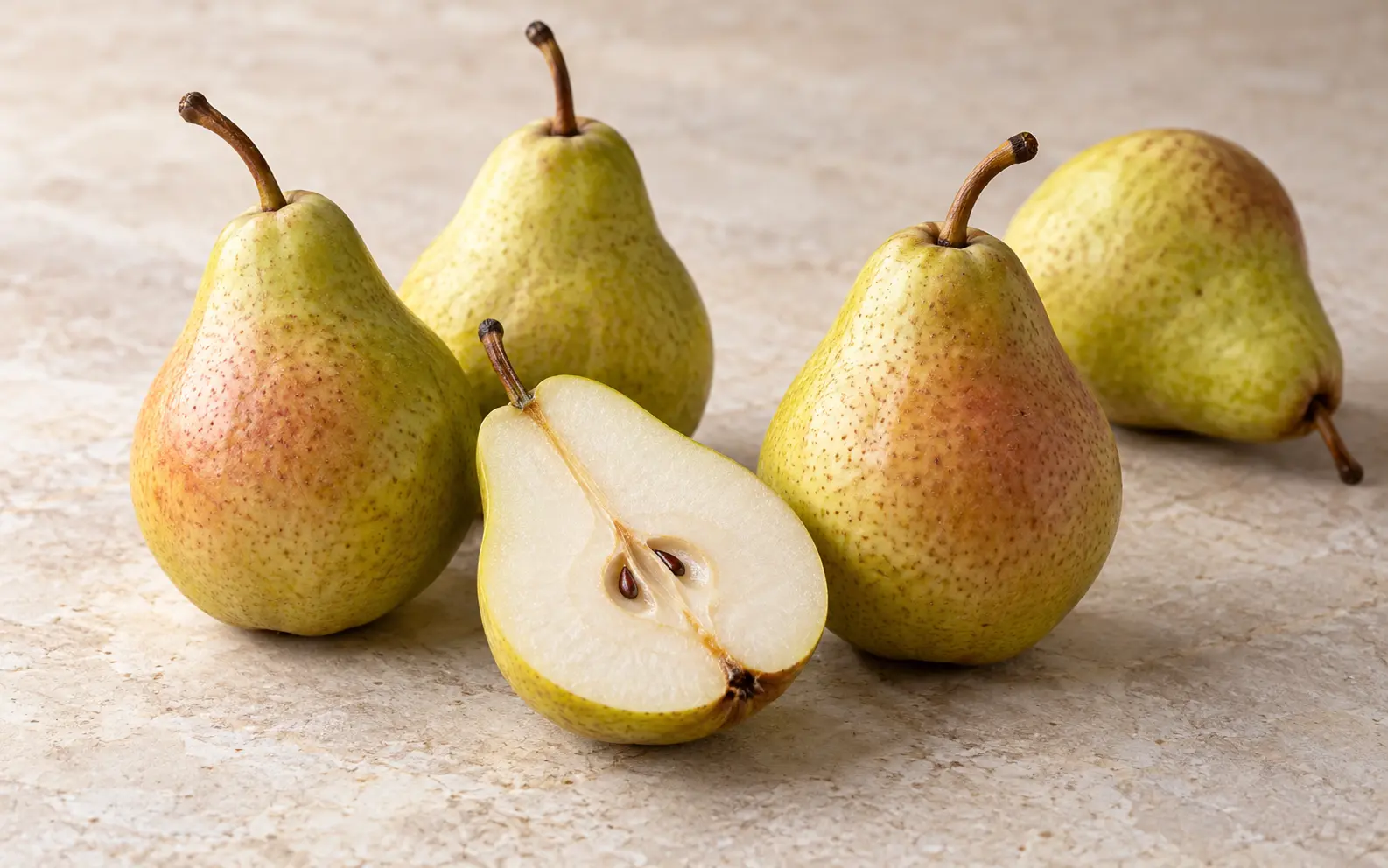
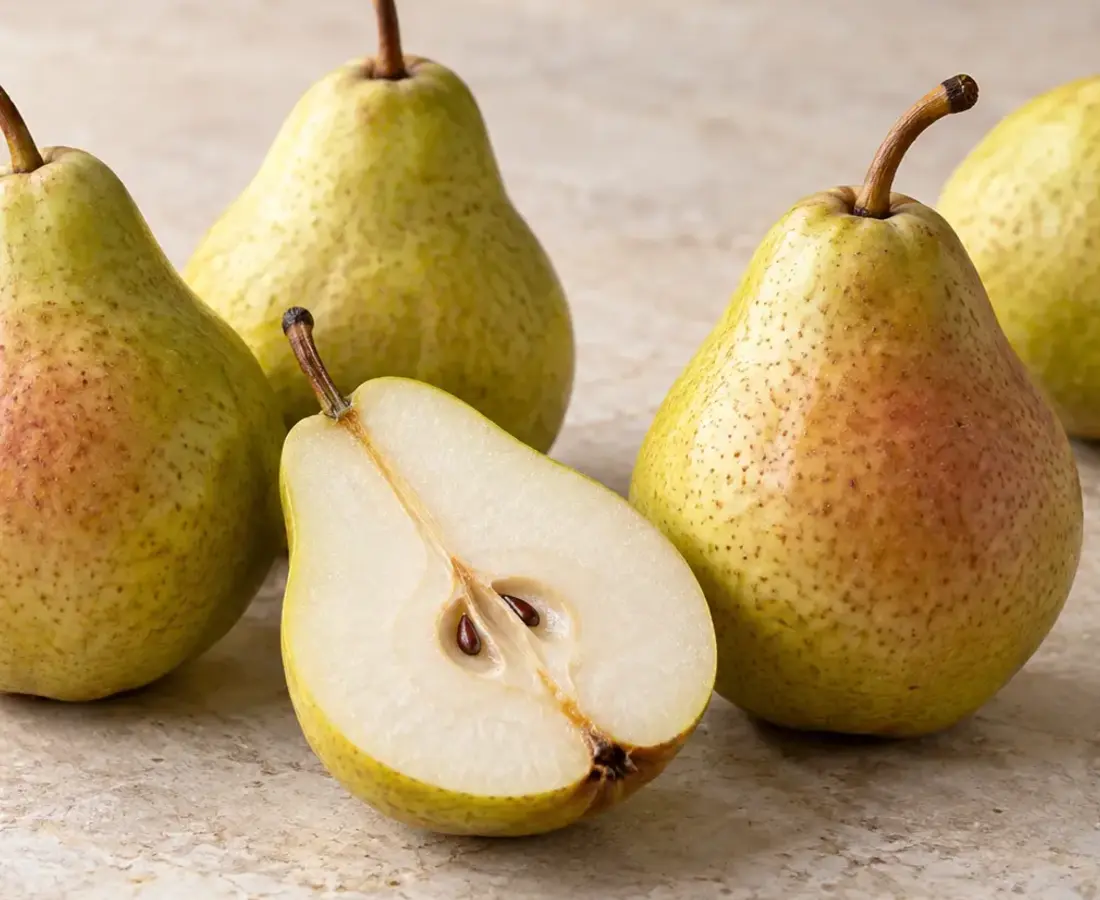
Editorial boundary: These AI-generated orientation images must not be used to identify wild foods, judge edibility, prove safe preparation, or diagnose spoilage. The verified safety-image panel and written guidance control where present.
Book readiness · Rewrite 04
European-type pears, raw. Scientific identity: Pyrus communis L.; the generic record does not represent Asian pears. Edible part: Fresh fruit flesh and skin; core, seed, leaves, and stems are excluded. Exact source form: Pears, raw, corresponding to USDA FoodData Central FDC 169118.
Question: Why are many pears sold hard, and how can ripeness be judged?
Repeated experience: People repeatedly report pears staying hard, then changing quickly or softening unevenly; growers commonly say European pears ripen better after harvest.
Michigan State and Oregon State Extension say pears ripen best off the tree and recommend gentle pressure at the stem end—the neck—because most varieties show little dramatic color change.
For common European pears, off-tree ripening and the neck test explain the human pattern better than whole-fruit softness or color alone. Asian pears follow different harvest behavior.
Exclude or qualify: Do not merge this chapter with: Asian pear, named cultivars, canned or dried fruit, juice, nectar, preserves, perry, seed, extracts, and finished foods. Remove or qualify medical-treatment, universal-safety, cross-species, cross-part, cross-product, and cross-preparation claims unless an exact source is reviewed for that wording.
| Layer | Disposition | Sources |
|---|---|---|
| Identity And Form | supported for bounded scope | [1] [2] [3] |
| Human Experience | experience documented not generalized | [4] |
| Authoritative Control | supported control | [5] |
| Supported Conclusion | supported with stated limits | [4] [5] |
| Safety And Limitations | required boundary | [1] [2] [3] [5] |
Review status: This controlled rewrite uses the adjudicated identity, food-form, human-experience, authoritative-control, conclusion, and safety fields. It replaces broader legacy prose for this chapter layer but does not constitute final specialist or publication approval.
Final gate · Approval 03
Status: Approved for informational book assembly
Approved for informational book assembly with its claim-to-source map retained.
Specialist-review flags: None
Safety-box triggers: No additional trigger
Review scope: Final source-completeness, structure, exclusion, and risk-triage review for book assembly. This is not a claim that an external specialist reviewed the chapter.
Book placement · Volume 4
Chapter 16 in The Food Glossary: Evidence Edition — Volume 4. Standard controlled chapter format.
Editorial classification corrected
Duplicate or misspelled heading redirected to pears. This duplicate heading now points to Pears.
Named raw-form example · full chapter unreviewed
The broad glossary heading may cover more than one variety or preparation. This is a separate USDA raw-form example, not a nutrient value for every version of the food. A nutrient record is not evidence that a plant or part is safe to eat raw. Identity, edible part, and safe preparation still require their own sources.
This USDA panel is a raw-pear record; a Bartlett, Bosc, Asian pear, canned pear, or pear juice may have its own record. Pear varieties differ in harvest and ripening behavior, so one variety’s handling guidance is not a rule for every pear.
UC Davis Postharvest: winter pears · UC Davis Postharvest: Asian pear
| Energy | 57 kcal |
|---|---|
| Protein | 0.36 g |
| Fat | 0.14 g |
| Carbohydrate | 15.2 g |
| Fiber | 3.1 g |
| Total sugars | 9.75 g |
| Potassium | 116 mg |
USDA FoodData Central FDC 169118 · SR Legacy (final release, April 2018). Values describe only this named form, not all products or varieties.
Human experience evidence · Batch 14
Question: Why are many pears sold hard, and how can ripeness be judged?
People repeatedly report pears staying hard, then changing quickly or softening unevenly; growers commonly say European pears ripen better after harvest.
Michigan State and Oregon State Extension say pears ripen best off the tree and recommend gentle pressure at the stem end—the neck—because most varieties show little dramatic color change.
For common European pears, off-tree ripening and the neck test explain the human pattern better than whole-fruit softness or color alone. Asian pears follow different harvest behavior.
Name European versus Asian pear and, where possible, cultivar. Present the neck test as a practical cue, not a guarantee against internal breakdown.
Reddit Fruit and FruitTree
Finding: People report long hard stages followed by rapid softening, shriveling or internal decline; growers commonly advise harvesting mature fruit and ripening it off the tree.
Supported conclusion: Captures the timing problem and the reason color or whole-fruit softness alone frustrates consumers.
Limitations: Discussion cannot establish harvest maturity or apply one method to every European and Asian cultivar.
Evidence strength: Repeated ripening signal
Safety/current gate: No
Michigan State University Extension; Oregon State University Extension
Finding: Extension says pears ripen best off the tree and recommends gentle thumb pressure at the neck; most varieties do not show a dramatic ripe color change.
Supported conclusion: Supports an off-tree process and a localized ripeness cue rather than squeezing the whole fruit.
Limitations: Asian pears and individual cultivars can differ, and the test cannot rule out hidden core breakdown.
Evidence strength: University extension control
Safety/current gate: No
Generated: 2026-09-26T10:52:18.508446+00:00
Status: starter_book_research
Pears are a genus of trees, Pyrus, in the family Rosaceae, that bear an edible apple-like fruit of the same name. Several species of pears are cultivated for their fruit and juices, while others are grown as ornamental flowering trees.
Survival/category tags: fruit/foraged or cultivated edible
USDA FoodData Central match: null
Collect crop-specific growing instructions from Extension/agronomy sources: climate, soil, sunlight, propagation, planting, harvest stage, and common pests/diseases.
Needed for final book: climate range, soil, sunlight, water, propagation, planting spacing, harvest signs, common pests, container/garden/wild context.
Document edible parts, best harvest stage, field identification traits, and whether it is commonly wild-foraged, cultivated, or both.
Survival note: positive identification is mandatory for wild foods; include local lookalikes and preparation requirements before recommending field use.
Collect culinary instructions: edible parts, raw vs cooked use, basic preparation, common traditional dishes, and safe cooking notes.
Needed for final book: raw/cooked safety, basic prep, boiling/roasting/frying/drying/powdering, traditional uses, emergency/survival meal applications.
Collect preservation instructions: fresh storage, drying/dehydration, freezing, pickling/fermenting, canning where safe, and shelf-life cautions.
Book preservation checklist to fill per food:
Collect pairings, preservation interactions, acid/salt/sugar/oil effects, culinary transformations, and foods this helps preserve or tenderize/flavor.
For survival/nature use: never eat wild lookalikes without positive identification; document toxic lookalikes, contraindications, allergies, and preparation requirements.
{
  "wiki": {
    "query": "Pear",
    "title": "Pear",
    "extract": "Pears are a genus of trees, Pyrus, in the family Rosaceae, that bear an edible apple-like fruit of the same name. Several species of pears are cultivated for their fruit and juices, while others are grown as ornamental flowering trees.",
    "url": "https://en.wikipedia.org/wiki/Pear",
    "source": "Wikipedia summary API"
  },
  "fdc": {
    "query": "Pear raw",
    "error": "HTTPError: HTTP Error 429: Too Many Requests"
  },
  "generic_sources": [
    {
      "id": "nchfp_home_preservation",
      "title": "National Center for Home Food Preservation",
      "url": "https://nchfp.uga.edu/",
      "publisher": "University of Georgia / USDA-supported NCHFP",
      "use": "safe canning, freezing, drying, pickling, fermentation principles"
    },
    {
      "id": "usda_complete_guide_canning",
      "title": "USDA Complete Guide to Home Canning",
      "url": "https://www.nifa.usda.gov/about-nifa/blogs/usdas-complete-guide-home-canning",
      "publisher": "USDA/NIFA",
      "use": "pressure canning and water-bath canning safety"
    },
    {
      "id": "extension_food_safety",
      "title": "Extension food preservation resources",
      "url": "https://extension.umn.edu/preserving-and-preparing",
      "publisher": "University Extension",
      "use": "practical preservation and storage safety cross-check"
    },
    {
      "id": "poisonous_plants_general",
      "title": "Poisonous plant / wild food caution principle",
      "url": "https://www.fs.usda.gov/wildflowers/ethnobotany/edible.shtml",
      "publisher": "USDA Forest Service",
      "use": "wild edible plants require positive identification and local expert caution"
    }
  ]
}Reviewed in 20-food milestone batch 005 on 2026-09-26.
Checkpoint status:
Batch source reminders:
Milestone batch 005; row-order item 89/220; checked 2026-09-26.
Completion date: 2026-09-26T16:56:24.394825+00:00
Completion status: v1_complete_draft_needs_source_deepening
Food type: general_food_entry
Pears are a genus of trees, Pyrus, in the family Rosaceae, that bear an edible apple-like fruit of the same name. Several species of pears are cultivated for their fruit and juices, while others are grown as ornamental flowering trees.
Survival/category tags: fruit/foraged or cultivated edible
Collect climate, sunlight, soil, water, propagation, planting/spacing, harvest signs, and common pests/diseases from Extension/agricultural sources.
For survival use, document whether it is wild, cultivated, or naturalized; which parts are edible; harvest season; preparation requirements; and dangerous lookalikes. Do not recommend wild eating without positive identification.
Document raw/cooked safety, cleaning, cutting, boiling/roasting/frying/steaming/drying/powdering, common dishes, and emergency low-tool preparation methods.
Document fresh storage, freezing, drying/dehydration, pickling/fermentation, canning suitability, salt/sugar/oil/vinegar methods, shelf-life, and spoilage signs. Use tested canning sources for shelf-stable methods.
Document how Pear interacts with other foods: acidity, sweetness, starch, oil, salt, aromatics, thickening, fermentation, tenderizing, preservation support, flavor pairing, and texture changes through heat/drying/freezing.
Document allergies, toxic lookalikes, unsafe raw forms, drug/condition cautions, and preservation risks such as botulism in low-acid canning or fresh herbs/garlic in oil.
Completed v1 packaging: 2026-09-28T05:04:32.703969+00:00
Status: book_entry_v1_complete_source_scaffolded
This chapter is finished as a Food Glossary v1 research/wiki entry. Before print publication or survival advice use, perform final editorial review for wording, citations, local identification, toxic lookalikes, and tested preservation/canning details. Do not add uncited cure claims.
Finalized: 2026-09-28T16:17:47.337022+00:00
Status: `final_v2_food_entry_with_nutrition_source_scaffolded`
Scope: natural/growable food library; animal farming/meat/dairy/eggs/fish intentionally excluded.
Source stream: original Food Glossary short list
Category: unknown
Nutrition status: accepted USDA/local nutrition table present
This entry is included in the completed v2 wiki/book scaffold. Before print/public survival guidance, verify exact identity, edible parts, toxic lookalikes, contraindications, and preservation safety from authoritative sources.
Reviewed: 2026-09-29T00:42:22.143212+00:00
Review status: `deep_review_batch003_public_source_targets`
Scientific/identity target: Exact scientific name pending taxonomy verification; use GBIF/WFO/CABI/PFAF/Extension source during final editorial pass.
This entry now has public expert source targets for nutrition, growing/cultivation, edible parts, cooking/preparation, preservation/storage, taxonomy, and cautions/lookalikes where relevant. These are preserved for the book review workflow. Final publication still requires claim-by-claim verification against the exact pages and any local/regional safety rules.