Repeated human experience
People consistently identify peanuts as legumes botanically while noting that kitchens and stores use them like nuts; discussion sometimes incorrectly treats that classification as an allergy rule.
Book readiness · Identity 05
Book readiness · Publication 04
Visual orientation
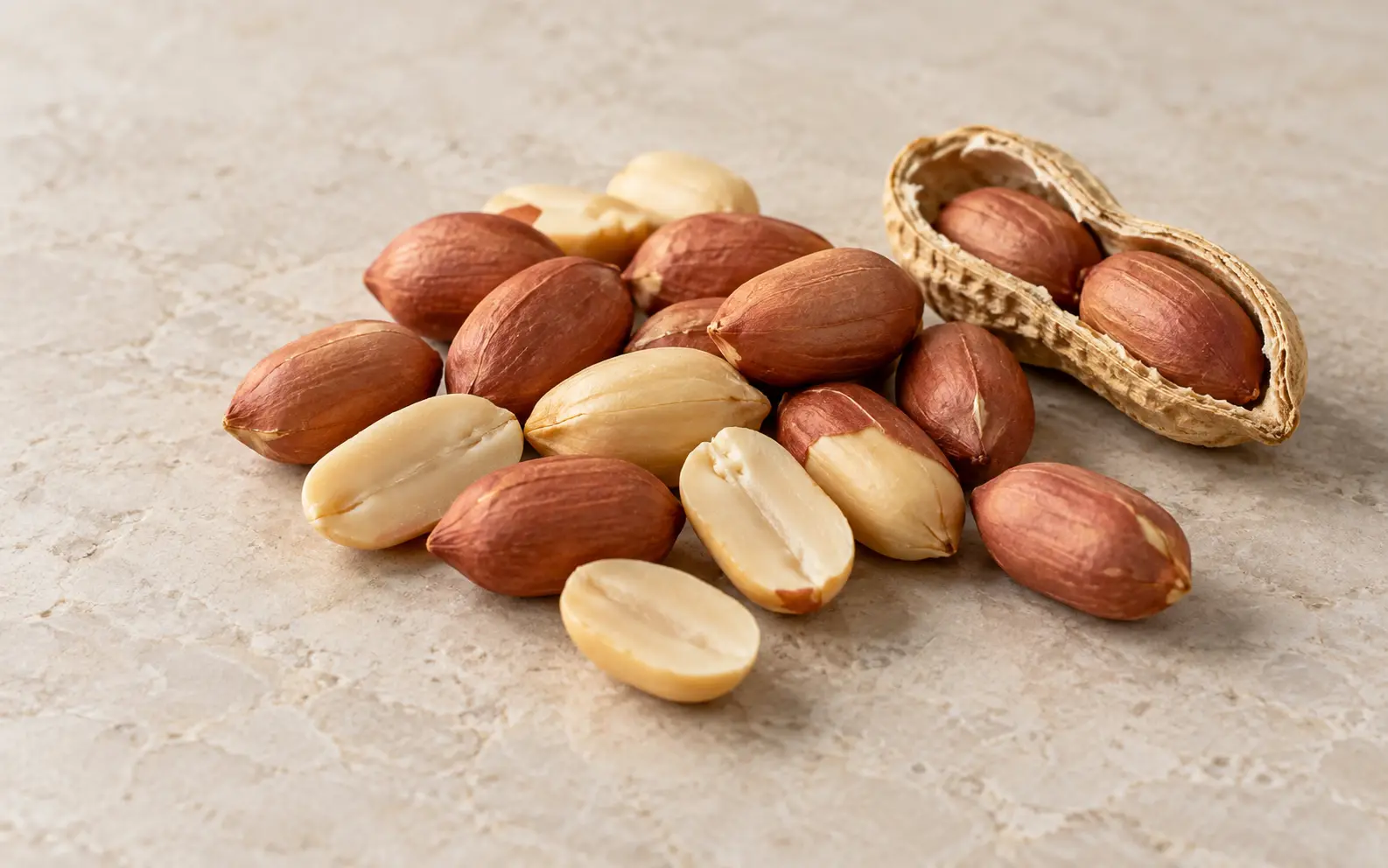
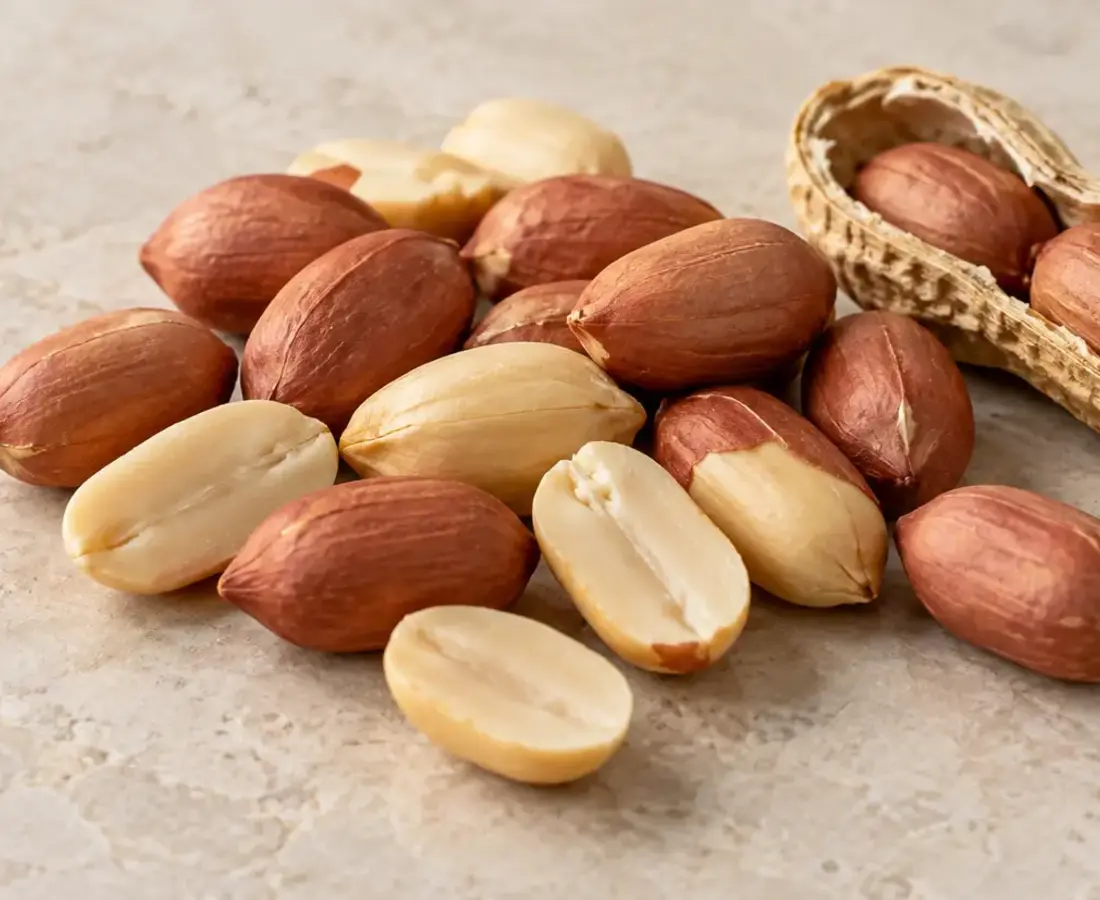
Editorial boundary: These AI-generated orientation images must not be used to identify wild foods, judge edibility, prove safe preparation, or diagnose spoilage. The verified safety-image panel and written guidance control where present.
Book readiness · Rewrite 04
Peanut kernels, raw. Scientific identity: Arachis hypogaea L. Edible part: Raw mature seed kernels; shell, skin-only products, sprouts, and plant foliage are excluded. Exact source form: Peanuts, all types, raw, corresponding to USDA FoodData Central FDC 172430.
Question: Are peanuts nuts, beans or something else—and does the label change allergy safety?
Repeated experience: People consistently identify peanuts as legumes botanically while noting that kitchens and stores use them like nuts; discussion sometimes incorrectly treats that classification as an allergy rule.
USDA ARS identifies peanut as Arachis hypogaea in the legume family and notes that it grows underground rather than on trees.
Botanically, peanut is a legume; culinarily, it is commonly grouped with nuts. That taxonomy does not make peanut allergy equivalent to—or protective against—tree-nut or other-legume allergy.
Exclude or qualify: Do not merge this chapter with: Roasted, boiled, salted, flavored or coated peanuts, peanut butter, flour, oil, milk, sprouts, extracts, and finished foods. Remove or qualify medical-treatment, universal-safety, cross-species, cross-part, cross-product, and cross-preparation claims unless an exact source is reviewed for that wording.
| Layer | Disposition | Sources |
|---|---|---|
| Identity And Form | supported for bounded scope | [1] [2] [3] |
| Human Experience | experience documented not generalized | [4] |
| Authoritative Control | supported control | [5] |
| Supported Conclusion | supported with stated limits | [4] [5] |
| Safety And Limitations | required boundary | [1] [2] [3] [5] |
Review status: This controlled rewrite uses the adjudicated identity, food-form, human-experience, authoritative-control, conclusion, and safety fields. It replaces broader legacy prose for this chapter layer but does not constitute final specialist or publication approval.
Final gate · Approval 03
Status: Approved for book assembly with required safety box
Approved for informational book assembly only with the authoritative safety-and-limitations box retained beside the chapter text.
Specialist-review flags: None
Safety-box triggers: allerg, raw
Review scope: Final source-completeness, structure, exclusion, and risk-triage review for book assembly. This is not a claim that an external specialist reviewed the chapter.
Book placement · Volume 4
Chapter 15 in The Food Glossary: Evidence Edition — Volume 4. The authoritative safety box is mandatory in every edition.
Named raw-form example · full chapter unreviewed
The broad glossary heading may cover more than one variety or preparation. This is a separate USDA raw-form example, not a nutrient value for every version of the food. A nutrient record is not evidence that a plant or part is safe to eat raw. Identity, edible part, and safe preparation still require their own sources.
The panel is for raw peanuts across types, not boiled or salted roasted peanuts and not peanut butter. Processing and added oil or salt require separate records. Peanut is a major food allergen under U.S. labeling rules.
USDA FoodData Central: peanuts, raw · FDA: food allergens
| Energy | 567 kcal |
|---|---|
| Protein | 25.8 g |
| Fat | 49.2 g |
| Carbohydrate | 16.1 g |
| Fiber | 8.5 g |
| Total sugars | 4.72 g |
| Potassium | 705 mg |
USDA FoodData Central FDC 172430 · SR Legacy (final release, April 2018). Values describe only this named form, not all products or varieties.
Human experience evidence · Batch 14
Question: Are peanuts nuts, beans or something else—and does the label change allergy safety?
People consistently identify peanuts as legumes botanically while noting that kitchens and stores use them like nuts; discussion sometimes incorrectly treats that classification as an allergy rule.
USDA ARS identifies peanut as Arachis hypogaea in the legume family and notes that it grows underground rather than on trees.
Botanically, peanut is a legume; culinarily, it is commonly grouped with nuts. That taxonomy does not make peanut allergy equivalent to—or protective against—tree-nut or other-legume allergy.
Keep the scientific identity and the regulatory/allergen label together. Never infer individual allergy safety from botanical family alone.
Reddit NoStupidQuestions and Botany
Finding: Participants consistently distinguish botanical classification as a legume from culinary treatment as a nut-like food, while debating whether peanuts count as pulses.
Supported conclusion: Replicates the taxonomy-versus-culinary-language distinction readers encounter.
Limitations: Crowd taxonomy cannot determine allergy cross-reactivity or a person's safe foods.
Evidence strength: Repeated identity signal
Safety/current gate: Yes
USDA Agricultural Research Service
Finding: USDA identifies peanut as Arachis hypogaea in the legume family with peas and beans and explains that the pods develop underground rather than on trees.
Supported conclusion: Anchors the entry botanically and corrects the tree-nut misconception.
Limitations: Botanical family does not predict whether an individual with peanut, tree-nut or other-legume allergy will react.
Evidence strength: Federal identity control
Safety/current gate: Yes
These 26 links are organized by a matching whole-food name. Prepared products and ingredients have separate composition profiles. Confirm the identity and form on each page; a similar name alone is not proof.
Generated: 2026-09-26T10:50:07.588584+00:00
Status: starter_book_research
Peanuts is a syndicated daily and Sunday American comic strip written and illustrated by Charles M. Schulz, which eventually expanded into a media franchise. The strip originally ran from October 2, 1950 to February 13, 2000, continuing in reruns afterward. Peanuts is regarded as one of the most popular and influential comic strips in history, with 17,897 strips published in all, making it "arguably the longest story ever told by one human being". At the time of Schulz's death in 2000, Peanuts ran in over 2,600 newspapers, with a readership of roughly 355 million across 75 countries, and had been translated into 21 languages. It helped to cement the four-panel gag strip as the standard in the United States, and together with its merchandise earned Schulz more than $1 billion. Following successful animated television and stage-theatrical adaptations over the years, five animated theatrical films have been released. It is also one of the highest-grossing media franchises of all time.
Survival/category tags: edible food entry; verify local species/variety
USDA FoodData Central match: null
Collect crop-specific growing instructions from Extension/agronomy sources: climate, soil, sunlight, propagation, planting, harvest stage, and common pests/diseases.
Needed for final book: climate range, soil, sunlight, water, propagation, planting spacing, harvest signs, common pests, container/garden/wild context.
Document edible parts, best harvest stage, field identification traits, and whether it is commonly wild-foraged, cultivated, or both.
Survival note: positive identification is mandatory for wild foods; include local lookalikes and preparation requirements before recommending field use.
Collect culinary instructions: edible parts, raw vs cooked use, basic preparation, common traditional dishes, and safe cooking notes.
Needed for final book: raw/cooked safety, basic prep, boiling/roasting/frying/drying/powdering, traditional uses, emergency/survival meal applications.
Collect preservation instructions: fresh storage, drying/dehydration, freezing, pickling/fermenting, canning where safe, and shelf-life cautions.
Book preservation checklist to fill per food:
Collect pairings, preservation interactions, acid/salt/sugar/oil effects, culinary transformations, and foods this helps preserve or tenderize/flavor.
For survival/nature use: never eat wild lookalikes without positive identification; document toxic lookalikes, contraindications, allergies, and preparation requirements.
{
  "wiki": {
    "query": "Peanuts",
    "title": "Peanuts",
    "extract": "Peanuts is a syndicated daily and Sunday American comic strip written and illustrated by Charles M. Schulz, which eventually expanded into a media franchise. The strip originally ran from October 2, 1950 to February 13, 2000, continuing in reruns afterward. Peanuts is regarded as one of the most popular and influential comic strips in history, with 17,897 strips published in all, making it \"arguably the longest story ever told by one human being\". At the time of Schulz's death in 2000, Peanuts ran in over 2,600 newspapers, with a readership of roughly 355 million across 75 countries, and had been translated into 21 languages. It helped to cement the four-panel gag strip as the standard in the United States, and together with its merchandise earned Schulz more than $1 billion. Following successful animated television and stage-theatrical adaptations over the years, five animated theatrical films have been released. It is also one of the highest-grossing media franchises of all time.",
    "url": "https://en.wikipedia.org/wiki/Peanuts",
    "source": "Wikipedia summary API"
  },
  "fdc": {
    "query": "Peanuts raw",
    "error": "HTTPError: HTTP Error 429: Too Many Requests"
  },
  "generic_sources": [
    {
      "id": "nchfp_home_preservation",
      "title": "National Center for Home Food Preservation",
      "url": "https://nchfp.uga.edu/",
      "publisher": "University of Georgia / USDA-supported NCHFP",
      "use": "safe canning, freezing, drying, pickling, fermentation principles"
    },
    {
      "id": "usda_complete_guide_canning",
      "title": "USDA Complete Guide to Home Canning",
      "url": "https://www.nifa.usda.gov/about-nifa/blogs/usdas-complete-guide-home-canning",
      "publisher": "USDA/NIFA",
      "use": "pressure canning and water-bath canning safety"
    },
    {
      "id": "extension_food_safety",
      "title": "Extension food preservation resources",
      "url": "https://extension.umn.edu/preserving-and-preparing",
      "publisher": "University Extension",
      "use": "practical preservation and storage safety cross-check"
    },
    {
      "id": "poisonous_plants_general",
      "title": "Poisonous plant / wild food caution principle",
      "url": "https://www.fs.usda.gov/wildflowers/ethnobotany/edible.shtml",
      "publisher": "USDA Forest Service",
      "use": "wild edible plants require positive identification and local expert caution"
    }
  ]
}Reviewed in 20-food milestone batch 004 on 2026-09-26.
Checkpoint status:
Batch source reminders:
Milestone batch 004; row-order item 63/220; checked 2026-09-26.
Completion date: 2026-09-26T16:56:24.236483+00:00
Completion status: v1_complete_draft_needs_source_deepening
Food type: general_food_entry
Peanuts is a syndicated daily and Sunday American comic strip written and illustrated by Charles M. Schulz, which eventually expanded into a media franchise. The strip originally ran from October 2, 1950 to February 13, 2000, continuing in reruns afterward. Peanuts is regarded as one of the most popular and influential comic strips in history, with 17,897 strips published in all, making it "arguably the longest story ever told by one human being". At the time of Schulz's death in 2000, Peanuts ran in over 2,600 newspapers, with a readership of roughly 355 million across 75 countries, and had been translated into 21 languages. It helped to cement the four-panel gag strip as the standard in the United States, and together with its merchandise earned Schulz more than $1 billion. Following successful animated television and stage-theatrical adaptations over the years, five animated theatrical films have been released. It is also one of the highest-grossing media franchises of all time.
Survival/category tags: edible food entry; verify local species/variety
Collect climate, sunlight, soil, water, propagation, planting/spacing, harvest signs, and common pests/diseases from Extension/agricultural sources.
For survival use, document whether it is wild, cultivated, or naturalized; which parts are edible; harvest season; preparation requirements; and dangerous lookalikes. Do not recommend wild eating without positive identification.
Document raw/cooked safety, cleaning, cutting, boiling/roasting/frying/steaming/drying/powdering, common dishes, and emergency low-tool preparation methods.
Document fresh storage, freezing, drying/dehydration, pickling/fermentation, canning suitability, salt/sugar/oil/vinegar methods, shelf-life, and spoilage signs. Use tested canning sources for shelf-stable methods.
Document how Peanuts interacts with other foods: acidity, sweetness, starch, oil, salt, aromatics, thickening, fermentation, tenderizing, preservation support, flavor pairing, and texture changes through heat/drying/freezing.
Document allergies, toxic lookalikes, unsafe raw forms, drug/condition cautions, and preservation risks such as botulism in low-acid canning or fresh herbs/garlic in oil.
Completed v1 packaging: 2026-09-28T05:04:32.703969+00:00
Status: book_entry_v1_complete_source_scaffolded
This chapter is finished as a Food Glossary v1 research/wiki entry. Before print publication or survival advice use, perform final editorial review for wording, citations, local identification, toxic lookalikes, and tested preservation/canning details. Do not add uncited cure claims.
Finalized: 2026-09-28T16:17:47.337022+00:00
Status: `final_v2_food_entry_with_nutrition_source_scaffolded`
Scope: natural/growable food library; animal farming/meat/dairy/eggs/fish intentionally excluded.
Source stream: original Food Glossary short list
Category: unknown
Nutrition status: accepted USDA/local nutrition table present
This entry is included in the completed v2 wiki/book scaffold. Before print/public survival guidance, verify exact identity, edible parts, toxic lookalikes, contraindications, and preservation safety from authoritative sources.
Reviewed: 2026-09-29T00:42:22.143212+00:00
Review status: `deep_review_batch003_public_source_targets`
Scientific/identity target: Exact scientific name pending taxonomy verification; use GBIF/WFO/CABI/PFAF/Extension source during final editorial pass.
This entry now has public expert source targets for nutrition, growing/cultivation, edible parts, cooking/preparation, preservation/storage, taxonomy, and cautions/lookalikes where relevant. These are preserved for the book review workflow. Final publication still requires claim-by-claim verification against the exact pages and any local/regional safety rules.