Repeated human experience
People with celiac disease report both tolerance and symptoms even with labeled gluten-free oats, raising separate questions about grain cross-contact and individual oat sensitivity.
Book readiness · Identity 07
Book readiness · Publication 03
Visual orientation
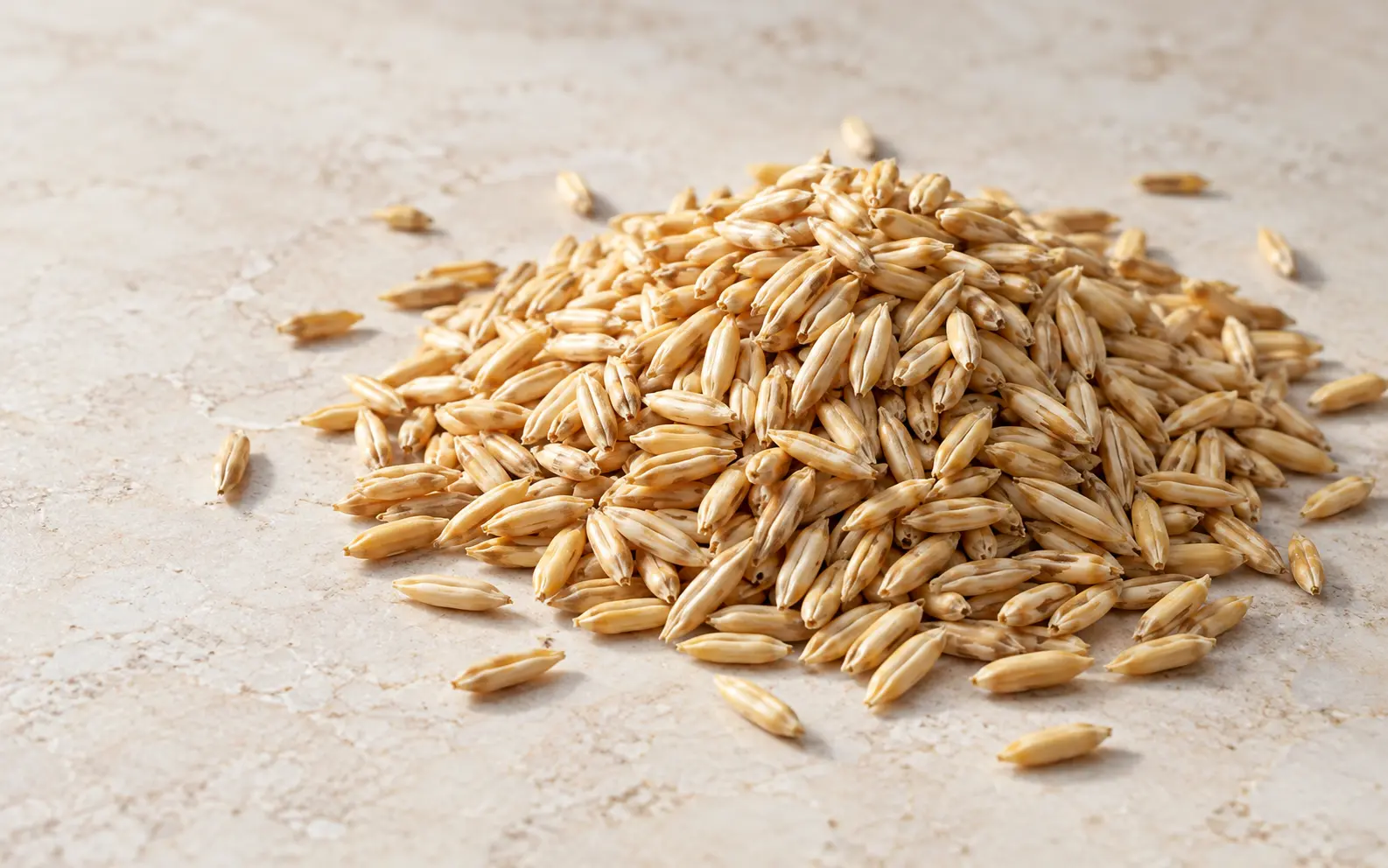
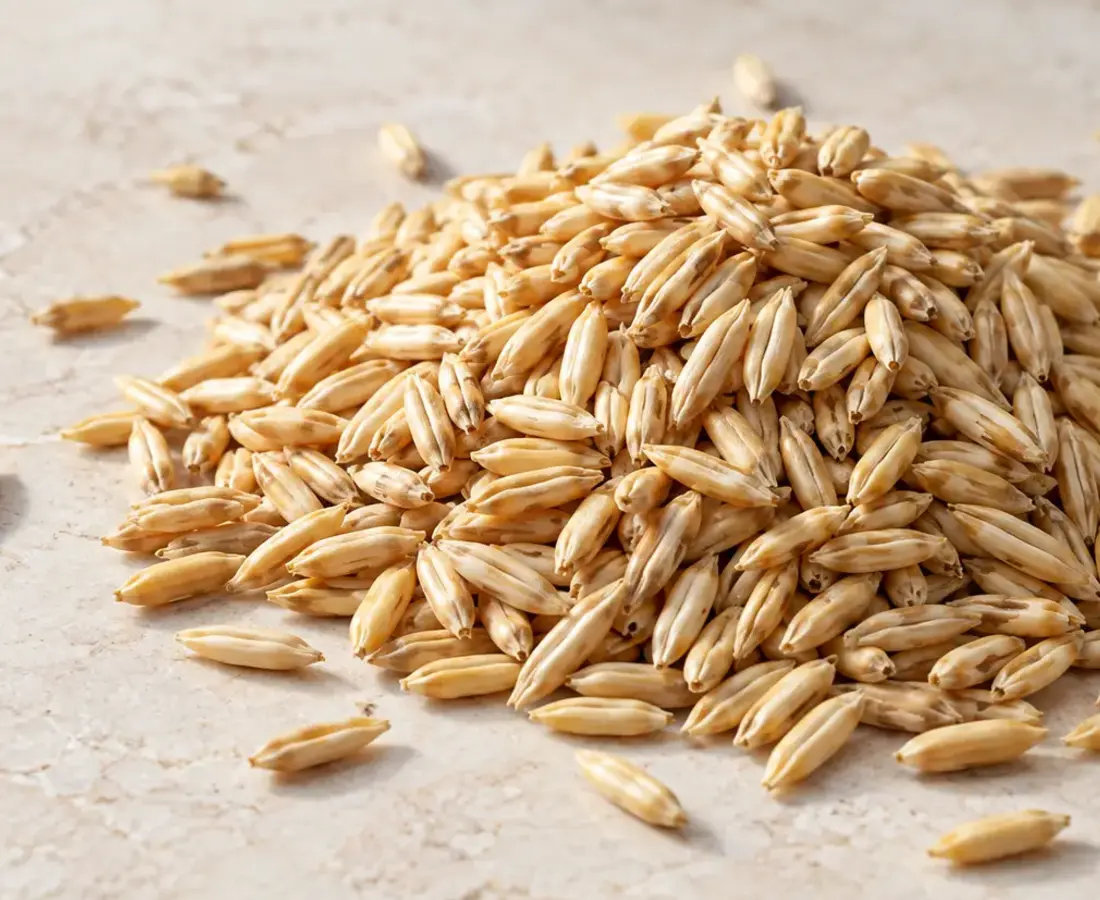
Editorial boundary: These AI-generated orientation images must not be used to identify wild foods, judge edibility, prove safe preparation, or diagnose spoilage. The verified safety-image panel and written guidance control where present.
Book readiness · Rewrite 03
Oat grain, dry. Scientific identity: Avena sativa L.; generic oat grain product. Edible part: Dry cleaned grain or groat represented by the record. Exact source form: Oats, corresponding to USDA FoodData Central FDC 169705; the record is dry and not a prepared serving.
Question: Are oats automatically safe for everyone following a gluten-free diet?
Repeated experience: People with celiac disease report both tolerance and symptoms even with labeled gluten-free oats, raising separate questions about grain cross-contact and individual oat sensitivity.
NIDDK says oat cross-contact with wheat, barley or rye is common; FDA requires foods labeled gluten-free to meet its standard and advises sensitive consumers to work with clinicians.
Ordinary oats cannot be assumed gluten-free. A compliant gluten-free label addresses gluten contamination but does not guarantee that every person with celiac disease tolerates oats.
Exclude or qualify: Do not merge this chapter with: Rolled, steel-cut, quick or instant oats, oat bran, flour, milk, cooked porridge, flavored products, supplements, and other Avena species. Remove or qualify medical-treatment, universal-safety, cross-species, cross-part, cross-product, and cross-preparation claims unless an exact source is reviewed for that wording.
| Layer | Disposition | Sources |
|---|---|---|
| Identity And Form | supported for bounded scope | [1] [2] [3] |
| Human Experience | experience documented not generalized | [4] |
| Authoritative Control | supported control | [3] |
| Supported Conclusion | supported with stated limits | [4] [3] |
| Safety And Limitations | required boundary | [1] [2] [3] |
Review status: This controlled rewrite uses the adjudicated identity, food-form, human-experience, authoritative-control, conclusion, and safety fields. It replaces broader legacy prose for this chapter layer but does not constitute final specialist or publication approval.
Final gate · Approval 03
Status: Approved for informational book assembly
Approved for informational book assembly with its claim-to-source map retained.
Specialist-review flags: None
Safety-box triggers: No additional trigger
Review scope: Final source-completeness, structure, exclusion, and risk-triage review for book assembly. This is not a claim that an external specialist reviewed the chapter.
Book placement · Volume 4
Chapter 5 in The Food Glossary: Evidence Edition — Volume 4. Standard controlled chapter format.
Corrected USDA food/form panel · other claims unreviewed
oats, as listed in USDA SR Legacy. Other chapter claims unverified. The earlier mismatched or broader nutrient assignment is not used here. This panel describes only the named food and preparation, not every food sold under the glossary heading. A nutrient record does not establish raw-consumption safety.
Oats are a cereal grain; rolled oats are one whole-grain form. The USDA panel below is for oats as named in the source record, not a bowl of cooked oatmeal. Water added during cooking changes nutrients per 100 grams of the prepared food, while sweetened instant packets, oat bran, and oat milk are distinct products.
USDA Food Buying Guide: grains and dry-versus-cooked measures
| Energy | 389 kcal |
|---|---|
| Protein | 16.9 g |
| Fat | 6.9 g |
| Carbohydrate | 66.3 g |
| Fiber | 10.6 g |
| Potassium | 429 mg |
USDA FoodData Central FDC 169705 · SR Legacy (final release, April 2018). Values describe only this named form, not all products or varieties.
Human experience evidence · Batch 13
Question: Are oats automatically safe for everyone following a gluten-free diet?
People with celiac disease report both tolerance and symptoms even with labeled gluten-free oats, raising separate questions about grain cross-contact and individual oat sensitivity.
NIDDK says oat cross-contact with wheat, barley or rye is common; FDA requires foods labeled gluten-free to meet its standard and advises sensitive consumers to work with clinicians.
Ordinary oats cannot be assumed gluten-free. A compliant gluten-free label addresses gluten contamination but does not guarantee that every person with celiac disease tolerates oats.
Separate conventional and labeled gluten-free oats. For celiac guidance, preserve clinician advice and individual tolerance rather than promising universal safety.
Reddit Celiac
Finding: People with celiac disease report mixed tolerance to gluten-free oats and distinguish suspected cross-contact from possible individual reactions to oat protein.
Supported conclusion: Captures two different mechanisms behind the same reported symptom pattern.
Limitations: Symptoms alone cannot identify gluten exposure, avenin sensitivity or another cause.
Evidence strength: Repeated adverse-response signal
Safety/current gate: Yes
National Institute of Diabetes and Digestive and Kidney Diseases
Finding: NIDDK states that cross-contact between oats and gluten-containing grains is common and can make oats unsafe; FDA labeling standards apply to gluten-free claims.
Supported conclusion: Establishes the label and cross-contact boundary.
Limitations: A compliant label does not mean every individual with celiac disease tolerates oats.
Evidence strength: Federal clinical guidance
Safety/current gate: Yes
These 36 links are organized by a matching whole-food name. Prepared products and ingredients have separate composition profiles. Confirm the identity and form on each page; a similar name alone is not proof.
Nutrition for oats, as listed in USDA SR Legacy. USDA record: Oats (Includes foods for USDA's Food Distribution Program).
| Nutrient | Amount |
|---|---|
| Energy | 389 kcal |
| Protein | 16.9 g |
| Fat | 6.9 g |
| Carbohydrate | 66.3 g |
| Fiber | 10.6 g |
| Calcium | 54 mg |
| Iron | 4.72 mg |
| Magnesium | 177 mg |
| Phosphorus | 523 mg |
| Potassium | 429 mg |
| Sodium | 2 mg |
| Zinc | 3.97 mg |
| Vitamin A, RAE | 0 µg |
| Vitamin C | 0 mg |
| Folate, total | 56 µg |
USDA FoodData Central FDC 169705, SR Legacy (April 2018).
Identity, preparation safety, growing, preservation, and health claims are not yet approved. No field-use or canning guidance is established here.