Repeated human experience
Users report mixed tolerance to leaf powder, including appetite changes, gas, cramps and diarrhea, while others report uneventful use; doses and products vary widely.
Book readiness · Identity 05
Book readiness · Publication 03
Visual orientation
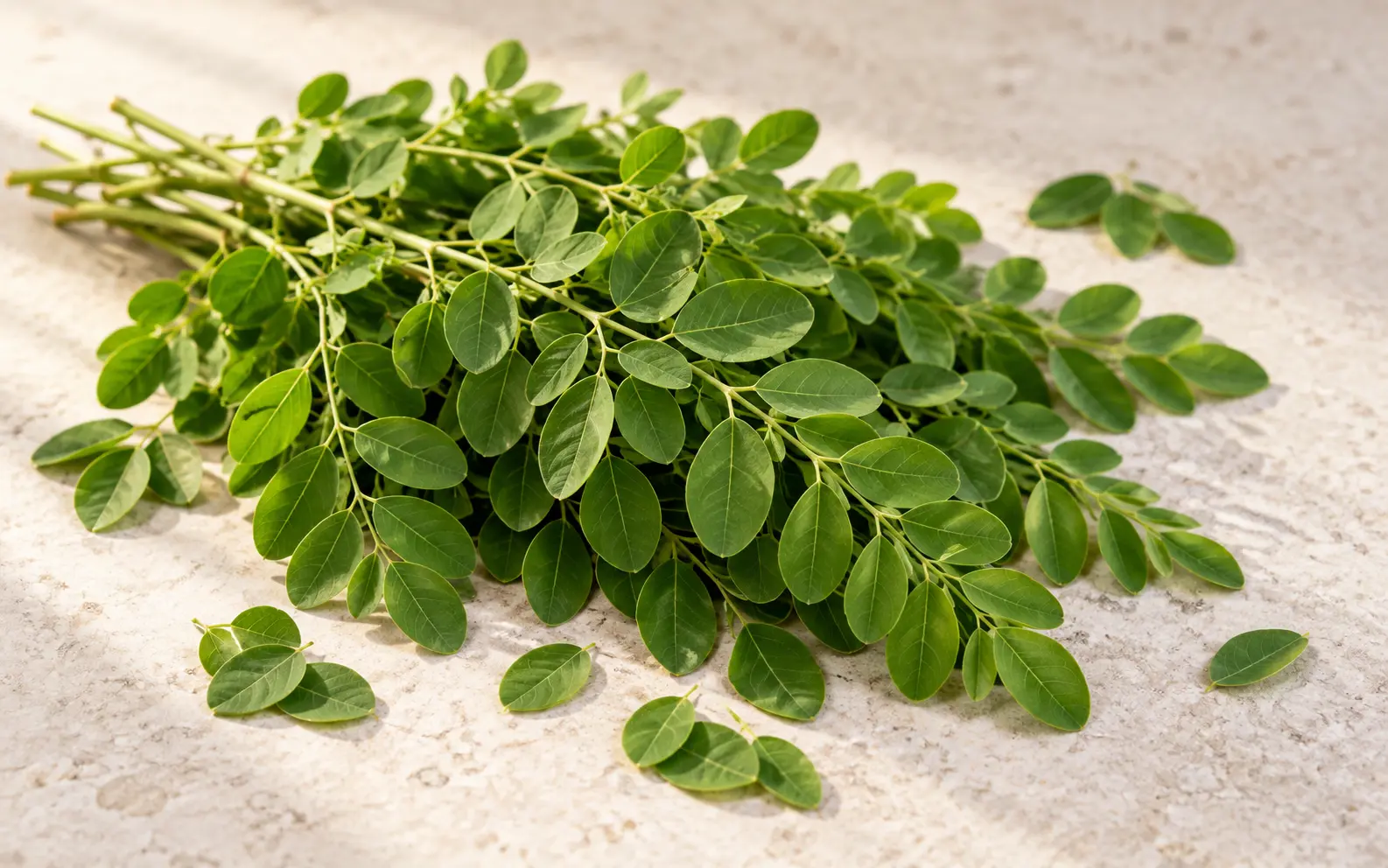
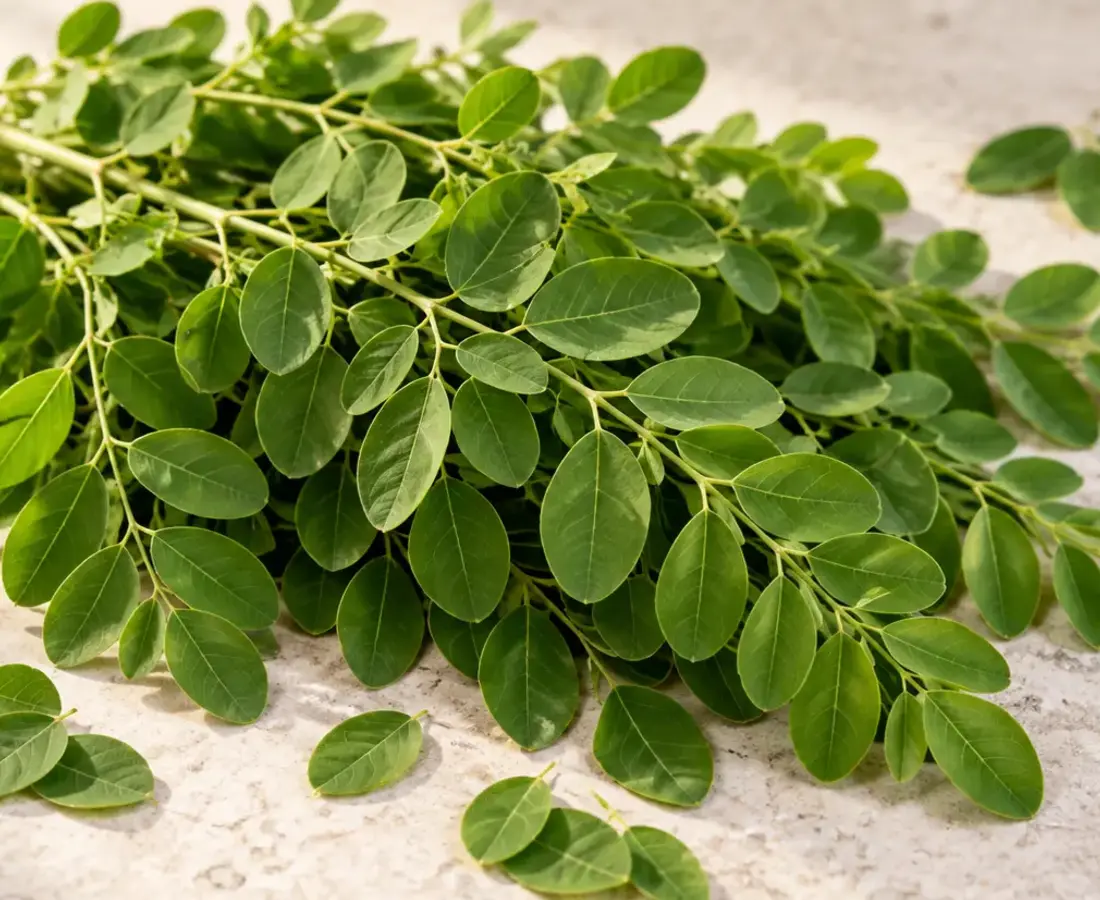
Editorial boundary: These AI-generated orientation images must not be used to identify wild foods, judge edibility, prove safe preparation, or diagnose spoilage. The verified safety-image panel and written guidance control where present.
Book readiness · Rewrite 03
Moringa drumstick leaves, raw. Scientific identity: Moringa oleifera Lam. Edible part: Fresh leaves represented by the source record; pods, seeds, roots, bark, flowers, and stem are separate parts. Exact source form: Drumstick leaves, raw, corresponding to USDA FoodData Central FDC 168416.
Question: Are digestive symptoms from moringa powder normal, and is every product currently safe?
Repeated experience: Users report mixed tolerance to leaf powder, including appetite changes, gas, cramps and diarrhea, while others report uneventful use; doses and products vary widely.
A U.S. human study found more mild gastrointestinal symptoms at higher powder doses, while FDA and CDC investigated 2026 Salmonella outbreaks linked to specific moringa leaf-powder products.
Human replication shows dose and product matter. A side effect cannot be assumed to be detoxification, and a recall signal is product-specific rather than proof that all moringa is contaminated.
Exclude or qualify: Do not merge this chapter with: Dried leaf powder, tea, supplements, pods, seeds, seed oil, roots, bark, extracts, capsules, and other Moringa species. Remove or qualify medical-treatment, universal-safety, cross-species, cross-part, cross-product, and cross-preparation claims unless an exact source is reviewed for that wording.
| Layer | Disposition | Sources |
|---|---|---|
| Identity And Form | supported for bounded scope | [1] [2] [3] |
| Human Experience | experience documented not generalized | [4] |
| Authoritative Control | supported control | [5] |
| Supported Conclusion | supported with stated limits | [4] [5] |
| Safety And Limitations | required boundary | [1] [2] [3] [5] |
Review status: This controlled rewrite uses the adjudicated identity, food-form, human-experience, authoritative-control, conclusion, and safety fields. It replaces broader legacy prose for this chapter layer but does not constitute final specialist or publication approval.
Final gate · Approval 03
Status: Approved for book assembly with required safety box
Approved for informational book assembly only with the authoritative safety-and-limitations box retained beside the chapter text.
Specialist-review flags: None
Safety-box triggers: raw
Review scope: Final source-completeness, structure, exclusion, and risk-triage review for book assembly. This is not a claim that an external specialist reviewed the chapter.
Book placement · Volume 4
Chapter 1 in The Food Glossary: Evidence Edition — Volume 4. The authoritative safety box is mandatory in every edition.
Nutrition correction
The earlier nutrient assignment is not accepted for this heading. Do not transfer numbers from a similarly named or related food.
What is needed: Specify Moringa oleifera leaves, pods, or powder and food form; pumpkin leaves are unrelated.
No replacement nutrient panel has been verified for this exact food and form.
USDA food/form-matched panel · other claims unreviewed
This per-100-gram panel uses the specifically named USDA SR Legacy food and preparation shown here. The glossary heading may be broader; these values do not describe every commercial brand, cultivar, or different cooking or processing method. A composition record does not establish raw-consumption or home-preservation safety.
This named leaf example is Moringa oleifera, also called the drumstick tree. The USDA record describes raw leaves, not pods, seeds, oil, or dried leaf powder; the common names should stay attached to the specified part.
USDA FoodData Central: stated form · USDA ARS: moringa and drumstick leaves
| Energy | 64 kcal |
|---|---|
| Protein | 9.4 g |
| Fat | 1.4 g |
| Carbohydrate | 8.28 g |
| Fiber | 2 g |
| Potassium | 337 mg |
USDA FoodData Central FDC 168416 · SR Legacy (final release, April 2018). Values describe only this named form, not all products or varieties.
Human experience evidence · Batch 13
Question: Are digestive symptoms from moringa powder normal, and is every product currently safe?
Users report mixed tolerance to leaf powder, including appetite changes, gas, cramps and diarrhea, while others report uneventful use; doses and products vary widely.
A U.S. human study found more mild gastrointestinal symptoms at higher powder doses, while FDA and CDC investigated 2026 Salmonella outbreaks linked to specific moringa leaf-powder products.
Human replication shows dose and product matter. A side effect cannot be assumed to be detoxification, and a recall signal is product-specific rather than proof that all moringa is contaminated.
Keep generic entry held. Separate leaf food, powder, extract, seed and other plant parts; check current recalls and avoid medicinal promises.
Reddit Supplements
Finding: Users ask whether powder produces benefits and report mixed experiences, including gastrointestinal symptoms and changes in appetite.
Supported conclusion: Captures the actual dose-and-tolerance question readers bring to the ingredient.
Limitations: Self-reports cannot diagnose contamination, drug interaction or treatment benefit.
Evidence strength: Repeated tolerance signal
Safety/current gate: Yes
Peer-reviewed human study; U.S. Food and Drug Administration
Finding: A U.S. study found more mild GI symptoms above 7 g/day; FDA investigated 2026 Salmonella illnesses linked to identified moringa leaf-powder products and recalls.
Supported conclusion: Separates dose tolerance from a product-specific contamination event.
Limitations: The study does not prove broad health benefits, and the outbreak does not make every moringa product unsafe.
Evidence strength: Human-study and federal control
Safety/current gate: Yes
These 2 links are organized by a matching whole-food name. Prepared products and ingredients have separate composition profiles. Confirm the identity and form on each page; a similar name alone is not proof.
Specify Moringa oleifera leaves, pods, or powder and food form; pumpkin leaves are unrelated.
The former match was rejected. An exact ingredient, edible part, preparation form, and source must be verified before adding values. Other claims remain unverified.