Repeated human experience
Cooks use Persian limes when Key limes are unavailable but report differences in tartness, aroma, seediness and yield, especially in lime pie.
Book readiness · Identity 04
Book readiness · Publication 03
Visual orientation
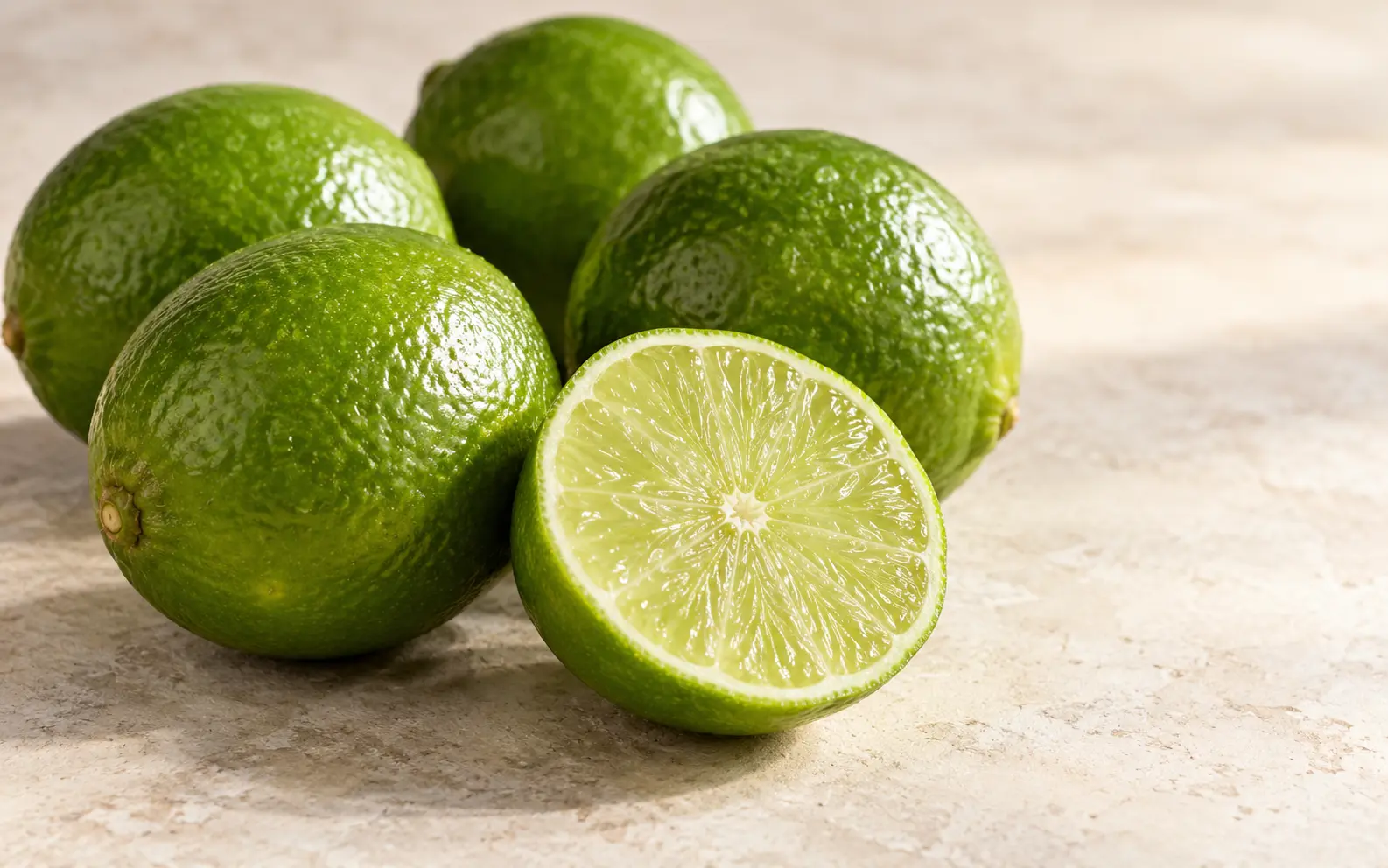
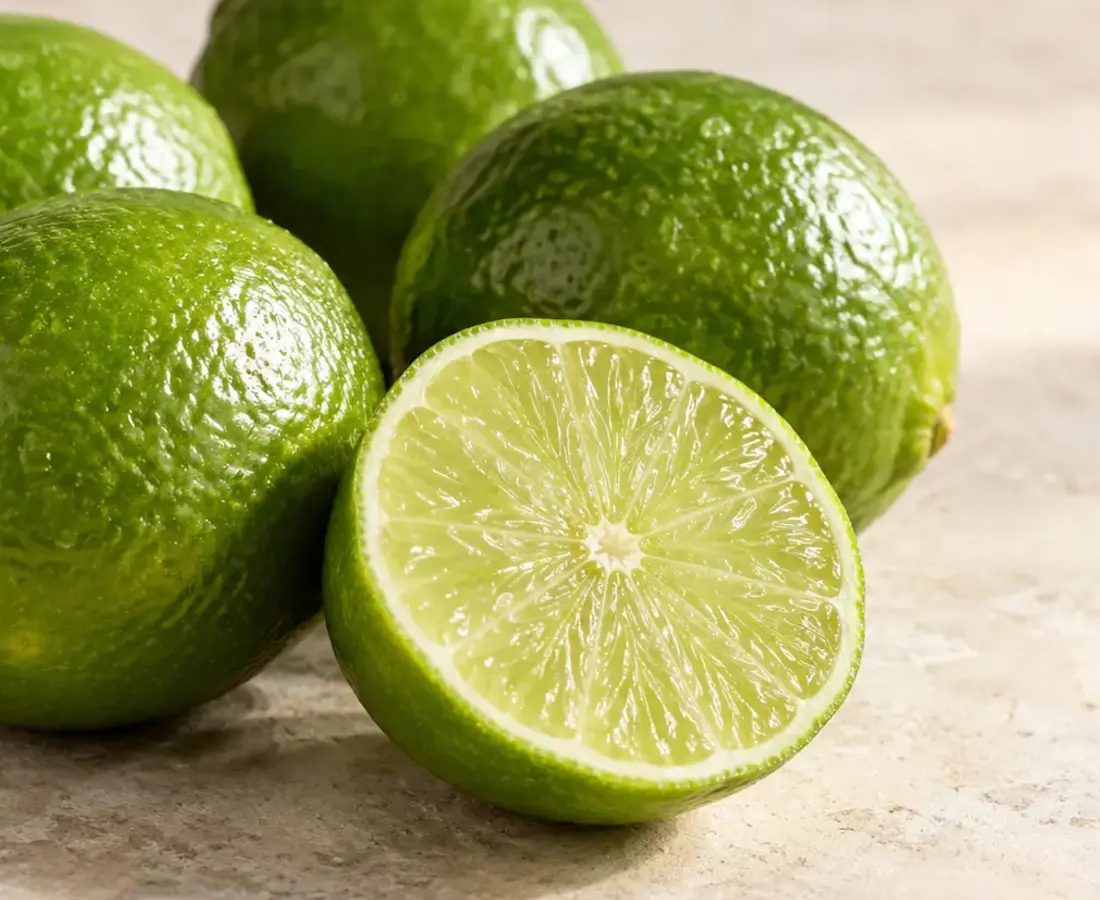
Editorial boundary: These AI-generated orientation images must not be used to identify wild foods, judge edibility, prove safe preparation, or diagnose spoilage. The verified safety-image panel and written guidance control where present.
Book readiness · Rewrite 03
Limes, raw. Scientific identity: Citrus species and hybrids sold as limes; the USDA generic record does not identify a cultivar or species. Edible part: Fruit flesh and juice vesicles; peel, seed, and essential oil are separate. Exact source form: Limes, raw, corresponding to USDA FoodData Central FDC 168155.
Question: Are Key limes and common grocery-store limes interchangeable?
Repeated experience: Cooks use Persian limes when Key limes are unavailable but report differences in tartness, aroma, seediness and yield, especially in lime pie.
UF/IFAS distinguishes smaller, rounder, tarter Key/Mexican limes from Persian/Tahitian limes commonly sold in stores.
They can sometimes substitute by measured juice, but the name, flavor and fruit count are not equivalent.
Exclude or qualify: Do not merge this chapter with: Key, Persian, makrut, and sweet limes, juice, concentrate, cordial, zest, essential oil, pickles, extracts, and supplements. Remove or qualify medical-treatment, universal-safety, cross-species, cross-part, cross-product, and cross-preparation claims unless an exact source is reviewed for that wording.
| Layer | Disposition | Sources |
|---|---|---|
| Identity And Form | supported for bounded scope | [1] [2] [3] |
| Human Experience | experience documented not generalized | [4] |
| Authoritative Control | supported control | [3] |
| Supported Conclusion | supported with stated limits | [4] [3] |
| Safety And Limitations | required boundary | [1] [2] [3] |
Review status: This controlled rewrite uses the adjudicated identity, food-form, human-experience, authoritative-control, conclusion, and safety fields. It replaces broader legacy prose for this chapter layer but does not constitute final specialist or publication approval.
Final gate · Approval 03
Status: Approved for book assembly with required safety box
Approved for informational book assembly only with the authoritative safety-and-limitations box retained beside the chapter text.
Specialist-review flags: None
Safety-box triggers: concentrat, essential oil
Review scope: Final source-completeness, structure, exclusion, and risk-triage review for book assembly. This is not a claim that an external specialist reviewed the chapter.
Book placement · Volume 3
Chapter 24 in The Food Glossary: Evidence Edition — Volume 3. The authoritative safety box is mandatory in every edition.
Editorial classification corrected
Duplicate or misspelled heading redirected to limes. This duplicate heading now points to Limes.
Named raw-form example · full chapter unreviewed
The broad glossary heading may cover more than one variety or preparation. This is a separate USDA raw-form example, not a nutrient value for every version of the food. A nutrient record is not evidence that a plant or part is safe to eat raw. Identity, edible part, and safe preparation still require their own sources.
This raw-lime panel is not a panel for lime juice, zest, cordial, or pickled lime. Many commercial limes are harvested green; exposure to ethylene can make the green rind turn yellow during handling, so skin color alone is not a complete measure of the fruit’s quality.
| Energy | 30 kcal |
|---|---|
| Protein | 0.7 g |
| Fat | 0.2 g |
| Carbohydrate | 10.5 g |
| Fiber | 2.8 g |
| Total sugars | 1.69 g |
| Potassium | 102 mg |
USDA FoodData Central FDC 168155 · SR Legacy (final release, April 2018). Values describe only this named form, not all products or varieties.
Human experience evidence · Batch 12
Question: Are Key limes and common grocery-store limes interchangeable?
Cooks use Persian limes when Key limes are unavailable but report differences in tartness, aroma, seediness and yield, especially in lime pie.
UF/IFAS distinguishes smaller, rounder, tarter Key/Mexican limes from Persian/Tahitian limes commonly sold in stores.
They can sometimes substitute by measured juice, but the name, flavor and fruit count are not equivalent.
Record species/type and measured juice volume. Do not use fruit counts as a universal conversion.
Reddit AskCulinary
Finding: Cooks report workable substitutions by juice volume but noticeable differences in aroma, tartness, seediness and fruit yield.
Supported conclusion: Shows that substitution is possible without making the fruit types identical.
Limitations: Taste reports cannot provide a universal fruit-count conversion.
Evidence strength: Repeated substitution signal
Safety/current gate: No
UF/IFAS Gardening Solutions
Finding: UF/IFAS describes Key/Mexican limes as smaller, rounder and tarter than the Persian/Tahitian limes commonly found in grocery stores.
Supported conclusion: Supports separate type labels and measured-volume substitutions.
Limitations: Cultivar, maturity and storage still affect flavor and yield.
Evidence strength: University extension control
Safety/current gate: No
Generated: 2026-09-26T10:53:12.811170+00:00
Status: starter_book_research
Lime most commonly refers to:Lime (fruit), a green citrus fruit
Lime (material), inorganic materials containing calcium, usually calcium oxide or calcium hydroxide
Lime (color), between yellow and green
Survival/category tags: fruit/foraged or cultivated edible
USDA FoodData Central match: null
Collect crop-specific growing instructions from Extension/agronomy sources: climate, soil, sunlight, propagation, planting, harvest stage, and common pests/diseases.
Needed for final book: climate range, soil, sunlight, water, propagation, planting spacing, harvest signs, common pests, container/garden/wild context.
Document edible parts, best harvest stage, field identification traits, and whether it is commonly wild-foraged, cultivated, or both.
Survival note: positive identification is mandatory for wild foods; include local lookalikes and preparation requirements before recommending field use.
Collect culinary instructions: edible parts, raw vs cooked use, basic preparation, common traditional dishes, and safe cooking notes.
Needed for final book: raw/cooked safety, basic prep, boiling/roasting/frying/drying/powdering, traditional uses, emergency/survival meal applications.
Collect preservation instructions: fresh storage, drying/dehydration, freezing, pickling/fermenting, canning where safe, and shelf-life cautions.
Book preservation checklist to fill per food:
Collect pairings, preservation interactions, acid/salt/sugar/oil effects, culinary transformations, and foods this helps preserve or tenderize/flavor.
For survival/nature use: never eat wild lookalikes without positive identification; document toxic lookalikes, contraindications, allergies, and preparation requirements.
{
  "wiki": {
    "query": "Lime",
    "title": "Lime",
    "extract": "Lime most commonly refers to:Lime (fruit), a green citrus fruit\nLime (material), inorganic materials containing calcium, usually calcium oxide or calcium hydroxide\nLime (color), between yellow and green",
    "url": "https://en.wikipedia.org/wiki/Lime",
    "source": "Wikipedia summary API"
  },
  "fdc": {
    "query": "Lime raw",
    "error": "HTTPError: HTTP Error 429: Too Many Requests"
  },
  "generic_sources": [
    {
      "id": "nchfp_home_preservation",
      "title": "National Center for Home Food Preservation",
      "url": "https://nchfp.uga.edu/",
      "publisher": "University of Georgia / USDA-supported NCHFP",
      "use": "safe canning, freezing, drying, pickling, fermentation principles"
    },
    {
      "id": "usda_complete_guide_canning",
      "title": "USDA Complete Guide to Home Canning",
      "url": "https://www.nifa.usda.gov/about-nifa/blogs/usdas-complete-guide-home-canning",
      "publisher": "USDA/NIFA",
      "use": "pressure canning and water-bath canning safety"
    },
    {
      "id": "extension_food_safety",
      "title": "Extension food preservation resources",
      "url": "https://extension.umn.edu/preserving-and-preparing",
      "publisher": "University Extension",
      "use": "practical preservation and storage safety cross-check"
    },
    {
      "id": "poisonous_plants_general",
      "title": "Poisonous plant / wild food caution principle",
      "url": "https://www.fs.usda.gov/wildflowers/ethnobotany/edible.shtml",
      "publisher": "USDA Forest Service",
      "use": "wild edible plants require positive identification and local expert caution"
    }
  ]
}Reviewed in 20-food milestone batch 005 on 2026-09-26.
Checkpoint status:
Batch source reminders:
Milestone batch 005; row-order item 100/220; checked 2026-09-26.
Completion date: 2026-09-26T16:56:24.458626+00:00
Completion status: v1_complete_draft_needs_source_deepening
Food type: general_food_entry
Lime most commonly refers to:Lime (fruit), a green citrus fruit
Lime (material), inorganic materials containing calcium, usually calcium oxide or calcium hydroxide
Lime (color), between yellow and green
Survival/category tags: fruit/foraged or cultivated edible
Collect climate, sunlight, soil, water, propagation, planting/spacing, harvest signs, and common pests/diseases from Extension/agricultural sources.
For survival use, document whether it is wild, cultivated, or naturalized; which parts are edible; harvest season; preparation requirements; and dangerous lookalikes. Do not recommend wild eating without positive identification.
Document raw/cooked safety, cleaning, cutting, boiling/roasting/frying/steaming/drying/powdering, common dishes, and emergency low-tool preparation methods.
Document fresh storage, freezing, drying/dehydration, pickling/fermentation, canning suitability, salt/sugar/oil/vinegar methods, shelf-life, and spoilage signs. Use tested canning sources for shelf-stable methods.
Document how Lime interacts with other foods: acidity, sweetness, starch, oil, salt, aromatics, thickening, fermentation, tenderizing, preservation support, flavor pairing, and texture changes through heat/drying/freezing.
Document allergies, toxic lookalikes, unsafe raw forms, drug/condition cautions, and preservation risks such as botulism in low-acid canning or fresh herbs/garlic in oil.
Completed v1 packaging: 2026-09-28T05:04:32.703969+00:00
Status: book_entry_v1_complete_source_scaffolded
This chapter is finished as a Food Glossary v1 research/wiki entry. Before print publication or survival advice use, perform final editorial review for wording, citations, local identification, toxic lookalikes, and tested preservation/canning details. Do not add uncited cure claims.
Finalized: 2026-09-28T16:17:47.337022+00:00
Status: `final_v2_food_entry_with_nutrition_source_scaffolded`
Scope: natural/growable food library; animal farming/meat/dairy/eggs/fish intentionally excluded.
Source stream: original Food Glossary short list
Category: unknown
Nutrition status: accepted USDA/local nutrition table present
This entry is included in the completed v2 wiki/book scaffold. Before print/public survival guidance, verify exact identity, edible parts, toxic lookalikes, contraindications, and preservation safety from authoritative sources.
Reviewed: 2026-09-29T00:42:22.143212+00:00
Review status: `deep_review_batch003_public_source_targets`
Scientific/identity target: Exact scientific name pending taxonomy verification; use GBIF/WFO/CABI/PFAF/Extension source during final editorial pass.
This entry now has public expert source targets for nutrition, growing/cultivation, edible parts, cooking/preparation, preservation/storage, taxonomy, and cautions/lookalikes where relevant. These are preserved for the book review workflow. Final publication still requires claim-by-claim verification against the exact pages and any local/regional safety rules.