Repeated human experience
Gardeners and cooks repeatedly report that many colored bell peppers begin green and sweeten as they color, while also noting that cultivar determines the final color and flavor.
Book readiness · Identity 07
Book readiness · Publication 03
Visual orientation
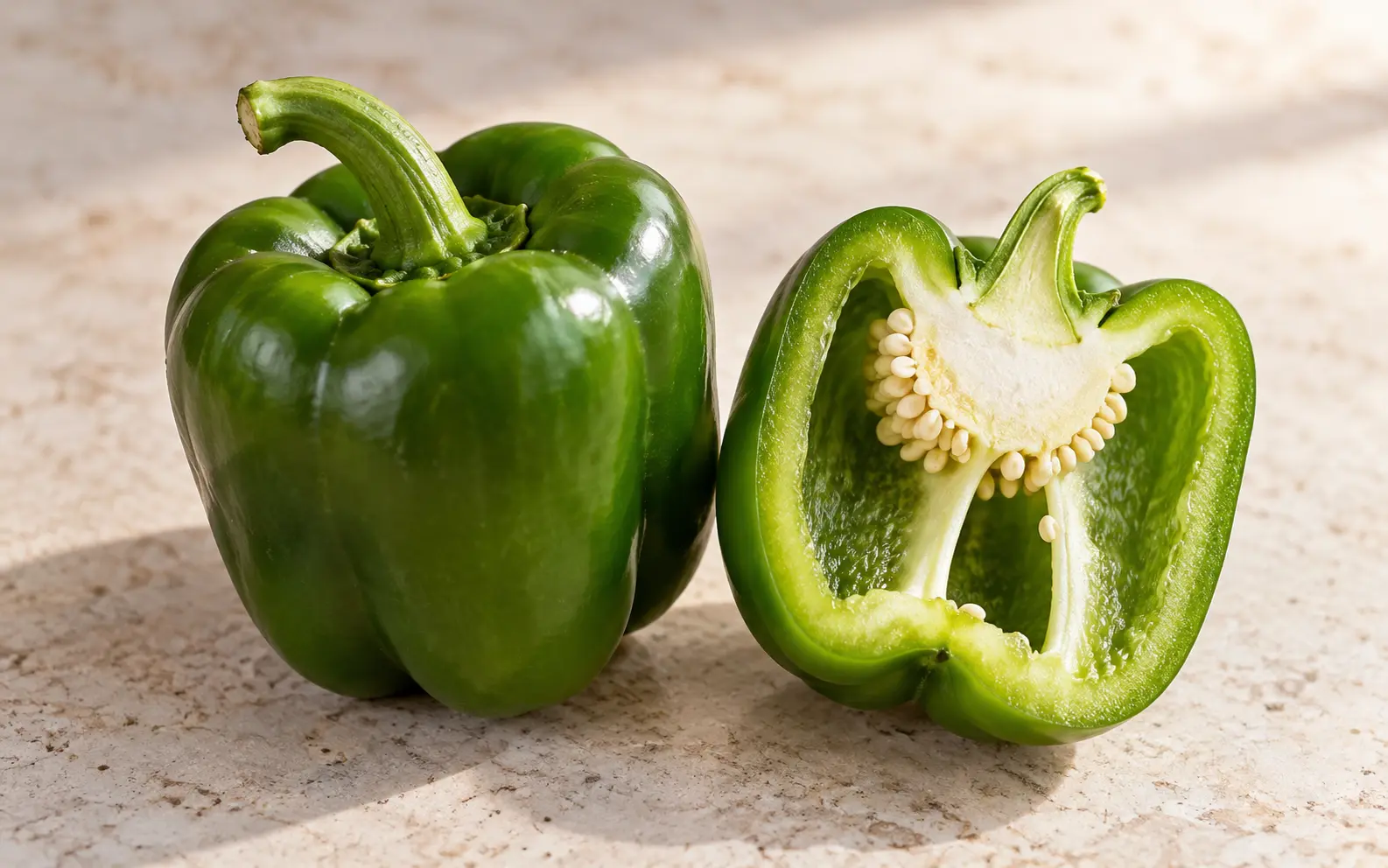
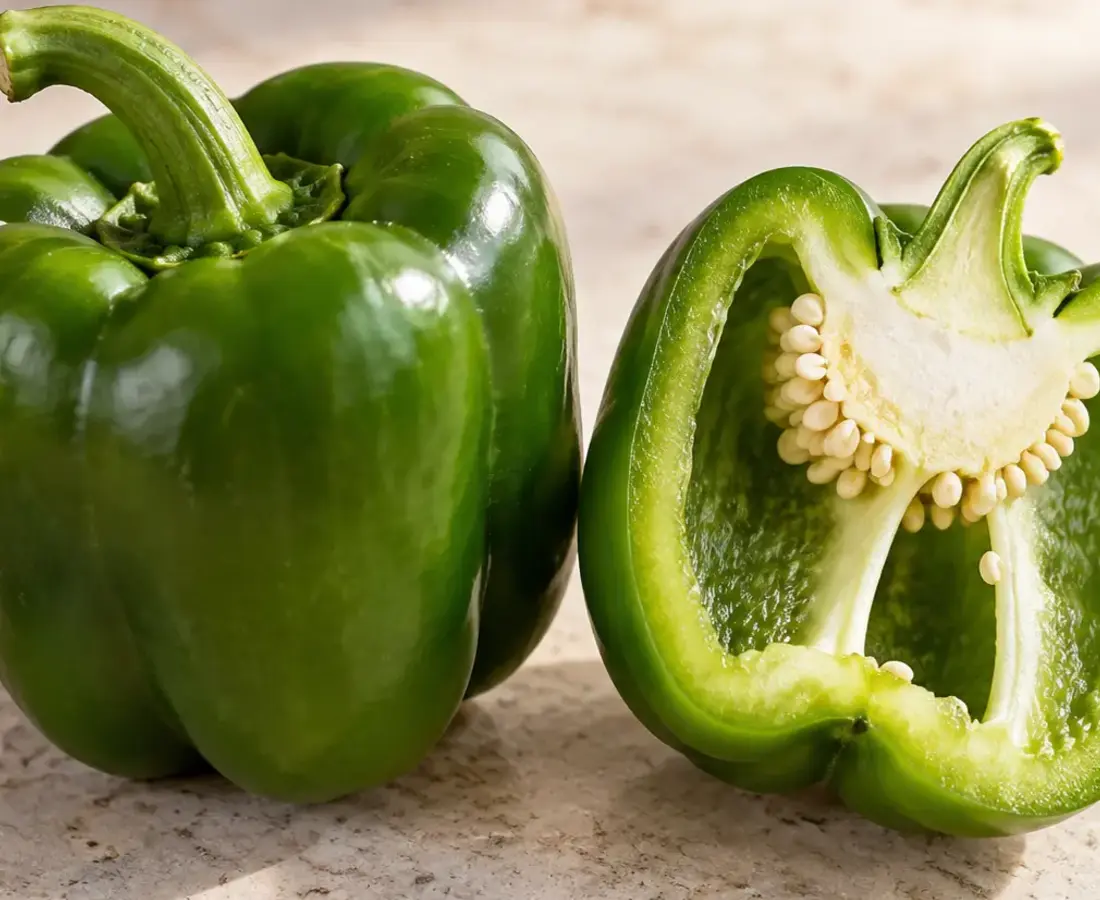
Editorial boundary: These AI-generated orientation images must not be used to identify wild foods, judge edibility, prove safe preparation, or diagnose spoilage. The verified safety-image panel and written guidance control where present.
Book readiness · Rewrite 03
Green sweet bell pepper, raw. Scientific identity: Capsicum annuum L.; non-pungent bell-pepper cultivar group at the green immature stage. Edible part: Fresh fruit flesh, skin, placenta, and seeds as normally prepared. Exact source form: Peppers, sweet, green, raw, corresponding to USDA FoodData Central FDC 170427.
Question: Is every green bell pepper simply an unripe red pepper?
Repeated experience: Gardeners and cooks repeatedly report that many colored bell peppers begin green and sweeten as they color, while also noting that cultivar determines the final color and flavor.
University of Maryland Extension says all pepper fruits start green and ripen to cultivar-dependent colors; bell peppers reach a mature-green stage before full ripeness.
Green describes a harvest stage for many cultivars, not one guaranteed final color or a separate sex. A mature-green pepper is edible but usually less sweet than its fully colored form.
Exclude or qualify: Do not merge this chapter with: Hot green chiles, named cultivars, ripe red, yellow or orange peppers, roasted or cooked peppers, flakes, powders, sauces, extracts, and finished foods. Remove or qualify medical-treatment, universal-safety, cross-species, cross-part, cross-product, and cross-preparation claims unless an exact source is reviewed for that wording.
| Layer | Disposition | Sources |
|---|---|---|
| Identity And Form | supported for bounded scope | [1] [2] [3] |
| Human Experience | experience documented not generalized | [4] |
| Authoritative Control | supported control | [2] |
| Supported Conclusion | supported with stated limits | [4] [2] |
| Safety And Limitations | required boundary | [1] [2] [3] |
Review status: This controlled rewrite uses the adjudicated identity, food-form, human-experience, authoritative-control, conclusion, and safety fields. It replaces broader legacy prose for this chapter layer but does not constitute final specialist or publication approval.
Final gate · Approval 02
Status: Approved for informational book assembly
Approved for informational book assembly with its claim-to-source map retained.
Specialist-review flags: None
Safety-box triggers: No additional trigger
Review scope: Final source-completeness, structure, exclusion, and risk-triage review for book assembly. This is not a claim that an external specialist reviewed the chapter.
Book placement · Volume 3
Chapter 11 in The Food Glossary: Evidence Edition — Volume 3. Standard controlled chapter format.
Corrected USDA food/form panel · other claims unreviewed
raw green sweet bell pepper; not hot green chile. Other chapter claims unverified. The earlier mismatched or broader nutrient assignment is not used here. This panel describes only the named food and preparation, not every food sold under the glossary heading. A nutrient record does not establish raw-consumption safety.
The matched record is green sweet or bell pepper, raw. Hot green chiles, cooked peppers, roasted peppers, pickles, sauce, and mixed dishes require separate records.
USDA FoodData Central: green sweet pepper, raw · FDA: produce safety
| Energy | 20 kcal |
|---|---|
| Protein | 0.86 g |
| Fat | 0.17 g |
| Carbohydrate | 4.64 g |
| Fiber | 1.7 g |
| Total sugars | 2.4 g |
| Potassium | 175 mg |
USDA FoodData Central FDC 170427 · SR Legacy (final release, April 2018). Values describe only this named form, not all products or varieties.
Human experience evidence · Batch 11
Question: Is every green bell pepper simply an unripe red pepper?
Gardeners and cooks repeatedly report that many colored bell peppers begin green and sweeten as they color, while also noting that cultivar determines the final color and flavor.
University of Maryland Extension says all pepper fruits start green and ripen to cultivar-dependent colors; bell peppers reach a mature-green stage before full ripeness.
Green describes a harvest stage for many cultivars, not one guaranteed final color or a separate sex. A mature-green pepper is edible but usually less sweet than its fully colored form.
Define green bell pepper as a Capsicum annuum bell-type fruit harvested at the green stage; keep cultivar and maturity stage attached to comparisons.
Reddit TodayILearned
Finding: Growers report that many colored cultivars begin green and later color, while some market varieties and stages complicate the simplified one-pepper claim.
Supported conclusion: Captures the recurring maturity-stage question and cultivar exception.
Limitations: Crowd comments cannot identify a cultivar or quantify nutrient changes.
Evidence strength: Repeated maturity-stage signal
Safety/current gate: No
University of Maryland Extension
Finding: Extension states that pepper fruits start green, reach a mature-green stage, and then ripen to cultivar-dependent colors over additional time.
Supported conclusion: Defines green as a valid harvest stage while preserving cultivar identity.
Limitations: The page does not imply that all green peppers will finish red or have identical flavor.
Evidence strength: University extension control
Safety/current gate: No
Nutrition for raw green sweet bell pepper; not hot green chile. USDA record: Peppers, sweet, green, raw.
| Nutrient | Amount |
|---|---|
| Energy | 20 kcal |
| Protein | 0.86 g |
| Fat | 0.17 g |
| Carbohydrate | 4.64 g |
| Fiber | 1.7 g |
| Calcium | 10 mg |
| Iron | 0.34 mg |
| Magnesium | 10 mg |
| Phosphorus | 20 mg |
| Potassium | 175 mg |
| Sodium | 3 mg |
| Zinc | 0.13 mg |
| Vitamin A, RAE | 18 µg |
| Vitamin C | 80.4 mg |
| Folate, total | 10 µg |
USDA FoodData Central FDC 170427, SR Legacy (April 2018).
Identity, preparation safety, growing, preservation, and health claims are not yet approved. No field-use or canning guidance is established here.