Repeated human experience
Multilingual cooks repeatedly report substituting caraway for cumin or finding several unrelated seeds sold under black-cumin or black-caraway names.
Book readiness · Identity 04
Book readiness · Publication 02
Visual orientation
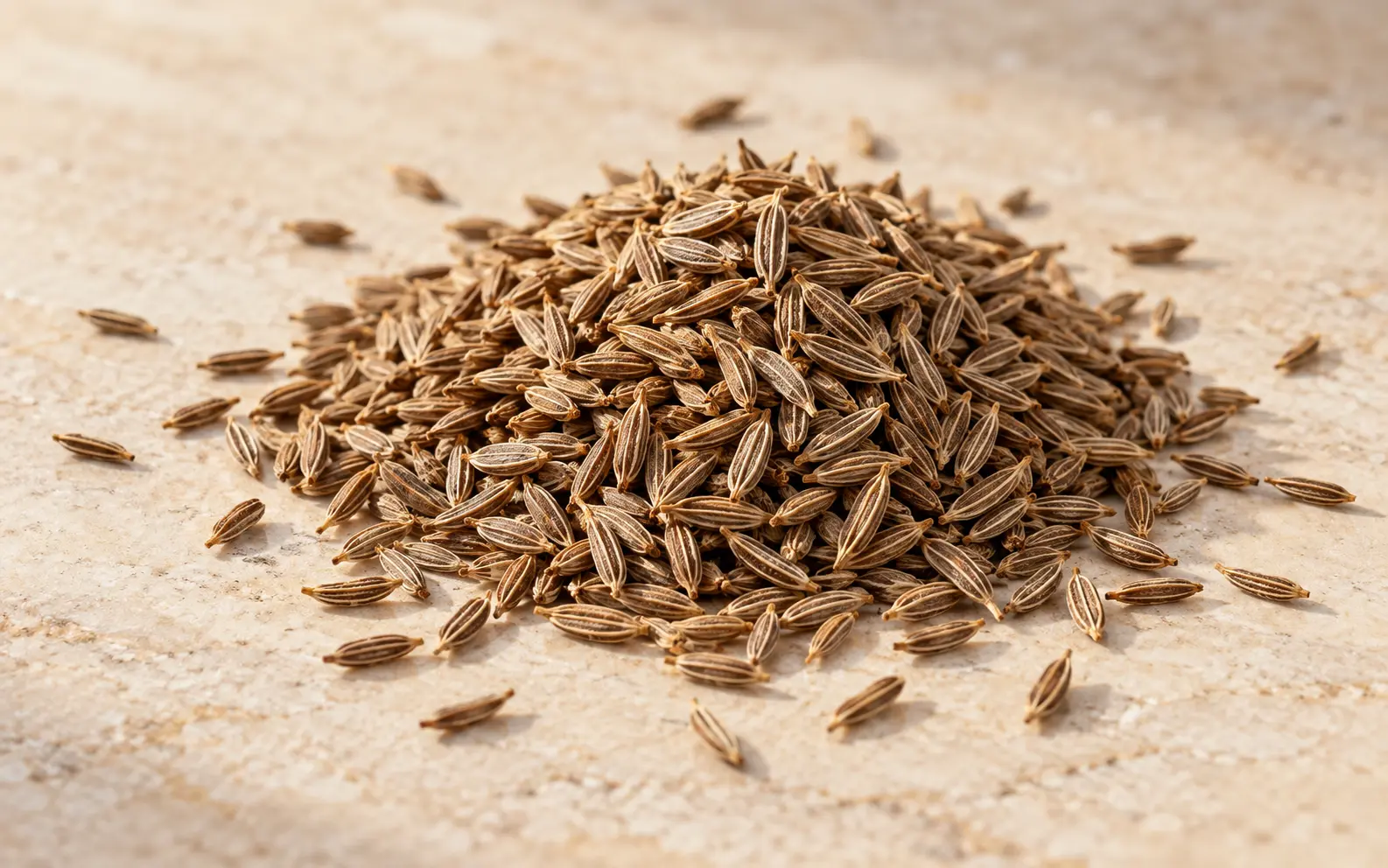
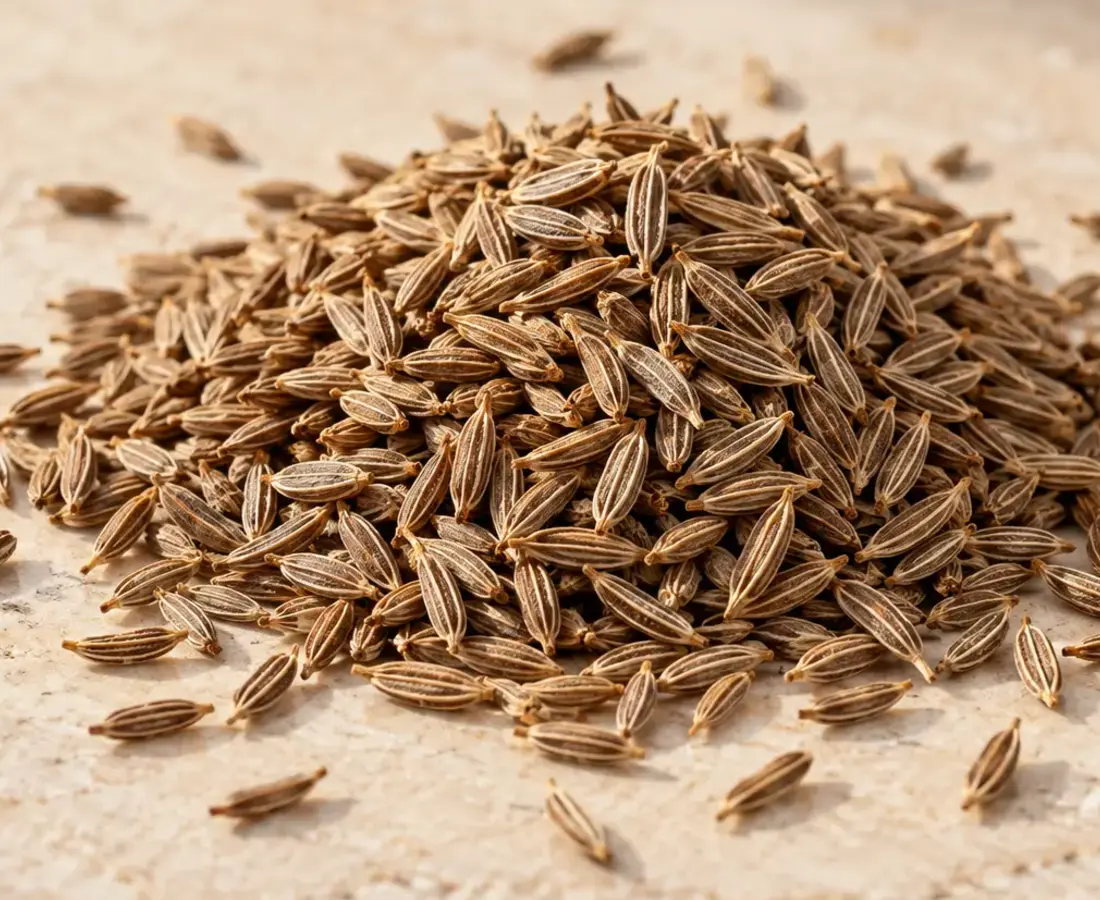
Editorial boundary: These AI-generated orientation images must not be used to identify wild foods, judge edibility, prove safe preparation, or diagnose spoilage. The verified safety-image panel and written guidance control where present.
Book readiness · Rewrite 02
Cumin seed spice. Scientific identity: Cuminum cyminum L. Edible part: Dried fruit commonly called seed. Exact source form: Spices, cumin seed, corresponding to USDA FoodData Central FDC 170923.
Question: Are cumin, caraway and products called black cumin the same spice?
Repeated experience: Multilingual cooks repeatedly report substituting caraway for cumin or finding several unrelated seeds sold under black-cumin or black-caraway names.
The federal spice list distinguishes cumin as Cuminum cyminum, caraway as Carum carvi and black cumin/black caraway as Nigella sativa.
Common names overlap, but the named spices are botanically and sensorially distinct. Replicated confusion supports scientific-name and label verification.
Exclude or qualify: Do not merge this chapter with: Black cumin or nigella, caraway, coriander, ground blends, essential oil, extracts, supplements, and finished foods. Remove or qualify medical-treatment, universal-safety, cross-species, cross-part, cross-product, and cross-preparation claims unless an exact source is reviewed for that wording.
| Layer | Disposition | Sources |
|---|---|---|
| Identity And Form | supported for bounded scope | [1] [2] |
| Human Experience | experience documented not generalized | [3] |
| Authoritative Control | supported control | [4] |
| Supported Conclusion | supported with stated limits | [3] [4] |
| Safety And Limitations | required boundary | [1] [2] [4] |
Review status: This controlled rewrite uses the adjudicated identity, food-form, human-experience, authoritative-control, conclusion, and safety fields. It replaces broader legacy prose for this chapter layer but does not constitute final specialist or publication approval.
Final gate · Approval 02
Status: Approved for book assembly with required safety box
Approved for informational book assembly only with the authoritative safety-and-limitations box retained beside the chapter text.
Specialist-review flags: None
Safety-box triggers: concentrat, essential oil, raw
Review scope: Final source-completeness, structure, exclusion, and risk-triage review for book assembly. This is not a claim that an external specialist reviewed the chapter.
Book placement · Volume 2
Chapter 25 in The Food Glossary: Evidence Edition — Volume 2. The authoritative safety box is mandatory in every edition.
USDA food/form-matched panel · other claims unreviewed
This per-100-gram panel uses the specifically named USDA SR Legacy food and preparation shown here. The glossary heading may be broader; these values do not describe every commercial brand, cultivar, or different cooking or processing method. A composition record does not establish raw-consumption or home-preservation safety.
This is cumin seed as named by USDA, not cumin leaves, ground cumin, oil, or a spice blend. A seed record does not represent a prepared condiment.
USDA FoodData Central: cumin seed
| Energy | 375 kcal |
|---|---|
| Protein | 17.8 g |
| Fat | 22.3 g |
| Carbohydrate | 44.2 g |
| Fiber | 10.5 g |
| Total sugars | 2.25 g |
| Potassium | 1790 mg |
USDA FoodData Central FDC 170923 · SR Legacy (final release, April 2018). Values describe only this named form, not all products or varieties.
Human experience evidence · Batch 09
Question: Are cumin, caraway and products called black cumin the same spice?
Multilingual cooks repeatedly report substituting caraway for cumin or finding several unrelated seeds sold under black-cumin or black-caraway names.
The federal spice list distinguishes cumin as Cuminum cyminum, caraway as Carum carvi and black cumin/black caraway as Nigella sativa.
Common names overlap, but the named spices are botanically and sensorially distinct. Replicated confusion supports scientific-name and label verification.
Use Cuminum cyminum for the cumin record and cross-link, rather than merge, caraway, Nigella and other regional black-cumin products.
Reddit Cooking
Finding: A cook reports using caraway wherever English recipes called for cumin, prompting users to explain that the spices have different flavors despite confusing regional names.
Supported conclusion: Demonstrates a repeatable common-name and translation failure.
Limitations: Crowd identifications may still confuse Nigella, Bunium and other products sold as black cumin.
Evidence strength: Repeated identity-confusion signal
Safety/current gate: Yes
Electronic Code of Federal Regulations
Finding: The federal list names cumin as Cuminum cyminum, caraway as Carum carvi and black cumin or black caraway as Nigella sativa.
Supported conclusion: Provides authoritative names showing these are distinct botanical ingredients.
Limitations: Regulatory recognition as a spice does not make the products flavor-equivalent or validate medicinal claims.
Evidence strength: Official regulatory control
Safety/current gate: Yes
These 2 links are organized by a matching whole-food name. Prepared products and ingredients have separate composition profiles. Confirm the identity and form on each page; a similar name alone is not proof.
Generated: 2026-09-26T10:46:22.111341+00:00
Status: starter_book_research
Cumin is a flowering plant in the family Apiaceae, native to the Irano-Turanian Region. Its seeds – each one contained within a fruit, which is dried – are used in the cuisines of many cultures in both whole and ground form. Although cumin is used in traditional medicine, there is no high-quality evidence that it is safe or effective as a therapeutic agent.
Survival/category tags: fruit/foraged or cultivated edible, seasoning/medicinal-food plant
USDA FoodData Central match: null
Collect crop-specific growing instructions from Extension/agronomy sources: climate, soil, sunlight, propagation, planting, harvest stage, and common pests/diseases.
Needed for final book: climate range, soil, sunlight, water, propagation, planting spacing, harvest signs, common pests, container/garden/wild context.
Document edible parts, best harvest stage, field identification traits, and whether it is commonly wild-foraged, cultivated, or both.
Survival note: positive identification is mandatory for wild foods; include local lookalikes and preparation requirements before recommending field use.
Collect culinary instructions: edible parts, raw vs cooked use, basic preparation, common traditional dishes, and safe cooking notes.
Needed for final book: raw/cooked safety, basic prep, boiling/roasting/frying/drying/powdering, traditional uses, emergency/survival meal applications.
Collect preservation instructions: fresh storage, drying/dehydration, freezing, pickling/fermenting, canning where safe, and shelf-life cautions.
Book preservation checklist to fill per food:
Collect pairings, preservation interactions, acid/salt/sugar/oil effects, culinary transformations, and foods this helps preserve or tenderize/flavor.
For survival/nature use: never eat wild lookalikes without positive identification; document toxic lookalikes, contraindications, allergies, and preparation requirements.
{
  "wiki": {
    "query": "Cumin",
    "title": "Cumin",
    "extract": "Cumin is a flowering plant in the family Apiaceae, native to the Irano-Turanian Region. Its seeds – each one contained within a fruit, which is dried – are used in the cuisines of many cultures in both whole and ground form. Although cumin is used in traditional medicine, there is no high-quality evidence that it is safe or effective as a therapeutic agent.",
    "url": "https://en.wikipedia.org/wiki/Cumin",
    "source": "Wikipedia summary API"
  },
  "fdc": {
    "query": "Cumin raw",
    "error": "HTTPError: HTTP Error 429: Too Many Requests"
  },
  "generic_sources": [
    {
      "id": "nchfp_home_preservation",
      "title": "National Center for Home Food Preservation",
      "url": "https://nchfp.uga.edu/",
      "publisher": "University of Georgia / USDA-supported NCHFP",
      "use": "safe canning, freezing, drying, pickling, fermentation principles"
    },
    {
      "id": "usda_complete_guide_canning",
      "title": "USDA Complete Guide to Home Canning",
      "url": "https://www.nifa.usda.gov/about-nifa/blogs/usdas-complete-guide-home-canning",
      "publisher": "USDA/NIFA",
      "use": "pressure canning and water-bath canning safety"
    },
    {
      "id": "extension_food_safety",
      "title": "Extension food preservation resources",
      "url": "https://extension.umn.edu/preserving-and-preparing",
      "publisher": "University Extension",
      "use": "practical preservation and storage safety cross-check"
    },
    {
      "id": "poisonous_plants_general",
      "title": "Poisonous plant / wild food caution principle",
      "url": "https://www.fs.usda.gov/wildflowers/ethnobotany/edible.shtml",
      "publisher": "USDA Forest Service",
      "use": "wild edible plants require positive identification and local expert caution"
    }
  ]
}Status: reviewed_for_batch_01_needs_followup
Cultivated Apiaceae seed spice, not a survival calorie source. Wild Apiaceae seed harvest is unsafe without expert ID due poisonous lookalikes. Preserve as thoroughly dried seed in airtight dark storage; use culinary amounts unless medical source supports otherwise.
{
  "batch_01_review": {
    "reviewed_at": "2026-09-26T16:27:08.149935+00:00",
    "reviewer": "Hermes cron",
    "sources": [
      {
        "id": "fdc_blocker_2026_09_26",
        "title": "USDA FoodData Central API search attempt",
        "url": "https://api.nal.usda.gov/fdc/v1/foods/search",
        "publisher": "USDA FoodData Central",
        "use": "nutrition lookup attempted; API returned HTTP 429 Too Many Requests for missing foods during this cron pass"
      },
      {
        "id": "nchfp_home",
        "title": "National Center for Home Food Preservation",
        "url": "https://nchfp.uga.edu/",
        "publisher": "University of Georgia / USDA-supported NCHFP",
        "use": "tested home food preservation and canning safety"
      },
      {
        "id": "usda_complete_guide",
        "title": "USDA Complete Guide to Home Canning",
        "url": "https://www.nifa.usda.gov/about-nifa/blogs/usdas-complete-guide-home-canning",
        "publisher": "USDA/NIFA",
        "use": "tested canning safety framework; pressure canning for low-acid foods"
      },
      {
        "id": "umn_preserving",
        "title": "Preserving and preparing food safely",
        "url": "https://extension.umn.edu/preserving-and-preparing",
        "publisher": "University of Minnesota Extension",
        "use": "Extension preservation cross-check"
      },
      {
        "id": "usfs_wild_edible_caution",
        "title": "Wild edible plants caution reference",
        "url": "https://www.fs.usda.gov/wildflowers/ethnobotany/edible.shtml",
        "publisher": "USDA Forest Service",
        "use": "positive identification and caution for wild edible plants"
      }
    ],
    "book_ready": false
  }
}Completion date: 2026-09-26T16:56:23.970789+00:00
Completion status: v1_complete_draft_needs_source_deepening
Food type: seed/nut/grain
Cumin is a flowering plant in the family Apiaceae, native to the Irano-Turanian Region. Its seeds – each one contained within a fruit, which is dried – are used in the cuisines of many cultures in both whole and ground form. Although cumin is used in traditional medicine, there is no high-quality evidence that it is safe or effective as a therapeutic agent.
Survival/category tags: fruit/foraged or cultivated edible, seasoning/medicinal-food plant
Collect climate, sunlight, soil, water, propagation, planting/spacing, harvest signs, and common pests/diseases from Extension/agricultural sources.
Seeds/nuts/grains can be high-value calorie/protein/fat staples, but may need shelling, soaking, grinding, cooking, or toxin/tannin reduction.
Document raw/cooked safety, cleaning, cutting, boiling/roasting/frying/steaming/drying/powdering, common dishes, and emergency low-tool preparation methods.
Seeds/nuts/grains preserve best dry, cool, dark, and protected from pests/oxygen/rancidity. Some can be milled to flour, roasted, sprouted, soaked, fermented, or stored whole longer than ground.
Document how Cumin interacts with other foods: acidity, sweetness, starch, oil, salt, aromatics, thickening, fermentation, tenderizing, preservation support, flavor pairing, and texture changes through heat/drying/freezing.
Document allergies, toxic lookalikes, unsafe raw forms, drug/condition cautions, and preservation risks such as botulism in low-acid canning or fresh herbs/garlic in oil.
Completed v1 packaging: 2026-09-28T05:04:32.703969+00:00
Status: book_entry_v1_complete_source_scaffolded
This chapter is finished as a Food Glossary v1 research/wiki entry. Before print publication or survival advice use, perform final editorial review for wording, citations, local identification, toxic lookalikes, and tested preservation/canning details. Do not add uncited cure claims.
Finalized: 2026-09-28T16:17:47.337022+00:00
Status: `final_v2_food_entry_with_nutrition_source_scaffolded`
Scope: natural/growable food library; animal farming/meat/dairy/eggs/fish intentionally excluded.
Source stream: original Food Glossary short list
Category: unknown
Nutrition status: accepted USDA/local nutrition table present
This entry is included in the completed v2 wiki/book scaffold. Before print/public survival guidance, verify exact identity, edible parts, toxic lookalikes, contraindications, and preservation safety from authoritative sources.
Reviewed: 2026-09-29T00:03:50.982439+00:00
Review status: `deep_review_batch001_public_sources_scaffolded`
Scientific/identity target: Cuminum cyminum seed
Dried spice seed. Main preservation is drying and airtight storage; contamination/adulteration and medicinal-dose claims need caution.