Repeated human experience
Many people who find cilantro leaves soapy report enjoying coriander seeds, while some dislike both; cooks also note regional naming differences that cause recipe confusion.
Book readiness · Identity 07
Book readiness · Publication 02
Visual orientation
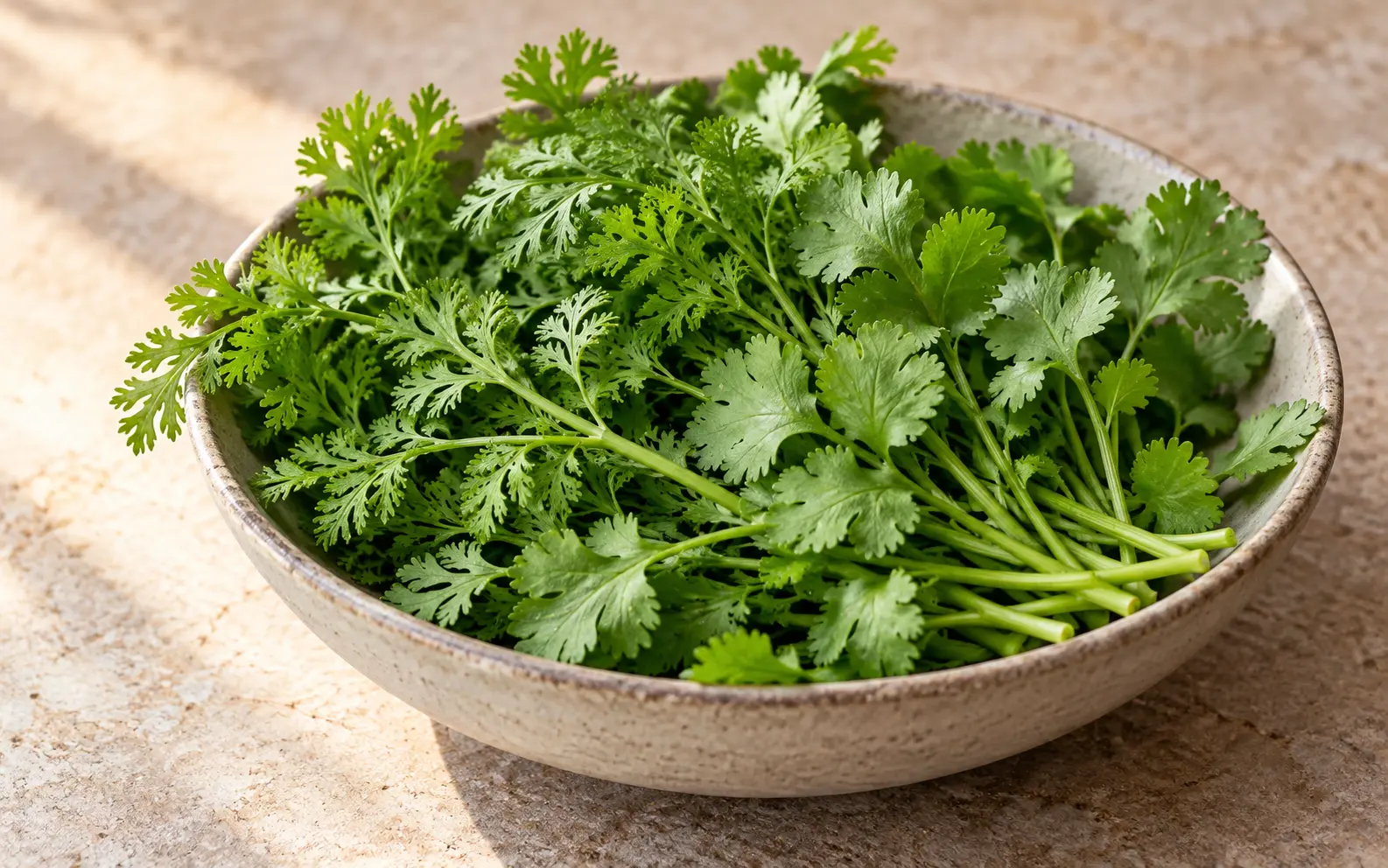
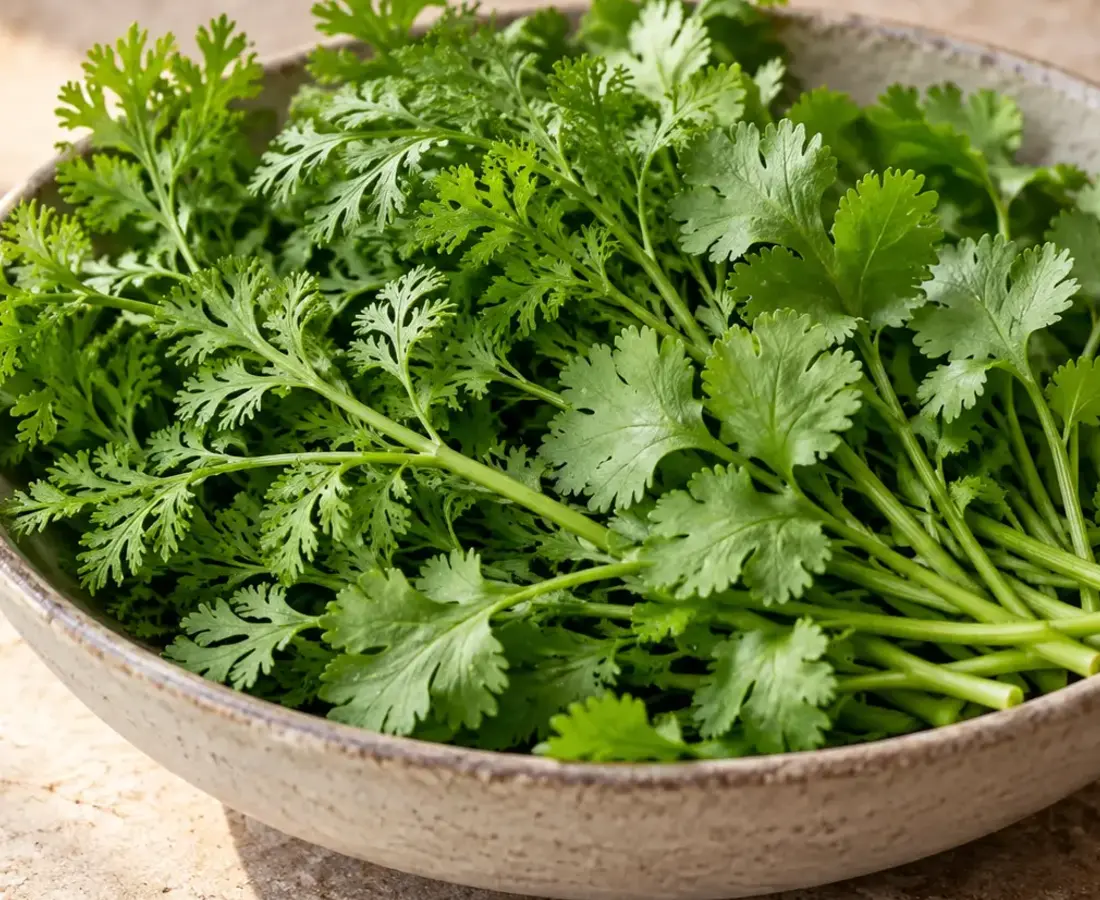
Editorial boundary: These AI-generated orientation images must not be used to identify wild foods, judge edibility, prove safe preparation, or diagnose spoilage. The verified safety-image panel and written guidance control where present.
Book readiness · Rewrite 02
Cilantro or coriander leaves, raw. Scientific identity: Coriandrum sativum L.; the source record is the fresh leaf form. Edible part: Fresh leaves and tender petioles. Exact source form: Coriander (cilantro) leaves, raw, corresponding to USDA FoodData Central FDC 169997.
Question: Are coriander seed and cilantro leaf different plants, and should someone who dislikes one expect the same flavor from the other?
Repeated experience: Many people who find cilantro leaves soapy report enjoying coriander seeds, while some dislike both; cooks also note regional naming differences that cause recipe confusion.
University extension identifies both as Coriandrum sativum: the leaves are commonly called cilantro or Chinese parsley, while the mature seeds are the spice coriander.
They are different culinary parts of the same species, not interchangeable forms. Shared identity does not require identical flavor perception or recipe use.
Exclude or qualify: Do not merge this chapter with: Dry coriander seed, ground coriander, roots, dried leaves, essential oil, extracts, supplements, sauces, and finished foods. Remove or qualify medical-treatment, universal-safety, cross-species, cross-part, cross-product, and cross-preparation claims unless an exact source is reviewed for that wording.
| Layer | Disposition | Sources |
|---|---|---|
| Identity And Form | supported for bounded scope | [1] [2] [3] |
| Human Experience | experience documented not generalized | [4] |
| Authoritative Control | supported control | [2] |
| Supported Conclusion | supported with stated limits | [4] [2] |
| Safety And Limitations | required boundary | [1] [2] [3] |
Review status: This controlled rewrite uses the adjudicated identity, food-form, human-experience, authoritative-control, conclusion, and safety fields. It replaces broader legacy prose for this chapter layer but does not constitute final specialist or publication approval.
Final gate · Approval 02
Status: Approved for book assembly with required safety box
Approved for informational book assembly only with the authoritative safety-and-limitations box retained beside the chapter text.
Specialist-review flags: None
Safety-box triggers: essential oil
Review scope: Final source-completeness, structure, exclusion, and risk-triage review for book assembly. This is not a claim that an external specialist reviewed the chapter.
Book placement · Volume 2
Chapter 20 in The Food Glossary: Evidence Edition — Volume 2. The authoritative safety box is mandatory in every edition.
Corrected USDA food/form panel · other claims unreviewed
raw coriander/cilantro leaves; not seeds. Other chapter claims unverified. The earlier mismatched or broader nutrient assignment is not used here. This panel describes only the named food and preparation, not every food sold under the glossary heading. A nutrient record does not establish raw-consumption safety.
This record is coriander or cilantro leaves, raw. Coriander seed, dried leaf, ground spice, chutney, sauce, and prepared dishes are different plant parts or products and need separate records.
USDA FoodData Central: cilantro leaves, raw · FDA: produce safety
| Energy | 23 kcal |
|---|---|
| Protein | 2.13 g |
| Fat | 0.52 g |
| Carbohydrate | 3.67 g |
| Fiber | 2.8 g |
| Total sugars | 0.87 g |
| Potassium | 521 mg |
USDA FoodData Central FDC 169997 · SR Legacy (final release, April 2018). Values describe only this named form, not all products or varieties.
Human experience evidence · Batch 08
Question: Are coriander seed and cilantro leaf different plants, and should someone who dislikes one expect the same flavor from the other?
Many people who find cilantro leaves soapy report enjoying coriander seeds, while some dislike both; cooks also note regional naming differences that cause recipe confusion.
University extension identifies both as Coriandrum sativum: the leaves are commonly called cilantro or Chinese parsley, while the mature seeds are the spice coriander.
They are different culinary parts of the same species, not interchangeable forms. Shared identity does not require identical flavor perception or recipe use.
Label every record by plant part and form—fresh leaf, dried leaf, whole seed or ground seed—and cross-link rather than merge their preparation guidance.
Reddit Cooking
Finding: Many users report disliking cilantro leaves while enjoying coriander seeds, though a minority perceive an unpleasant note in both forms.
Supported conclusion: Shows that flavor response must be recorded by plant part and form.
Limitations: Preference reports do not establish species identity or predict allergy.
Evidence strength: Repeated form-specific signal
Safety/current gate: No
University of Wisconsin Horticulture Extension
Finding: Extension identifies Coriandrum sativum as one plant: the leaves are the herb cilantro or Chinese parsley and the seeds are the spice coriander.
Supported conclusion: Resolves the identity while preserving different culinary forms.
Limitations: Shared species does not mean the leaf and seed have identical flavor, use or allergen exposure.
Evidence strength: University extension control
Safety/current gate: No
These 8 links are organized by a matching whole-food name. Prepared products and ingredients have separate composition profiles. Confirm the identity and form on each page; a similar name alone is not proof.
Nutrition for raw coriander/cilantro leaves; not seeds. USDA record: Coriander (cilantro) leaves, raw.
| Nutrient | Amount |
|---|---|
| Energy | 23 kcal |
| Protein | 2.13 g |
| Fat | 0.52 g |
| Carbohydrate | 3.67 g |
| Fiber | 2.8 g |
| Calcium | 67 mg |
| Iron | 1.77 mg |
| Magnesium | 26 mg |
| Phosphorus | 48 mg |
| Potassium | 521 mg |
| Sodium | 46 mg |
| Zinc | 0.5 mg |
| Vitamin A, RAE | 337 µg |
| Vitamin C | 27 mg |
| Folate, total | 62 µg |
USDA FoodData Central FDC 169997, SR Legacy (April 2018).
Identity, preparation safety, growing, preservation, and health claims are not yet approved. No field-use or canning guidance is established here.