Repeated human experience
Fruit users repeatedly identify the same fruit under several regional names and describe hard, latex-rich, astringent fruit as underripe, while ripe fruit softens and tastes sweet and malty.
Book readiness · Identity 07
Book readiness · Publication 02
Visual orientation
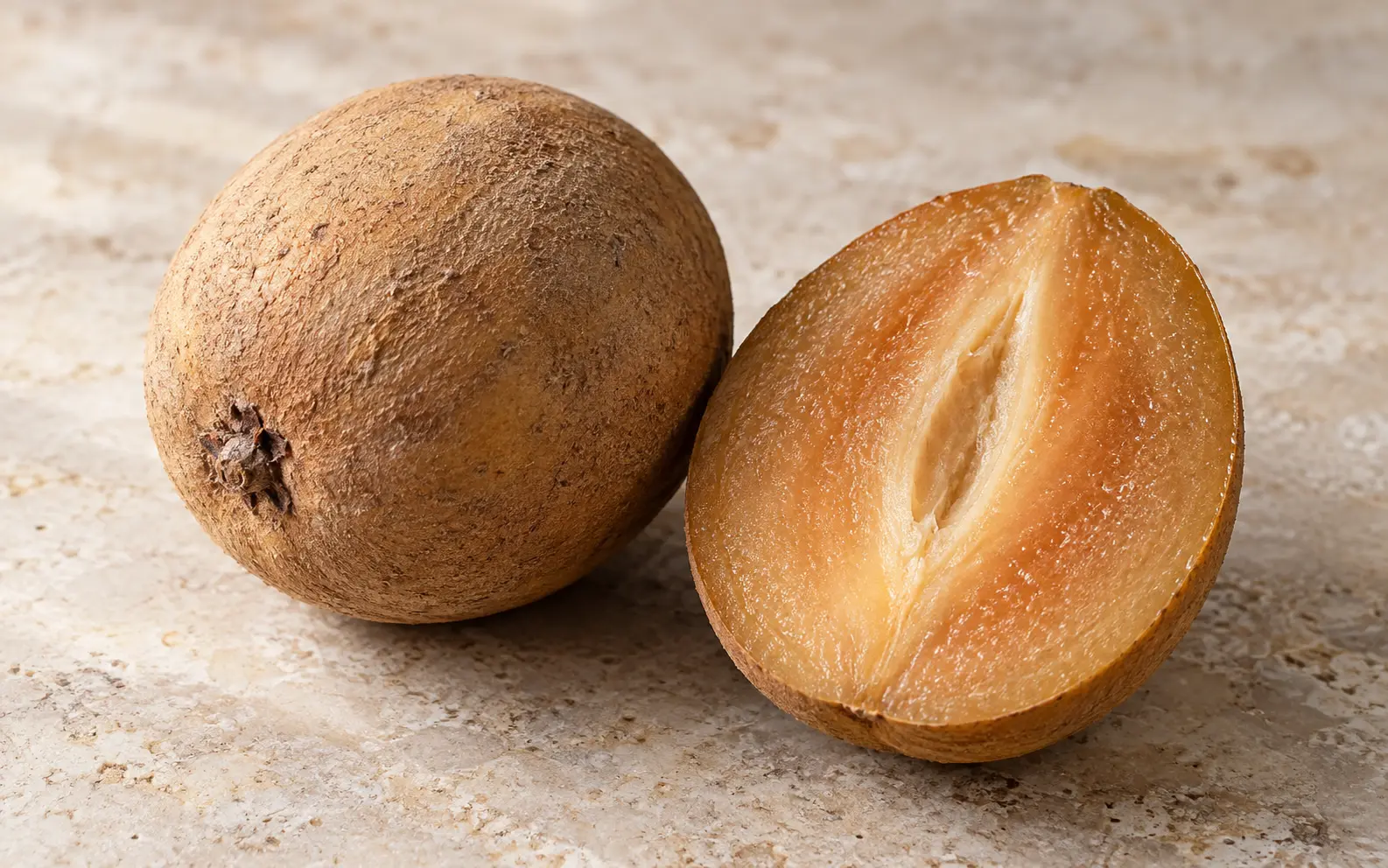
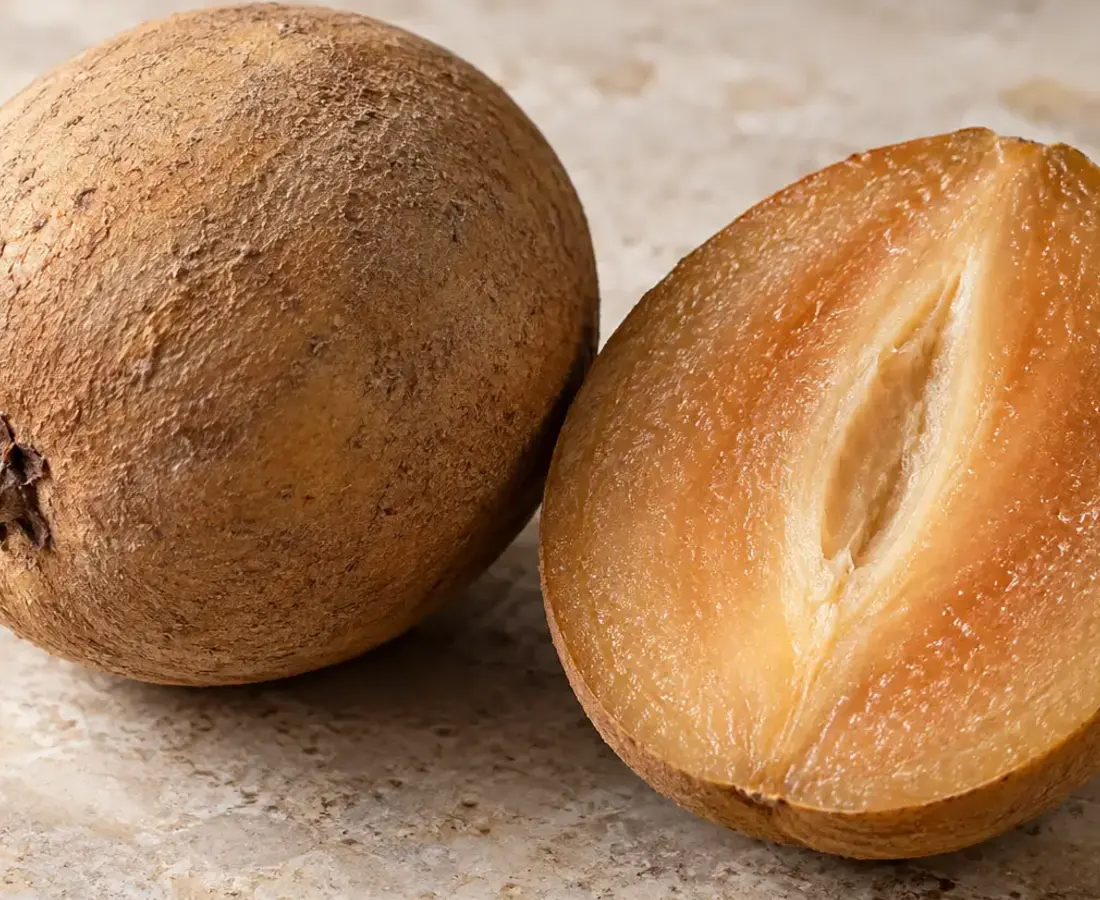
Editorial boundary: These AI-generated orientation images must not be used to identify wild foods, judge edibility, prove safe preparation, or diagnose spoilage. The verified safety-image panel and written guidance control where present.
Book readiness · Rewrite 02
Sapodilla or chico fruit, raw. Scientific identity: Manilkara zapota (L.) P.Royen. Edible part: Ripe fruit flesh; skin, latex, seeds, leaves, bark, and roots are excluded. Exact source form: Sapodilla, raw, corresponding to USDA FoodData Central FDC 167759.
Question: Are chico, chikoo and sapodilla the same fruit, and how can ripeness be recognized?
Repeated experience: Fruit users repeatedly identify the same fruit under several regional names and describe hard, latex-rich, astringent fruit as underripe, while ripe fruit softens and tastes sweet and malty.
University of Florida Extension identifies Manilkara zapota as sapodilla and notes that immature fruit may fail to soften, lack sweetness and contain pockets of coagulated latex.
Common names such as sapote can refer to unrelated fruits. Softness helps with maturity but does not replace species identification or rejection of fermented, damaged or spoiled fruit.
Exclude or qualify: Do not merge this chapter with: Mamey sapote, black or white sapote, unripe fruit, seeds, juice, puree, preserves, latex, extracts, supplements, and finished foods. Remove or qualify medical-treatment, universal-safety, cross-species, cross-part, cross-product, and cross-preparation claims unless an exact source is reviewed for that wording.
| Layer | Disposition | Sources |
|---|---|---|
| Identity And Form | supported for bounded scope | [1] [2] [3] |
| Human Experience | experience documented not generalized | [4] |
| Authoritative Control | supported control | [2] |
| Supported Conclusion | supported with stated limits | [4] [2] |
| Safety And Limitations | required boundary | [1] [2] [3] |
Review status: This controlled rewrite uses the adjudicated identity, food-form, human-experience, authoritative-control, conclusion, and safety fields. It replaces broader legacy prose for this chapter layer but does not constitute final specialist or publication approval.
Final gate · Approval 02
Status: Approved for informational book assembly
Approved for informational book assembly with its claim-to-source map retained.
Specialist-review flags: None
Safety-box triggers: No additional trigger
Review scope: Final source-completeness, structure, exclusion, and risk-triage review for book assembly. This is not a claim that an external specialist reviewed the chapter.
Book placement · Volume 2
Chapter 11 in The Food Glossary: Evidence Edition — Volume 2. Standard controlled chapter format.
Corrected USDA food/form panel · other claims unreviewed
raw sapodilla (chico) fruit. Other chapter claims unverified. The earlier mismatched or broader nutrient assignment is not used here. This panel describes only the named food and preparation, not every food sold under the glossary heading. A nutrient record does not establish raw-consumption safety.
The source identifies raw sapodilla fruit, also called chico. Juice, dried fruit, preserves, flavored products, and the seed are different forms and should not inherit this panel.
USDA FoodData Central: stated form · FDA: produce safety
| Energy | 83 kcal |
|---|---|
| Protein | 0.44 g |
| Fat | 1.1 g |
| Carbohydrate | 20 g |
| Fiber | 5.3 g |
| Potassium | 193 mg |
USDA FoodData Central FDC 167759 · SR Legacy (final release, April 2018). Values describe only this named form, not all products or varieties.
Human experience evidence · Batch 07
Question: Are chico, chikoo and sapodilla the same fruit, and how can ripeness be recognized?
Fruit users repeatedly identify the same fruit under several regional names and describe hard, latex-rich, astringent fruit as underripe, while ripe fruit softens and tastes sweet and malty.
University of Florida Extension identifies Manilkara zapota as sapodilla and notes that immature fruit may fail to soften, lack sweetness and contain pockets of coagulated latex.
Common names such as sapote can refer to unrelated fruits. Softness helps with maturity but does not replace species identification or rejection of fermented, damaged or spoiled fruit.
Retitle as Sapodilla (Chico/Chikoo), require Manilkara zapota, describe maturity and remove the hard glossy seeds before eating or blending.
Reddit Fruit
Finding: Users identify chico, chikoo and sapodilla as regional names and associate hard texture, latex and mouth-drying astringency with fruit picked too early.
Supported conclusion: Replicates the name and maturity confusion.
Limitations: Crowd identification and ripeness judgments cannot validate an unknown fruit.
Evidence strength: Repeated identity signal
Safety/current gate: Yes
University of Florida IFAS
Finding: Extension identifies sapodilla as Manilkara zapota and notes that immature fruit may not soften, may lack optimum sweetness and may contain coagulated latex pockets.
Supported conclusion: Anchors the glossary identity and maturity explanation.
Limitations: Common-name identification still matters because other sapotes are different species.
Evidence strength: University extension control
Safety/current gate: Yes
Nutrition for raw sapodilla (chico) fruit. USDA record: Sapodilla, raw.
| Nutrient | Amount |
|---|---|
| Energy | 83 kcal |
| Protein | 0.44 g |
| Fat | 1.1 g |
| Carbohydrate | 20 g |
| Fiber | 5.3 g |
| Calcium | 21 mg |
| Iron | 0.8 mg |
| Magnesium | 12 mg |
| Phosphorus | 12 mg |
| Potassium | 193 mg |
| Sodium | 12 mg |
| Zinc | 0.1 mg |
| Vitamin A, RAE | 3 µg |
| Vitamin C | 14.7 mg |
| Folate, total | 14 µg |
USDA FoodData Central FDC 167759, SR Legacy (April 2018).
Chico is interpreted here as sapodilla (Manilkara zapota); this identity is supported by UF/IFAS Extension. https://edis.ifas.ufl.edu/pdffiles/MG/MG05700.pdf
Identity, preparation safety, growing, preservation, and health claims are not yet approved. No field-use or canning guidance is established here.