Repeated human experience
People repeatedly report prolonged hand and eye burning after handling hot peppers and often find plain water less satisfying than dairy or oil-based approaches.
Book readiness · Identity 07
Book readiness · Publication 02
Visual orientation
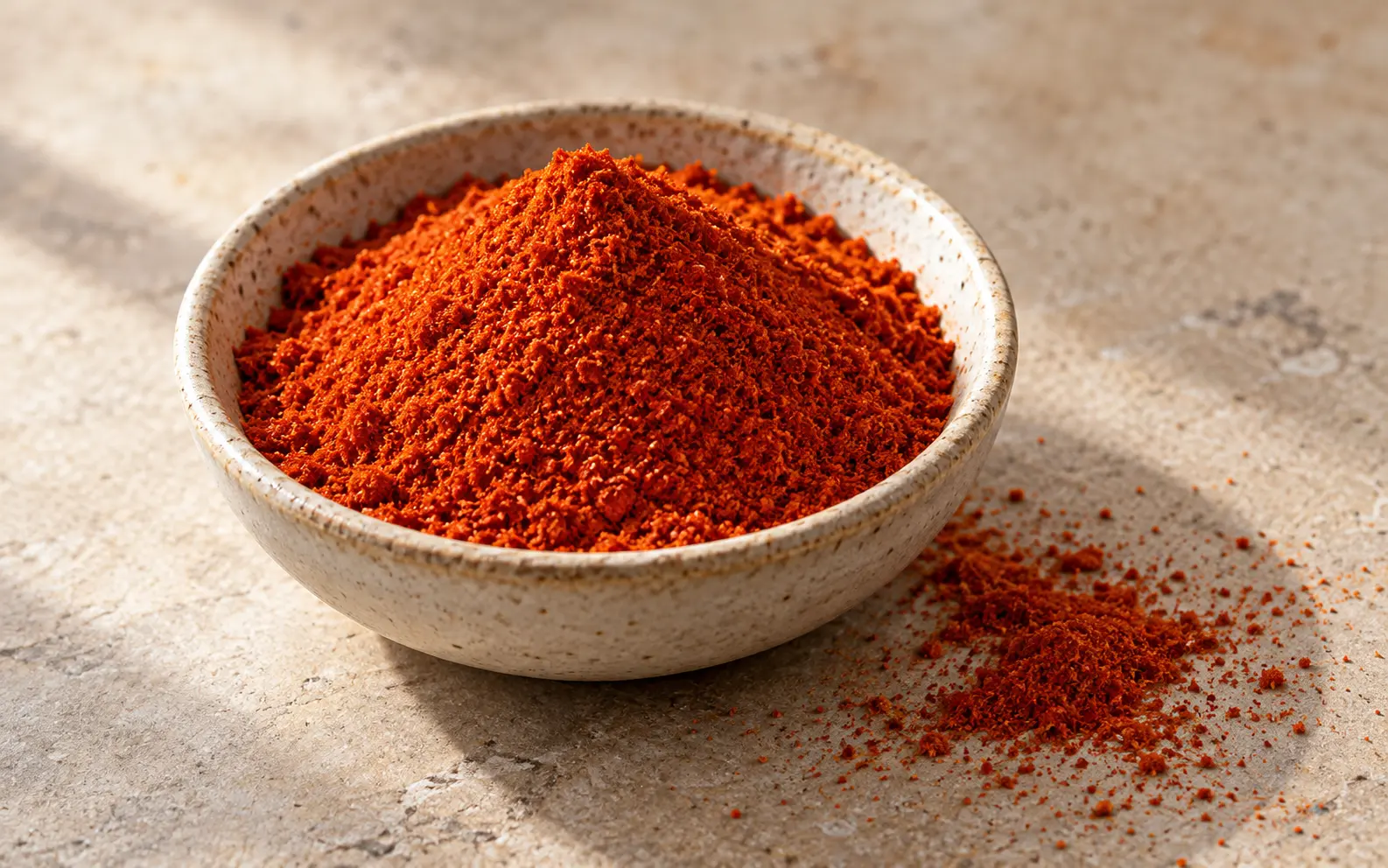
Editorial boundary: These AI-generated orientation images must not be used to identify wild foods, judge edibility, prove safe preparation, or diagnose spoilage. The verified safety-image panel and written guidance control where present.
Book readiness · Rewrite 02
Ground red or cayenne pepper spice. Scientific identity: Capsicum species, commonly C. annuum L. or C. frutescens L.; the generic USDA spice record does not resolve cultivar or species. Edible part: Dried ground pungent fruit with variable seed content. Exact source form: Spices, pepper, red or cayenne, corresponding to USDA FoodData Central FDC 170932.
Question: Why does cayenne burn the mouth, skin or eyes, and what actually helps?
Repeated experience: People repeatedly report prolonged hand and eye burning after handling hot peppers and often find plain water less satisfying than dairy or oil-based approaches.
Poison Control identifies capsaicin as the irritant, recommends small sips of milk or water for oral burning, copious warm-water eye irrigation for 15 minutes and decontamination guidance for skin exposure.
Culinary heat is a nerve response to capsaicin, but concentrated exposures can cause more serious symptoms. Cayenne powder, fresh peppers and extracts are not equivalent doses.
Exclude or qualify: Do not merge this chapter with: Fresh cayenne pods, paprika, crushed flakes, chili-powder blends, hot sauce, capsaicin creams, oleoresin, extracts, supplements, and finished foods. Remove or qualify medical-treatment, universal-safety, cross-species, cross-part, cross-product, and cross-preparation claims unless an exact source is reviewed for that wording.
| Layer | Disposition | Sources |
|---|---|---|
| Identity And Form | supported for bounded scope | [1] [2] [3] |
| Human Experience | experience documented not generalized | [4] |
| Authoritative Control | supported control | [3] |
| Supported Conclusion | supported with stated limits | [4] [3] |
| Safety And Limitations | required boundary | [1] [2] [3] |
Review status: This controlled rewrite uses the adjudicated identity, food-form, human-experience, authoritative-control, conclusion, and safety fields. It replaces broader legacy prose for this chapter layer but does not constitute final specialist or publication approval.
Final gate · Approval 01
Status: Approved for book assembly with required safety box
Approved for informational book assembly only with the authoritative safety-and-limitations box retained beside the chapter text.
Specialist-review flags: None
Safety-box triggers: concentrat, irritat, poison
Review scope: Final source-completeness, structure, exclusion, and risk-triage review for book assembly. This is not a claim that an external specialist reviewed the chapter.
Book placement · Volume 2
Chapter 4 in The Food Glossary: Evidence Edition — Volume 2. The authoritative safety box is mandatory in every edition.
Corrected USDA food/form panel · other claims unreviewed
dried red/cayenne pepper spice. Other chapter claims unverified. The earlier mismatched or broader nutrient assignment is not used here. This panel describes only the named food and preparation, not every food sold under the glossary heading. A nutrient record does not establish raw-consumption safety.
The source is dried ground red or cayenne pepper used as a spice. Fresh chile fruit, flakes, hot sauce, seasoning blends, and prepared dishes differ in moisture and ingredients and should remain separate.
USDA FoodData Central: red or cayenne pepper spice
| Energy | 318 kcal |
|---|---|
| Protein | 12 g |
| Fat | 17.3 g |
| Carbohydrate | 56.6 g |
| Fiber | 27.2 g |
| Total sugars | 10.3 g |
| Potassium | 2010 mg |
USDA FoodData Central FDC 170932 · SR Legacy (final release, April 2018). Values describe only this named form, not all products or varieties.
Human experience evidence · Batch 07
Question: Why does cayenne burn the mouth, skin or eyes, and what actually helps?
People repeatedly report prolonged hand and eye burning after handling hot peppers and often find plain water less satisfying than dairy or oil-based approaches.
Poison Control identifies capsaicin as the irritant, recommends small sips of milk or water for oral burning, copious warm-water eye irrigation for 15 minutes and decontamination guidance for skin exposure.
Culinary heat is a nerve response to capsaicin, but concentrated exposures can cause more serious symptoms. Cayenne powder, fresh peppers and extracts are not equivalent doses.
Separate culinary use from exposure first aid; include glove, eye-contact and concentrated-product warnings without therapeutic claims.
Reddit Cooking
Finding: Cooks report prolonged burning after cutting peppers without gloves or touching the eyes and frequently switch to gloves after a painful episode.
Supported conclusion: Replicates the handling hazard in ordinary kitchens.
Limitations: Pepper type, capsaicin dose and home remedies are uncontrolled.
Evidence strength: Repeated exposure signal
Safety/current gate: Yes
National Capital Poison Center
Finding: Poison Control recommends small sips of milk or water for oral burning, 15 minutes of copious warm-water eye irrigation and specific skin decontamination measures.
Supported conclusion: Provides symptom-based first aid and escalation context.
Limitations: Guidance for exposure does not turn cayenne into a treatment and concentrated products can cause more serious effects.
Evidence strength: Clinical poison-control guidance
Safety/current gate: Yes
These 1 links are organized by a matching whole-food name. Prepared products and ingredients have separate composition profiles. Confirm the identity and form on each page; a similar name alone is not proof.
Nutrition for dried red/cayenne pepper spice. USDA record: Spices, pepper, red or cayenne.
| Nutrient | Amount |
|---|---|
| Energy | 318 kcal |
| Protein | 12 g |
| Fat | 17.3 g |
| Carbohydrate | 56.6 g |
| Fiber | 27.2 g |
| Calcium | 148 mg |
| Iron | 7.8 mg |
| Magnesium | 152 mg |
| Phosphorus | 293 mg |
| Potassium | 2010 mg |
| Sodium | 30 mg |
| Zinc | 2.48 mg |
| Vitamin A, RAE | 2080 µg |
| Vitamin C | 76.4 mg |
| Folate, total | 106 µg |
USDA FoodData Central FDC 170932, SR Legacy (April 2018).
Identity, preparation safety, growing, preservation, and health claims are not yet approved. No field-use or canning guidance is established here.