Repeated human experience
Home cooks commonly soak cashews to make sauces and report leaving them at room temperature overnight, often judging safety only by smell or bubbles.
Book readiness · Identity 03
Book readiness · Publication 02
Visual orientation
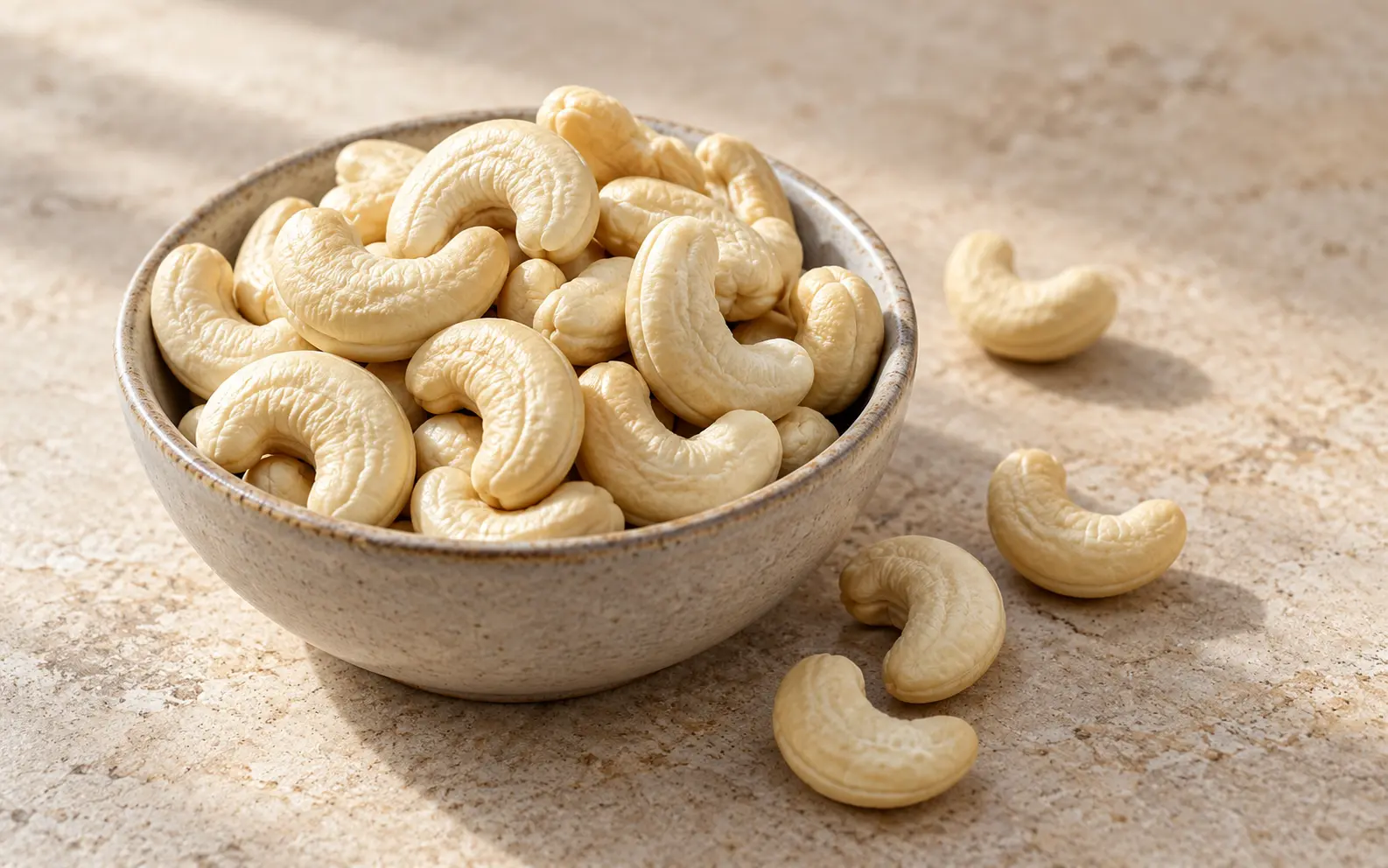
Editorial boundary: These AI-generated orientation images must not be used to identify wild foods, judge edibility, prove safe preparation, or diagnose spoilage. The verified safety-image panel and written guidance control where present.
Book readiness · Rewrite 02
Cashew kernels sold as raw. Scientific identity: Anacardium occidentale L. Edible part: Kernel removed from the shell; apple, shell, and shell liquid are excluded. Exact source form: Nuts, cashew nuts, raw, corresponding to USDA FoodData Central FDC 170162.
Question: Are raw cashews truly raw, and is overnight room-temperature soaking safe?
Repeated experience: Home cooks commonly soak cashews to make sauces and report leaving them at room temperature overnight, often judging safety only by smell or bubbles.
FDA notes caustic liquid in cashew shells, while food-safety research summarized by Oregon State found Salmonella can multiply during room-temperature soaking of cashews and other nuts; refrigeration reduced growth.
Retail kernels have already undergone shell-removal processing, but soaking adds water and can change microbial risk. Absence of off odor does not prove safety.
Exclude or qualify: Do not merge this chapter with: Roasted or salted kernels, cashew apple, shell, shell oil, butter, milk, flour, cheese alternatives, and finished foods. Remove or qualify medical-treatment, universal-safety, cross-species, cross-part, cross-product, and cross-preparation claims unless an exact source is reviewed for that wording.
| Layer | Disposition | Sources |
|---|---|---|
| Identity And Form | supported for bounded scope | [1] [2] [3] |
| Human Experience | experience documented not generalized | [4] |
| Authoritative Control | supported control | [5] |
| Supported Conclusion | supported with stated limits | [4] [5] |
| Safety And Limitations | required boundary | [1] [2] [3] [5] |
Review status: This controlled rewrite uses the adjudicated identity, food-form, human-experience, authoritative-control, conclusion, and safety fields. It replaces broader legacy prose for this chapter layer but does not constitute final specialist or publication approval.
Verified human-taken photographs
These cleared reference photographs support the written safety guidance. They do not prove that a wild specimen is edible, that a preparation is safe, or that spoiled food can be rescued.
Preparation reference
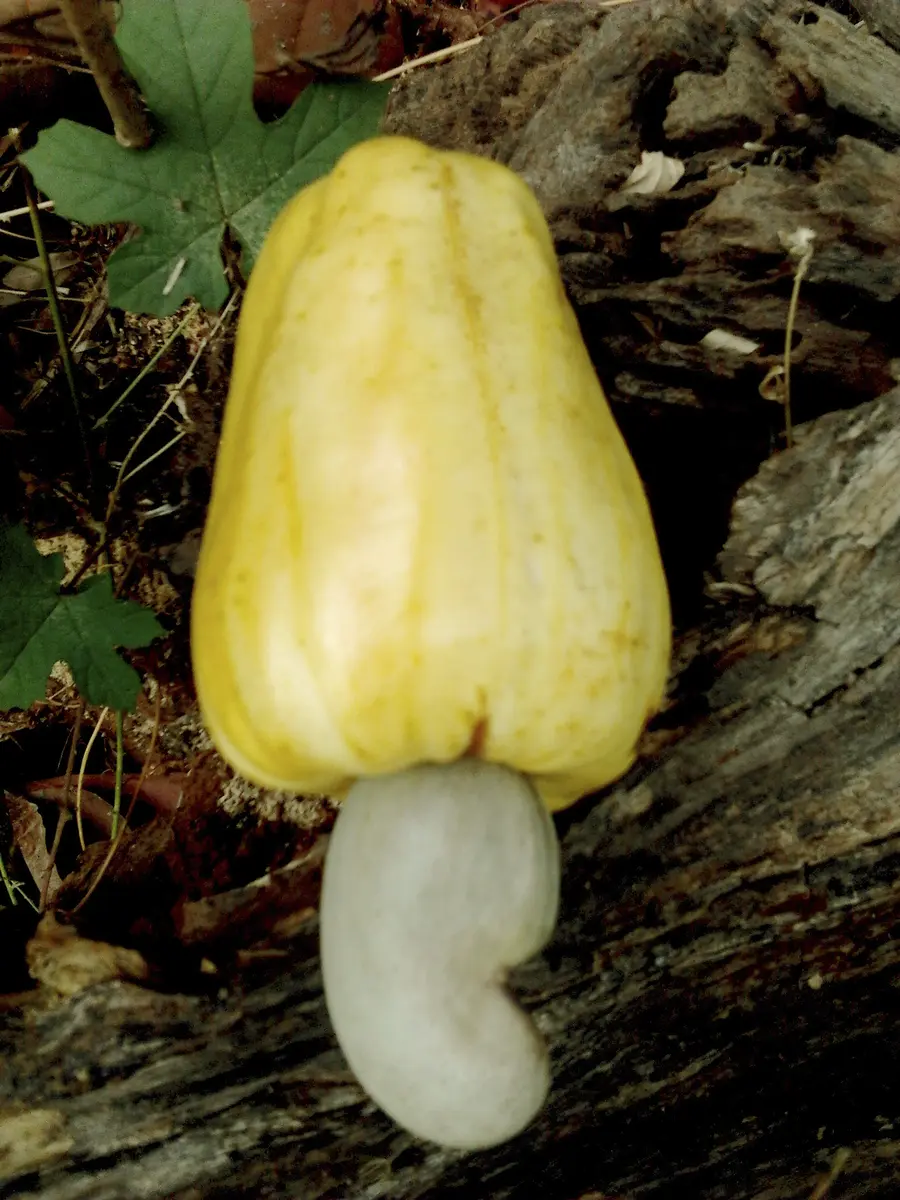
Use boundary: Use with the written safety instruction; the photograph does not prove safe preparation or toxin removal.
Final gate · Approval 01
Status: Approved for book assembly with required safety box
Approved for informational book assembly only with the authoritative safety-and-limitations box retained beside the chapter text.
Specialist-review flags: None
Safety-box triggers: allerg, kernel, raw, refrigerat, toxic
Review scope: Final source-completeness, structure, exclusion, and risk-triage review for book assembly. This is not a claim that an external specialist reviewed the chapter.
Book placement · Volume 2
Chapter 2 in The Food Glossary: Evidence Edition — Volume 2. The authoritative safety box is mandatory in every edition.
Named raw-form example · full chapter unreviewed
The broad glossary heading may cover more than one variety or preparation. This is a separate USDA raw-form example, not a nutrient value for every version of the food. A nutrient record is not evidence that a plant or part is safe to eat raw. Identity, edible part, and safe preparation still require their own sources.
This source describes cashew nuts as raw. Roasted, salted, and cashew-butter products need their own records. Cashew is a tree nut allergen; check the ingredient label for a specific product.
USDA FoodData Central: stated form · FDA: food allergens
| Energy | 553 kcal |
|---|---|
| Protein | 18.2 g |
| Fat | 43.8 g |
| Carbohydrate | 30.2 g |
| Fiber | 3.3 g |
| Total sugars | 5.91 g |
| Potassium | 660 mg |
USDA FoodData Central FDC 170162 · SR Legacy (final release, April 2018). Values describe only this named form, not all products or varieties.
Human experience evidence · Batch 07
Question: Are raw cashews truly raw, and is overnight room-temperature soaking safe?
Home cooks commonly soak cashews to make sauces and report leaving them at room temperature overnight, often judging safety only by smell or bubbles.
FDA notes caustic liquid in cashew shells, while food-safety research summarized by Oregon State found Salmonella can multiply during room-temperature soaking of cashews and other nuts; refrigeration reduced growth.
Retail kernels have already undergone shell-removal processing, but soaking adds water and can change microbial risk. Absence of off odor does not prove safety.
Describe retail raw cashews as unroasted rather than shell-raw; soak under refrigeration, use clean water and retain the standard tree-nut allergy warning.
Reddit Cooking
Finding: Users commonly report room-temperature soaking and judge the result by smell, bubbles or prior personal success before blending cashews into sauce.
Supported conclusion: Shows a repeated practice that needs a microbial control.
Limitations: Anecdotes cannot detect pathogens and successful past use does not establish safety.
Evidence strength: Risk-practice signal
Safety/current gate: Yes
Oregon State University Extension
Finding: In controlled work, Salmonella populations increased significantly during 24-hour room-temperature soaking of cashews and several other nuts; refrigeration and salt reduced growth.
Supported conclusion: Directly challenges casual counter-soaking advice.
Limitations: The inoculated study does not estimate illness probability for every retail package or validate home salt recipes.
Evidence strength: Controlled food-safety evidence
Safety/current gate: Yes
These 10 links are organized by a matching whole-food name. Prepared products and ingredients have separate composition profiles. Confirm the identity and form on each page; a similar name alone is not proof.
Generated: 2026-09-26T10:53:52.969664+00:00
Status: starter_book_research
Cashew is the common name of a tropical evergreen tree Anacardium occidentale, in the family Anacardiaceae. It is the source of the cashew nut and the cashew apple. The tree can grow as tall as 14 meters.
Survival/category tags: fruit/foraged or cultivated edible
USDA FoodData Central match: null
Collect crop-specific growing instructions from Extension/agronomy sources: climate, soil, sunlight, propagation, planting, harvest stage, and common pests/diseases.
Needed for final book: climate range, soil, sunlight, water, propagation, planting spacing, harvest signs, common pests, container/garden/wild context.
Document edible parts, best harvest stage, field identification traits, and whether it is commonly wild-foraged, cultivated, or both.
Survival note: positive identification is mandatory for wild foods; include local lookalikes and preparation requirements before recommending field use.
Collect culinary instructions: edible parts, raw vs cooked use, basic preparation, common traditional dishes, and safe cooking notes.
Needed for final book: raw/cooked safety, basic prep, boiling/roasting/frying/drying/powdering, traditional uses, emergency/survival meal applications.
Collect preservation instructions: fresh storage, drying/dehydration, freezing, pickling/fermenting, canning where safe, and shelf-life cautions.
Book preservation checklist to fill per food:
Collect pairings, preservation interactions, acid/salt/sugar/oil effects, culinary transformations, and foods this helps preserve or tenderize/flavor.
For survival/nature use: never eat wild lookalikes without positive identification; document toxic lookalikes, contraindications, allergies, and preparation requirements.
{
  "wiki": {
    "query": "Cashews",
    "title": "Cashew",
    "extract": "Cashew is the common name of a tropical evergreen tree Anacardium occidentale, in the family Anacardiaceae. It is the source of the cashew nut and the cashew apple. The tree can grow as tall as 14 meters.",
    "url": "https://en.wikipedia.org/wiki/Cashew",
    "source": "Wikipedia summary API"
  },
  "fdc": {
    "query": "Cashews raw",
    "error": "HTTPError: HTTP Error 429: Too Many Requests"
  },
  "generic_sources": [
    {
      "id": "nchfp_home_preservation",
      "title": "National Center for Home Food Preservation",
      "url": "https://nchfp.uga.edu/",
      "publisher": "University of Georgia / USDA-supported NCHFP",
      "use": "safe canning, freezing, drying, pickling, fermentation principles"
    },
    {
      "id": "usda_complete_guide_canning",
      "title": "USDA Complete Guide to Home Canning",
      "url": "https://www.nifa.usda.gov/about-nifa/blogs/usdas-complete-guide-home-canning",
      "publisher": "USDA/NIFA",
      "use": "pressure canning and water-bath canning safety"
    },
    {
      "id": "extension_food_safety",
      "title": "Extension food preservation resources",
      "url": "https://extension.umn.edu/preserving-and-preparing",
      "publisher": "University Extension",
      "use": "practical preservation and storage safety cross-check"
    },
    {
      "id": "poisonous_plants_general",
      "title": "Poisonous plant / wild food caution principle",
      "url": "https://www.fs.usda.gov/wildflowers/ethnobotany/edible.shtml",
      "publisher": "USDA Forest Service",
      "use": "wild edible plants require positive identification and local expert caution"
    }
  ]
}Reviewed in 20-food milestone batch 006 on 2026-09-26.
Checkpoint status:
Batch source reminders:
Milestone batch 006; row-order item 108/220; checked 2026-09-26.
Completion date: 2026-09-26T16:56:24.508435+00:00
Completion status: v1_complete_draft_needs_source_deepening
Food type: general_food_entry
Cashew is the common name of a tropical evergreen tree Anacardium occidentale, in the family Anacardiaceae. It is the source of the cashew nut and the cashew apple. The tree can grow as tall as 14 meters.
Survival/category tags: fruit/foraged or cultivated edible
Collect climate, sunlight, soil, water, propagation, planting/spacing, harvest signs, and common pests/diseases from Extension/agricultural sources.
For survival use, document whether it is wild, cultivated, or naturalized; which parts are edible; harvest season; preparation requirements; and dangerous lookalikes. Do not recommend wild eating without positive identification.
Document raw/cooked safety, cleaning, cutting, boiling/roasting/frying/steaming/drying/powdering, common dishes, and emergency low-tool preparation methods.
Document fresh storage, freezing, drying/dehydration, pickling/fermentation, canning suitability, salt/sugar/oil/vinegar methods, shelf-life, and spoilage signs. Use tested canning sources for shelf-stable methods.
Document how Cashews interacts with other foods: acidity, sweetness, starch, oil, salt, aromatics, thickening, fermentation, tenderizing, preservation support, flavor pairing, and texture changes through heat/drying/freezing.
Document allergies, toxic lookalikes, unsafe raw forms, drug/condition cautions, and preservation risks such as botulism in low-acid canning or fresh herbs/garlic in oil.
Completed v1 packaging: 2026-09-28T05:04:32.703969+00:00
Status: book_entry_v1_complete_source_scaffolded
This chapter is finished as a Food Glossary v1 research/wiki entry. Before print publication or survival advice use, perform final editorial review for wording, citations, local identification, toxic lookalikes, and tested preservation/canning details. Do not add uncited cure claims.
Finalized: 2026-09-28T16:17:47.337022+00:00
Status: `final_v2_food_entry_with_nutrition_source_scaffolded`
Scope: natural/growable food library; animal farming/meat/dairy/eggs/fish intentionally excluded.
Source stream: original Food Glossary short list
Category: unknown
Nutrition status: accepted USDA/local nutrition table present
This entry is included in the completed v2 wiki/book scaffold. Before print/public survival guidance, verify exact identity, edible parts, toxic lookalikes, contraindications, and preservation safety from authoritative sources.
Reviewed: 2026-09-29T00:42:22.143212+00:00
Review status: `deep_review_batch003_public_source_targets`
Scientific/identity target: Exact scientific name pending taxonomy verification; use GBIF/WFO/CABI/PFAF/Extension source during final editorial pass.
This entry now has public expert source targets for nutrition, growing/cultivation, edible parts, cooking/preparation, preservation/storage, taxonomy, and cautions/lookalikes where relevant. These are preserved for the book review workflow. Final publication still requires claim-by-claim verification against the exact pages and any local/regional safety rules.