Repeated human experience
First-time cooks repeatedly describe discarding most of the bud, scraping tender flesh from bract bases and removing the hairy center before eating the heart.
Book readiness · Identity 07
Book readiness · Publication 01
Visual orientation
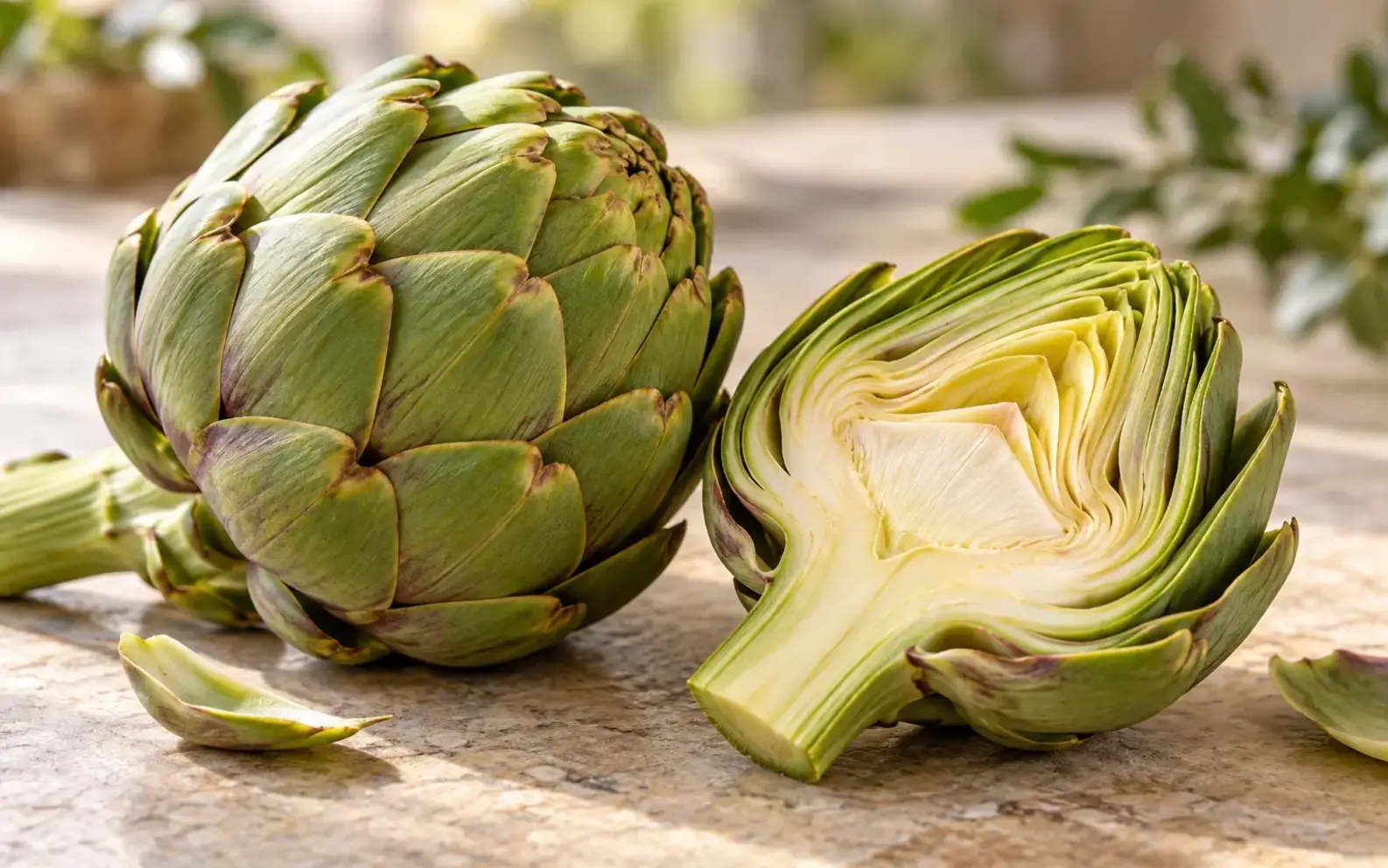
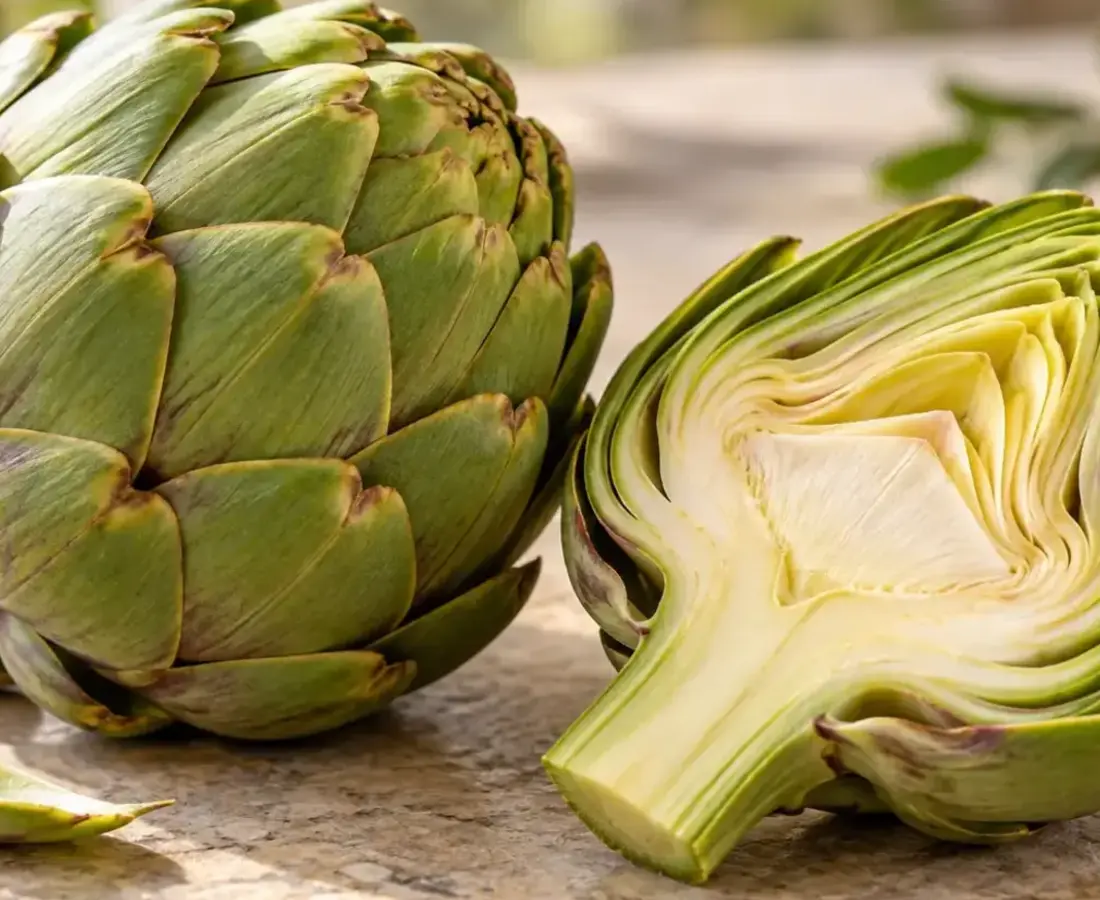
Editorial boundary: These AI-generated orientation images must not be used to identify wild foods, judge edibility, prove safe preparation, or diagnose spoilage. The verified safety-image panel and written guidance control where present.
Book readiness · Rewrite 01
Globe artichoke, raw. Scientific identity: Cynara cardunculus L. Scolymus Group; Cynara scolymus L. is a widely used synonym. Edible part: Fleshy leaf bases, receptacle or heart, and tender stem tissue after removal of inedible choke and fibrous parts. Exact source form: Artichokes (globe or French), raw, corresponding to USDA FoodData Central FDC 169205.
Question: Which parts of a globe artichoke are eaten, and what is the fuzzy choke?
Repeated experience: First-time cooks repeatedly describe discarding most of the bud, scraping tender flesh from bract bases and removing the hairy center before eating the heart.
University extension identifies globe artichoke as an immature flower bud and distinguishes edible bract bases and heart from the fibrous choke, thorns and tough outer material.
The name must mean globe artichoke, not Jerusalem artichoke. Edibility varies by plant part, maturity and preparation.
Exclude or qualify: Do not merge this chapter with: Jerusalem artichoke or sunchoke, cardoon stems, cooked or canned hearts, marinated products, extracts, supplements, and finished dishes. Remove or qualify medical-treatment, universal-safety, cross-species, cross-part, cross-product, and cross-preparation claims unless an exact source is reviewed for that wording.
| Layer | Disposition | Sources |
|---|---|---|
| Identity And Form | supported for bounded scope | [1] [2] [3] |
| Human Experience | experience documented not generalized | [4] |
| Authoritative Control | supported control | [5] |
| Supported Conclusion | supported with stated limits | [4] [5] |
| Safety And Limitations | required boundary | [1] [2] [3] [5] |
Review status: This controlled rewrite uses the adjudicated identity, food-form, human-experience, authoritative-control, conclusion, and safety fields. It replaces broader legacy prose for this chapter layer but does not constitute final specialist or publication approval.
Final gate · Approval 01
Status: Approved for book assembly with required safety box
Approved for informational book assembly only with the authoritative safety-and-limitations box retained beside the chapter text.
Specialist-review flags: None
Safety-box triggers: raw
Review scope: Final source-completeness, structure, exclusion, and risk-triage review for book assembly. This is not a claim that an external specialist reviewed the chapter.
Book placement · Volume 1
Chapter 9 in The Food Glossary: Evidence Edition — Volume 1. The authoritative safety box is mandatory in every edition.
Corrected USDA food/form panel · other claims unreviewed
raw globe/French artichoke; not Jerusalem artichoke. Other chapter claims unverified. The earlier mismatched or broader nutrient assignment is not used here. This panel describes only the named food and preparation, not every food sold under the glossary heading. A nutrient record does not establish raw-consumption safety.
The globe artichoke is harvested as an immature flower bud. The tender bases of its bracts and the fleshy heart are eaten; this differs from Jerusalem artichoke, a different plant grown for its tubers. Harvest a bud before its bracts spread open. The raw globe-artichoke panel is not a value for a marinated heart or dip.
University of California Master Gardener Program: artichokes · UC Marin Master Gardeners: Jerusalem artichoke
| Energy | 47 kcal |
|---|---|
| Protein | 3.27 g |
| Fat | 0.15 g |
| Carbohydrate | 10.5 g |
| Fiber | 5.4 g |
| Total sugars | 0.99 g |
| Potassium | 370 mg |
USDA FoodData Central FDC 169205 · SR Legacy (final release, April 2018). Values describe only this named form, not all products or varieties.
Human experience evidence · Batch 05
Question: Which parts of a globe artichoke are eaten, and what is the fuzzy choke?
First-time cooks repeatedly describe discarding most of the bud, scraping tender flesh from bract bases and removing the hairy center before eating the heart.
University extension identifies globe artichoke as an immature flower bud and distinguishes edible bract bases and heart from the fibrous choke, thorns and tough outer material.
The name must mean globe artichoke, not Jerusalem artichoke. Edibility varies by plant part, maturity and preparation.
Publish a labeled edible-parts guide and keep Cynara cardunculus var. scolymus separate from Jerusalem artichoke.
Reddit AskCulinary
Finding: Cooks repeatedly scrape tender bract bases, discard tough portions and remove the fuzzy choke before eating the heart.
Supported conclusion: Replicates the part-by-part eating pattern.
Limitations: Home methods and maturity vary.
Evidence strength: Repeated culinary signal
Safety/current gate: No
Iowa State University Extension
Finding: Extension guidance distinguishes the edible heart and lower fleshy petal portions from the stringy choke, tough outer petals and thorns.
Supported conclusion: Provides an authoritative anatomical boundary.
Limitations: Baby artichokes and specialized preparations can differ.
Evidence strength: University extension control
Safety/current gate: No
Nutrition for raw globe/French artichoke; not Jerusalem artichoke. USDA record: Artichokes, (globe or french), raw.
| Nutrient | Amount |
|---|---|
| Energy | 47 kcal |
| Protein | 3.27 g |
| Fat | 0.15 g |
| Carbohydrate | 10.5 g |
| Fiber | 5.4 g |
| Calcium | 44 mg |
| Iron | 1.28 mg |
| Magnesium | 60 mg |
| Phosphorus | 90 mg |
| Potassium | 370 mg |
| Sodium | 94 mg |
| Zinc | 0.49 mg |
| Vitamin A, RAE | 1 µg |
| Vitamin C | 11.7 mg |
| Folate, total | 68 µg |
USDA FoodData Central FDC 169205, SR Legacy (April 2018).
Identity, preparation safety, growing, preservation, and health claims are not yet approved. No field-use or canning guidance is established here.