Repeated human experience
Cooks report strong flavor and a porridge-like texture that changes with water ratio, heat and popping; some value it specifically as a gluten-free grain.
Book readiness · Identity 07
Book readiness · Publication 01
Visual orientation
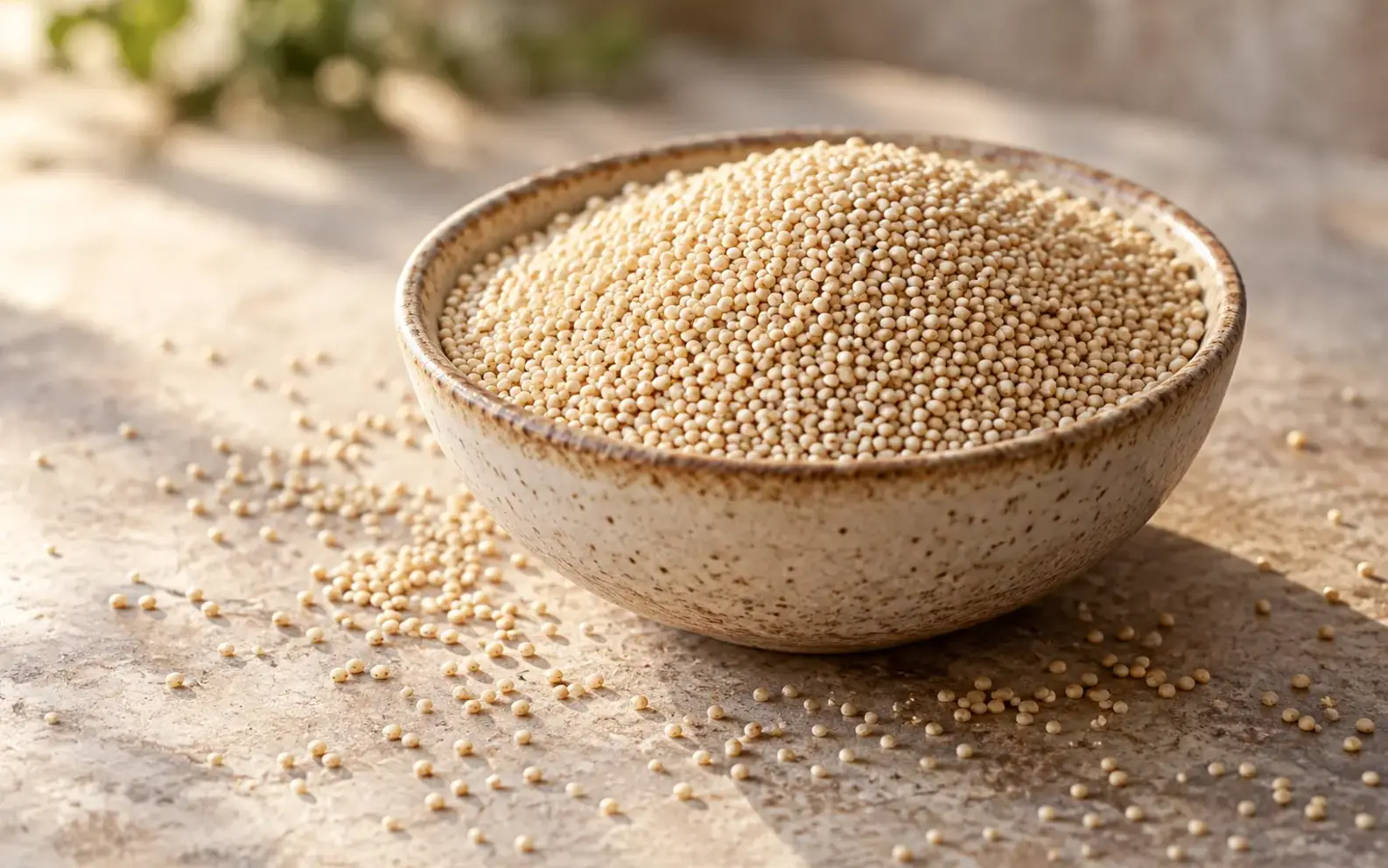
Editorial boundary: These AI-generated orientation images must not be used to identify wild foods, judge edibility, prove safe preparation, or diagnose spoilage. The verified safety-image panel and written guidance control where present.
Book readiness · Rewrite 01
Amaranth grain, uncooked. Scientific identity: Grain amaranths include Amaranthus cruentus L., A. hypochondriacus L., and A. caudatus L.; the USDA record does not name a species. Edible part: Cleaned mature dry seed used as a pseudocereal. Exact source form: Amaranth grain, uncooked, corresponding to USDA FoodData Central FDC 170682.
Question: Why does cooked amaranth vary from creamy to bitter or gummy, and is grain the same as leaves?
Repeated experience: Cooks report strong flavor and a porridge-like texture that changes with water ratio, heat and popping; some value it specifically as a gluten-free grain.
Research distinguishes grain from leaves and supports boiling, popping or milling grain. Nutrient and antinutrient profiles vary by species, part and processing.
The repeated texture signal is culinary, not evidence of harm. Grain, leaf and extract claims must remain separate.
Exclude or qualify: Do not merge this chapter with: Amaranth leaves, popped or cooked grain, flour, flakes, oil, sprouts, supplements, other Amaranthus species, and finished foods. Remove or qualify medical-treatment, universal-safety, cross-species, cross-part, cross-product, and cross-preparation claims unless an exact source is reviewed for that wording.
| Layer | Disposition | Sources |
|---|---|---|
| Identity And Form | supported for bounded scope | [1] [2] [3] |
| Human Experience | experience documented not generalized | [4] |
| Authoritative Control | supported control | [3] |
| Supported Conclusion | supported with stated limits | [4] [3] |
| Safety And Limitations | required boundary | [1] [2] [3] |
Review status: This controlled rewrite uses the adjudicated identity, food-form, human-experience, authoritative-control, conclusion, and safety fields. It replaces broader legacy prose for this chapter layer but does not constitute final specialist or publication approval.
Final gate · Approval 01
Status: Approved for informational book assembly
Approved for informational book assembly with its claim-to-source map retained.
Specialist-review flags: None
Safety-box triggers: No additional trigger
Review scope: Final source-completeness, structure, exclusion, and risk-triage review for book assembly. This is not a claim that an external specialist reviewed the chapter.
Book placement · Volume 1
Chapter 4 in The Food Glossary: Evidence Edition — Volume 1. Standard controlled chapter format.
Corrected USDA food/form panel · other claims unreviewed
uncooked amaranth grain; not leaves. Other chapter claims unverified. The earlier mismatched or broader nutrient assignment is not used here. This panel describes only the named food and preparation, not every food sold under the glossary heading. A nutrient record does not establish raw-consumption safety.
The source describes amaranth grain, uncooked. Cooked amaranth, popped grain, flour, leaves, breakfast cereal, and mixed products are different forms and should not inherit this panel.
USDA FoodData Central: amaranth grain, uncooked
| Energy | 371 kcal |
|---|---|
| Protein | 13.6 g |
| Fat | 7.02 g |
| Carbohydrate | 65.2 g |
| Fiber | 6.7 g |
| Total sugars | 1.69 g |
| Potassium | 508 mg |
USDA FoodData Central FDC 170682 · SR Legacy (final release, April 2018). Values describe only this named form, not all products or varieties.
Human experience evidence · Batch 04
Question: Why does cooked amaranth vary from creamy to bitter or gummy, and is grain the same as leaves?
Cooks report strong flavor and a porridge-like texture that changes with water ratio, heat and popping; some value it specifically as a gluten-free grain.
Research distinguishes grain from leaves and supports boiling, popping or milling grain. Nutrient and antinutrient profiles vary by species, part and processing.
The repeated texture signal is culinary, not evidence of harm. Grain, leaf and extract claims must remain separate.
Publish a grain-specific cooked profile; do not merge leafy amaranth nutrition or medicinal outcomes into the grain chapter.
Reddit plant-based cooking discussion
Finding: Cooks report that water ratio, salt, heat and serving style produce anything from creamy porridge to an unpleasant sticky texture.
Supported conclusion: Documents repeatable preparation sensitivity.
Limitations: Taste reports do not establish nutrient absorption or safety.
Evidence strength: Repeated culinary signal
Safety/current gate: No
NIH-indexed review
Finding: Amaranth grain is a pseudocereal used cooked, popped or milled; processing and species alter composition and digestibility, and leaves are a separate food.
Supported conclusion: Prevents grain-leaf and raw-cooked conflation.
Limitations: Many proposed clinical benefits remain under-studied.
Evidence strength: Scientific review
Safety/current gate: No
These 11 links are organized by a matching whole-food name. Prepared products and ingredients have separate composition profiles. Confirm the identity and form on each page; a similar name alone is not proof.
Nutrition for uncooked amaranth grain; not leaves. USDA record: Amaranth grain, uncooked.
| Nutrient | Amount |
|---|---|
| Energy | 371 kcal |
| Protein | 13.6 g |
| Fat | 7.02 g |
| Carbohydrate | 65.2 g |
| Fiber | 6.7 g |
| Calcium | 159 mg |
| Iron | 7.61 mg |
| Magnesium | 248 mg |
| Phosphorus | 557 mg |
| Potassium | 508 mg |
| Sodium | 4 mg |
| Zinc | 2.87 mg |
| Vitamin A, RAE | 0 µg |
| Vitamin C | 4.2 mg |
| Folate, total | 82 µg |
USDA FoodData Central FDC 170682, SR Legacy (April 2018).
Identity, preparation safety, growing, preservation, and health claims are not yet approved. No field-use or canning guidance is established here.