Vegetable · Brassicaceae
Cabbage
Brassica oleracea Capitata Group
A dense head of layered leaves that can be crisp and peppery raw or sweet and tender when cooked.
Core Edibles · Volume One
01
Meet the food
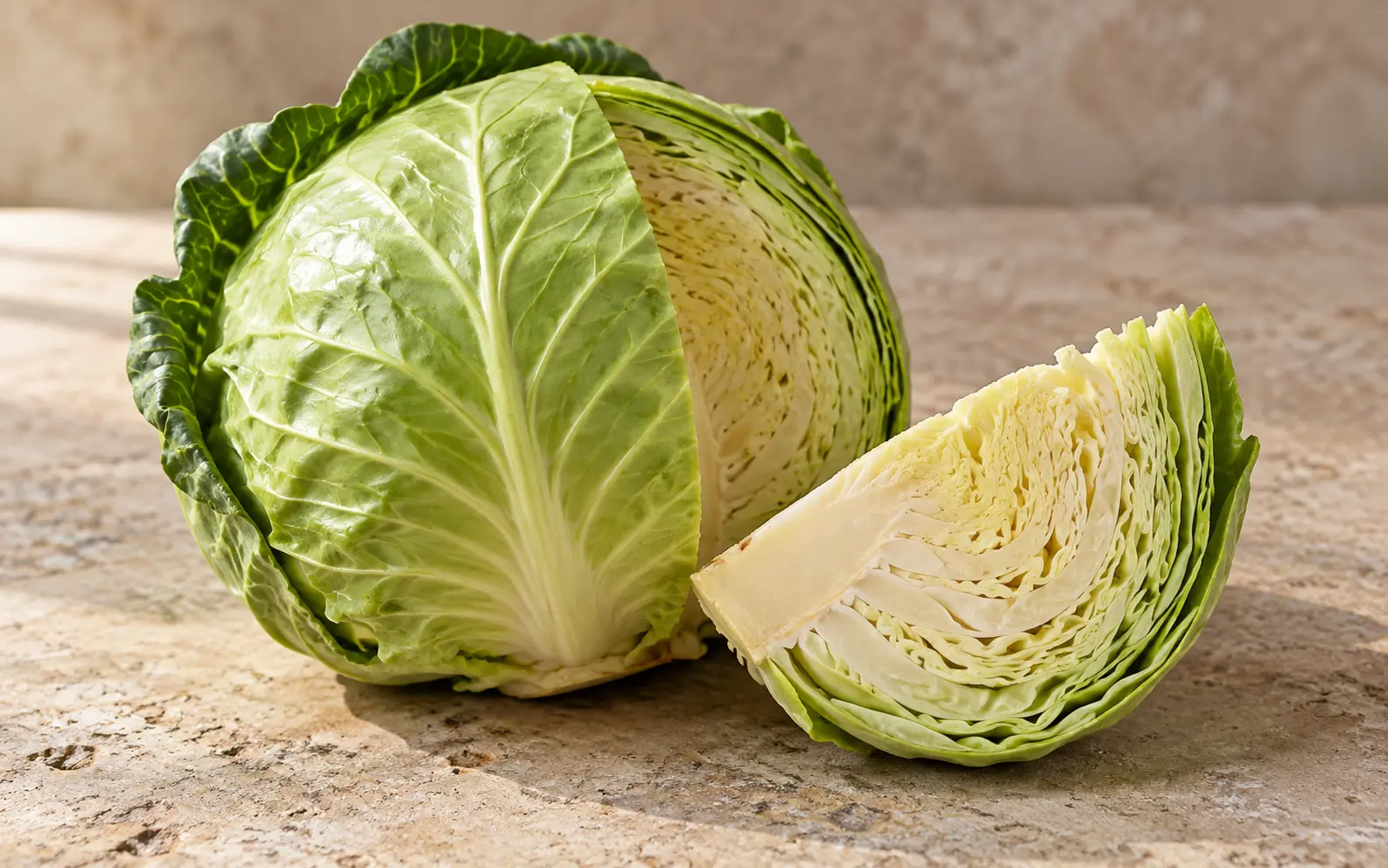
Head cabbage, raw. Scientific identity: Brassica oleracea L. Capitata Group; the USDA record is a generic market form. Edible part: Raw leaves from a compact head. Exact source form: Cabbage, raw, corresponding to USDA FoodData Central FDC 169975.
A dense head of layered leaves that can be crisp and peppery raw or sweet and tender when cooked.
- Common name
- Cabbage
- Scientific name
- Brassica oleracea Capitata Group
- Family
- Brassicaceae
- Edition
- Core Edibles
- Flavor
- Peppery · sweet · vegetal
- Texture
- Crisp raw · tender cooked
- Season
- Cool seasons
- Best storage
- Refrigerate whole
- Great for
- Slaw · sauté · soup
- Know this
- Home fermentation requires tested salt and temperature control
02
Pairings
- Carrot
- Apple
- Mustard
- Dill
- Beans
- Ginger
03
Safety & special considerations
Home fermentation requires tested salt and temperature control
Safety & special considerations Raw, cooked, and fermented cabbage are different foods. Use a tested fermentation or canning method rather than improvising shelf-stable storage.
04
Taste, choose & buy
Select a heavy, compact head with crisp leaves and no slime, deep rot, or spreading mold.
05
Nutrition
Exact food form · Per 100 g
Cabbage, raw
| Nutrient | Per 100 g |
|---|---|
| Energy | 25 kcal |
| Carbohydrate | 5.8 g |
| Protein | 1.28 g |
| Fat | 0.1 g |
| Fiber | 2.5 g |
| Total sugars | 3.2 g |
USDA FoodData Central · per 100 g. Typical eating portions may be much smaller, especially for spices.
Exact chapter values; per 100 g; no derived calculations; unavailable values remain n.a.
06
Store & preserve
- 1
Refrigerate whole
Refrigerate whole and dry. Wrap cut cabbage and use promptly; remove only minor dry surface damage.
- 2
Before using
Discard food with mold, pests, leaking decay, or an unmistakably off odor.
07
At a glance
- Flavor
- Peppery · sweet · vegetal
- Texture
- Crisp raw · tender cooked
- Uses
- Slaw · sauté · soup
- Storage
- Refrigerate whole
- Safety
- Home fermentation requires tested salt and temperature control
- Nutrition form
- Cabbage, raw
08
Grow: start to harvest
Cabbage is a cool-season biennial grown as an annual for its leafy head. Choose spring, summer, or storage varieties for the intended season.
- START WITH
- Head-cabbage seed
- CLIMATE
- Cool weather around 45–75°F
- LIGHT
- 6–8+ hours of direct sun
- SOIL
- Fertile, firm, well-drained soil
- 1
Start it
Start seed 1/4 inch deep 6–8 weeks before transplanting, or direct-sow in mild weather. Harden seedlings for 7–10 days.
- 2
Give it room
Plant 12–18 inches apart for smaller heads or 18–24 inches for large heads; rows 24–36 inches apart.
- 3
Water correctly
Give 1–1.5 inches weekly and keep moisture even to reduce splitting.
- 4
Care for it
Mulch, weed shallowly, and cover immediately with insect netting where cabbage worms are common.
- 5
Harvest
Cut when the head feels solid under hand pressure. Leave outer leaves and a short stem; harvest before splitting.
Depending on variety, heads mature roughly 60–100 days after transplanting.
Cut when the head feels solid under hand pressure. Leave outer leaves and a short stem; harvest before splitting.
09
Prepare & cook
- 1
Remove damaged outer leaves
Match the method to the exact food form and intended dish.
- 2
Rinse
Match the method to the exact food form and intended dish.
- 3
Quarter through core
Match the method to the exact food form and intended dish.
- 4
Cut out core and slice
Match the method to the exact food form and intended dish.
Sources
- extension.umn.eduhttps://extension.umn.edu/garden-and-home/yard-and-garden/gardening-in-minnesota/growing-cabbage
- fdc.nal.usda.govhttps://fdc.nal.usda.gov/food-details/169975/nutrients
- reddit.comhttps://www.reddit.com/r/AskCulinary/comments/1b1frho
- brownhealth.orghttps://www.brownhealth.org/be-well/cabbage-and-benefits-overlooked-superfood
core-edibles-2026.1 · cabbage