Vegetable · Brassicaceae
Brussels Sprouts
Brassica oleracea Gemmifera Group
Compact leaf buds that become sweet and nutty when browned quickly instead of boiled into softness.
Core Edibles · Volume One
01
Meet the food
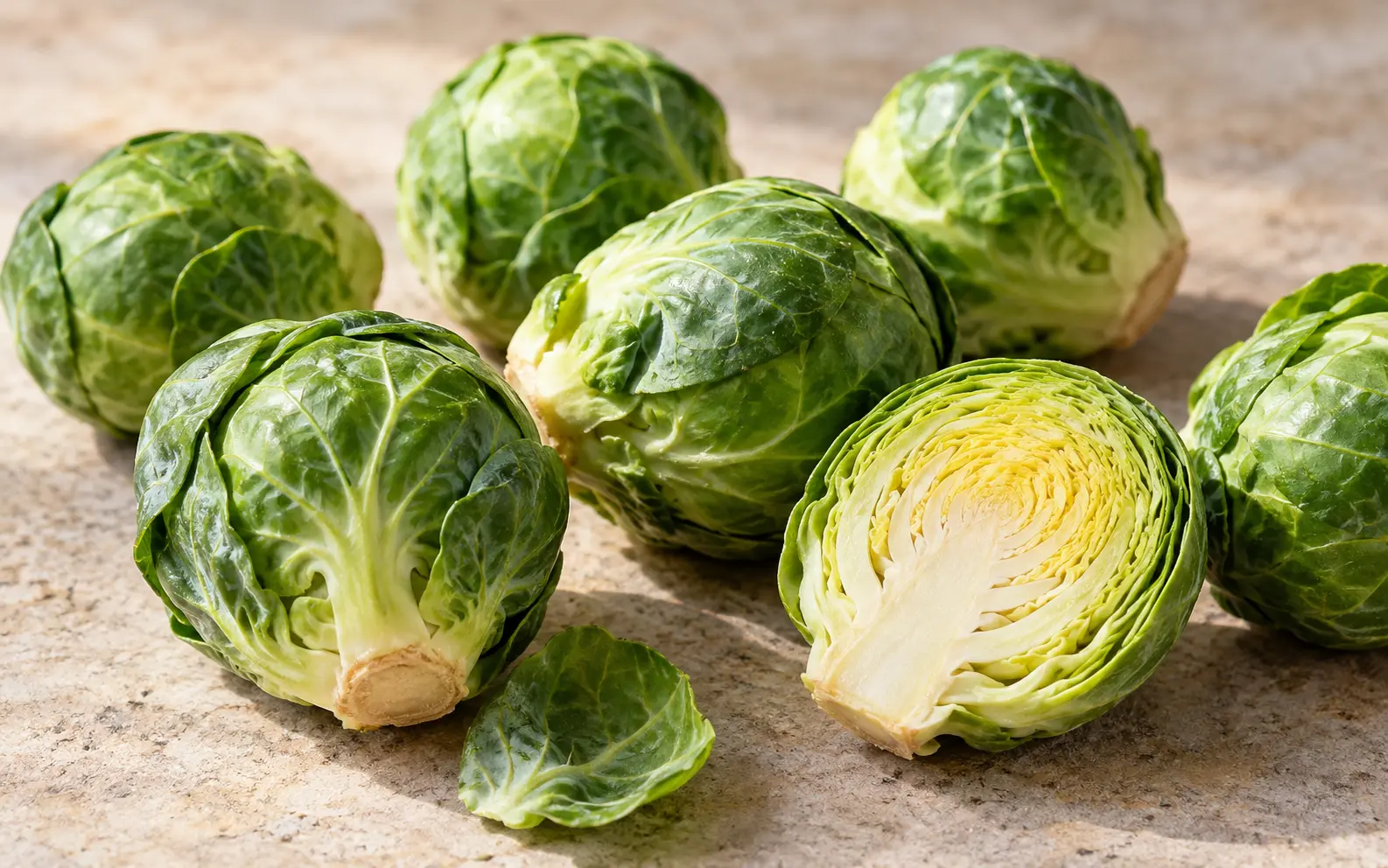
Brussels sprouts, raw. Scientific identity: Brassica oleracea L. Gemmifera Group. Edible part: Compact axillary leaf buds or sprouts. Exact source form: Brussels sprouts, raw, USDA SR Legacy food 11098 / FDC 170383.
Compact leaf buds that become sweet and nutty when browned quickly instead of boiled into softness.
- Common name
- Brussels Sprouts
- Scientific name
- Brassica oleracea Gemmifera Group
- Family
- Brassicaceae
- Edition
- Core Edibles
- Flavor
- Green · nutty · gently bitter
- Texture
- Dense · tender when cooked
- Season
- Fall–winter
- Best storage
- Refrigerate
- Great for
- Roast · sauté · shred
- Know this
- Strong cooking odor alone does not prove spoilage
02
Pairings
- Lemon
- Mustard
- Apple
- Hazelnut
- Garlic
- Thyme
03
Safety & special considerations
Strong cooking odor alone does not prove spoilage
Safety & special considerations Overcooking can intensify sulfur aroma without making the vegetable toxic. Discard sprouts with slime, mold, or rotten odor before cooking.
04
Taste, choose & buy
Pick firm, compact sprouts with tight leaves and no slime, yellow collapse, or black soft rot.
05
Nutrition
Exact food form · Per 100 g
Brussels sprouts, raw
| Nutrient | Per 100 g |
|---|---|
| Energy | 43 kcal |
| Carbohydrate | 8.95 g |
| Protein | 3.38 g |
| Fat | 0.3 g |
| Fiber | 3.8 g |
| Total sugars | 2.2 g |
USDA FoodData Central · per 100 g. Typical eating portions may be much smaller, especially for spices.
Exact chapter values; per 100 g; no derived calculations; unavailable values remain n.a.
06
Store & preserve
- 1
Refrigerate
Refrigerate unwashed in a loose bag; use while buds remain tight and firm.
- 2
Before using
Discard food with mold, pests, leaking decay, or an unmistakably off odor.
07
At a glance
- Flavor
- Green · nutty · gently bitter
- Texture
- Dense · tender when cooked
- Uses
- Roast · sauté · shred
- Storage
- Refrigerate
- Safety
- Strong cooking odor alone does not prove spoilage
- Nutrition form
- Brussels sprouts, raw
08
Grow: start to harvest
A long-season cool-weather crop. Flavor improves in cool fall weather, while summer heat can loosen sprouts.
- START WITH
- Brussels sprouts seed
- CLIMATE
- Cool season; start for a fall harvest in most regions
- LIGHT
- 6–8+ hours of direct sun
- SOIL
- Fertile, firm, well-drained soil
- 1
Start it
Start seed 1/4–1/2 inch deep 4–6 weeks before transplanting. Set plants outside about 90–110 days before expected fall frost.
- 2
Give it room
Plant 18–24 inches apart in rows 30 inches apart.
- 3
Water correctly
Provide 1–1.5 inches weekly and keep moisture even while sprouts enlarge.
- 4
Care for it
Mulch, stake tall stems in wind, remove yellow lower leaves, and protect against cabbage worms.
- 5
Harvest
Pick firm 1–2 inch sprouts from the bottom upward when tightly closed. A light frost can improve sweetness.
Most varieties need roughly 90–120 days from transplanting.
Pick firm 1–2 inch sprouts from the bottom upward when tightly closed. A light frost can improve sweetness.
09
Prepare & cook
- 1
Trim dry stem end
Match the method to the exact food form and intended dish.
- 2
Remove damaged outer leaves
Match the method to the exact food form and intended dish.
- 3
Halve evenly
Match the method to the exact food form and intended dish.
- 4
Cook hot and fast
Match the method to the exact food form and intended dish.
Sources
- powo.science.kew.orghttps://powo.science.kew.org/results?q=Brassica+oleracea+Gemmifera
- fdc.nal.usda.govhttps://fdc.nal.usda.gov/food-search/?query=sprouts&type=SR+Legacy
- reddit.comhttps://www.reddit.com/r/food/comments/50ewn1/why_do_brussel_sprouts_have_such_a_bad_rep_cant/
- pmc.ncbi.nlm.nih.govhttps://pmc.ncbi.nlm.nih.gov/articles/PMC5758100/
core-edibles-2026.1 · brussel_sprouts