Vegetable · Brassicaceae
Bok Choy
Brassica rapa subsp. chinensis
A crisp-stemmed Asian cabbage with tender green leaves and a clean mustard-family sweetness.
Core Edibles · Volume One
01
Meet the food
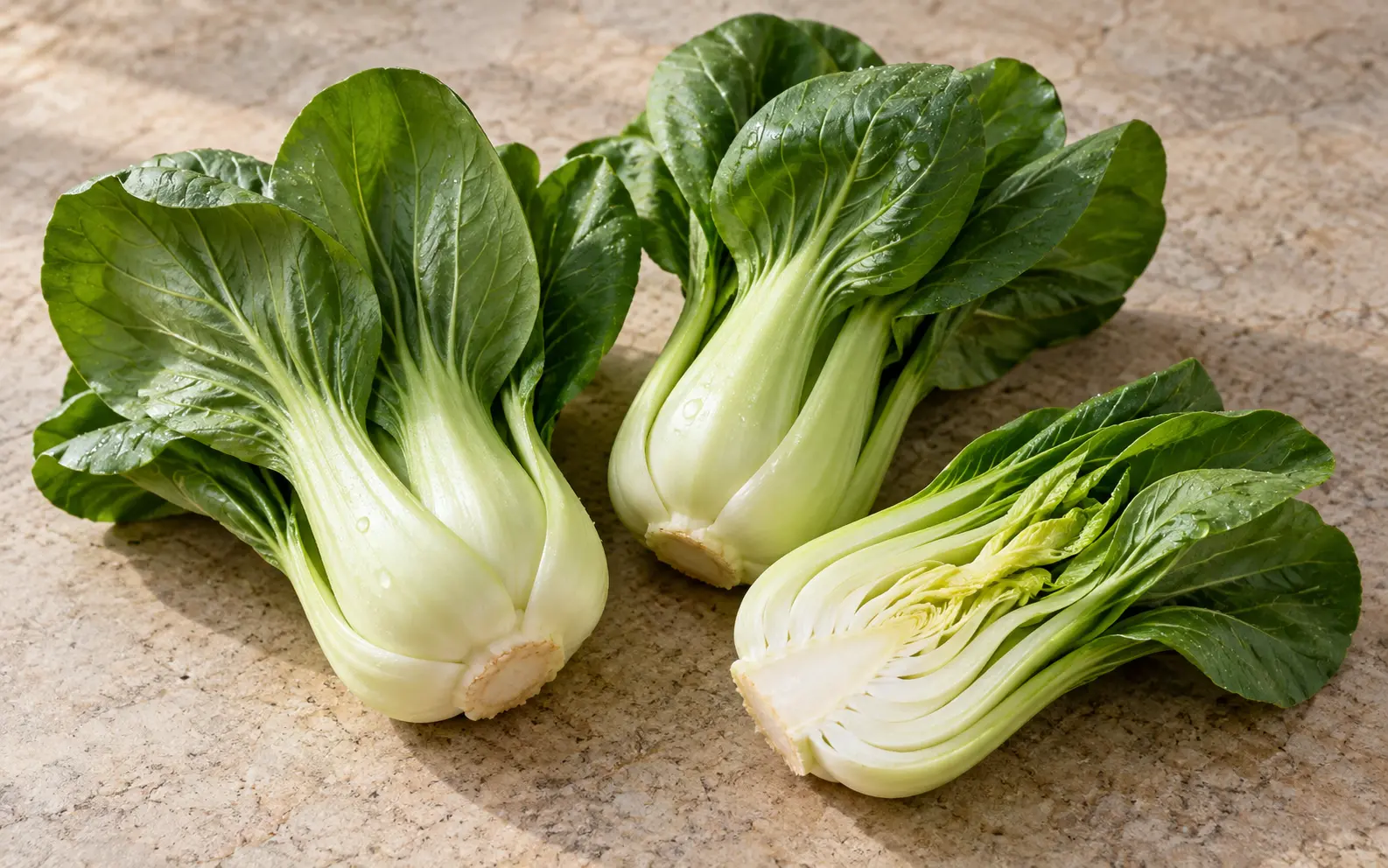
Bok choy or pak-choi leaves and petioles, raw. Scientific identity: Brassica rapa L. subsp. chinensis group. Edible part: Raw leaves and fleshy petioles. Exact source form: Cabbage, Chinese (pak-choi), raw, corresponding to USDA FoodData Central FDC 170390.
A crisp-stemmed Asian cabbage with tender green leaves and a clean mustard-family sweetness.
- Common name
- Bok Choy
- Scientific name
- Brassica rapa subsp. chinensis
- Family
- Brassicaceae
- Edition
- Core Edibles
- Flavor
- Mild · green · gently mustardy
- Texture
- Crisp stems · tender leaves
- Season
- Cool seasons
- Best storage
- Refrigerate dry
- Great for
- Stir-fry · steam · soup
- Know this
- Slimy decay is different from harmless pepper spot
02
Pairings
- Ginger
- Garlic
- Sesame
- Rice
- Mushroom
- Chili
03
Safety & special considerations
Slimy decay is different from harmless pepper spot
Safety & special considerations Tiny black pepper-like flecks can be a plant disorder, but soft wet lesions, slime, fuzz, and off odor indicate spoilage.
04
Taste, choose & buy
Look for crisp pale stalks and lively leaves without slime, yellow collapse, or sour odor.
05
Nutrition
Exact food form · Per 100 g
Cabbage, chinese (pak-choi), raw
| Nutrient | Per 100 g |
|---|---|
| Energy | 13 kcal |
| Carbohydrate | 2.18 g |
| Protein | 1.5 g |
| Fat | 0.2 g |
| Fiber | 1 g |
| Total sugars | 1.18 g |
USDA FoodData Central · per 100 g. Typical eating portions may be much smaller, especially for spices.
Exact chapter values; per 100 g; no derived calculations; unavailable values remain n.a.
06
Store & preserve
- 1
Refrigerate dry
Refrigerate unwashed in a loose bag and use before leaves wilt and stalks soften.
- 2
Before using
Discard food with mold, pests, leaking decay, or an unmistakably off odor.
07
At a glance
- Flavor
- Mild · green · gently mustardy
- Texture
- Crisp stems · tender leaves
- Uses
- Stir-fry · steam · soup
- Storage
- Refrigerate dry
- Safety
- Slimy decay is different from harmless pepper spot
- Nutrition form
- Cabbage, chinese (pak-choi), raw
08
Grow: start to harvest
A fast cool-season crop. Heat, crowding, drought, or sudden temperature swings can make plants bolt before forming full stalks.
- START WITH
- Bok choy seed
- CLIMATE
- Cool weather around 50–75°F; spring or fall
- LIGHT
- Full sun in cool weather; afternoon shade in warmth
- SOIL
- Fertile, well-drained soil with steady moisture
- 1
Start it
Direct-sow 1/4 inch deep 1–2 inches apart, or start cells 3–4 weeks early. Seedlings usually emerge in 4–10 days.
- 2
Give it room
Thin baby types to 4–6 inches and full-size types to 8–12 inches apart; rows 18 inches apart.
- 3
Water correctly
Give about 1 inch weekly and never let seedlings repeatedly dry out.
- 4
Care for it
Mulch lightly and use insect netting immediately if flea beetles or cabbage worms are common.
- 5
Harvest
Cut baby plants at 25–35 days or full heads near 45–60 days, before a flower stalk rises.
Baby bok choy can be ready in about one month; full heads in 45–60 days.
Cut baby plants at 25–35 days or full heads near 45–60 days, before a flower stalk rises.
09
Prepare & cook
- 1
Separate stalks
Match the method to the exact food form and intended dish.
- 2
Rinse between bases
Match the method to the exact food form and intended dish.
- 3
Slice stems and leaves separately
Match the method to the exact food form and intended dish.
- 4
Cook stems first
Match the method to the exact food form and intended dish.
Sources
- powo.science.kew.orghttps://powo.science.kew.org/results?q=Brassica+rapa+chinensis
- fdc.nal.usda.govhttps://fdc.nal.usda.gov/food-details/170390/nutrients
- ask.ifas.ufl.eduhttps://ask.ifas.ufl.edu/publication/HS352
- reddit.comhttps://www.reddit.com/r/foodsafety/comments/17zm2l0/what_are_these_black_spots_on_shanghai_bok_choy/
core-edibles-2026.1 · bok_choy