Fruit · Rosaceae
Blackberry
Rubus spp. and hybrids
A juicy aggregate berry balancing deep sweetness, wine-like aroma, and bright acidity.
Core Edibles · Volume One
01
Meet the food
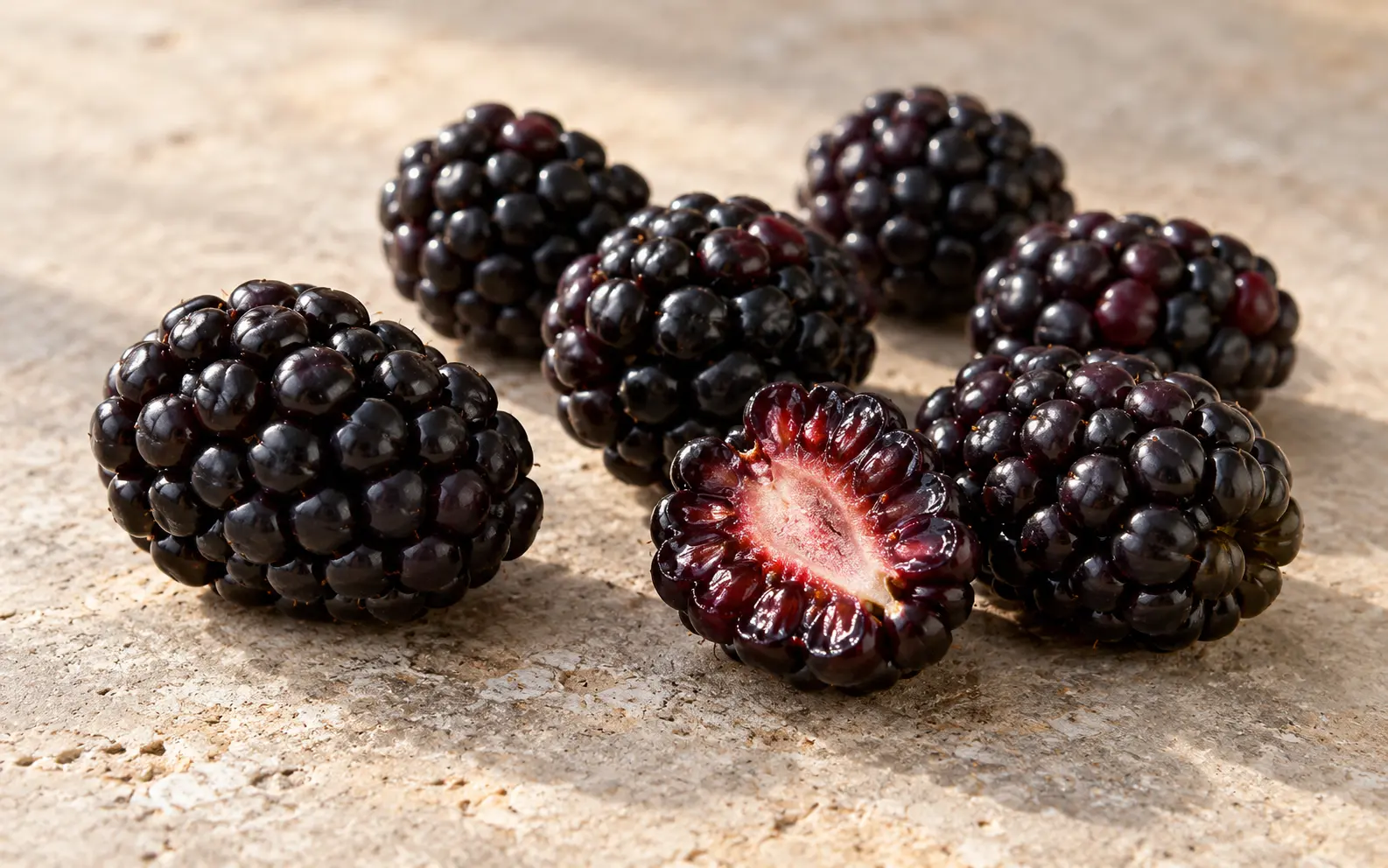
Blackberries, raw. Scientific identity: Rubus species and hybrids; the USDA record is not species- or variety-specific. Edible part: Fresh aggregate fruit; leaves, roots, and stems are excluded. Exact source form: Blackberries, raw, corresponding to USDA FoodData Central FDC 173946.
A juicy aggregate berry balancing deep sweetness, wine-like aroma, and bright acidity.
- Common name
- Blackberry
- Scientific name
- Rubus spp. and hybrids
- Family
- Rosaceae
- Edition
- Core Edibles
- Flavor
- Sweet · tart · floral
- Texture
- Juicy · seedy
- Season
- Summer
- Best storage
- Dry · refrigerated
- Great for
- Fresh · bake · preserve
- Know this
- Fuzzy growth is spoilage; pale drupelets may be sun damage
02
Pairings
- Lemon
- Mint
- Apple
- Oats
- Vanilla
- Thyme
03
Safety & special considerations
Fuzzy growth is spoilage; pale drupelets may be sun damage
Safety & special considerations White or red individual drupelets can be heat or handling damage. Fuzz, sour odor, leakage, and soft spreading rot are different rejection signs.
04
Taste, choose & buy
Select plump, deeply colored berries that are dry and intact, without fuzzy growth or pooled juice.
05
Nutrition
Exact food form · Per 100 g
Blackberries, raw
| Nutrient | Per 100 g |
|---|---|
| Energy | 43 kcal |
| Carbohydrate | 9.61 g |
| Protein | 1.39 g |
| Fat | 0.49 g |
| Fiber | 5.3 g |
| Total sugars | 4.88 g |
USDA FoodData Central · per 100 g. Typical eating portions may be much smaller, especially for spices.
Exact chapter values; per 100 g; no derived calculations; unavailable values remain n.a.
06
Store & preserve
- 1
Dry · refrigerated
Refrigerate dry and unwashed in a shallow ventilated container; rinse only before use.
- 2
Before using
Discard food with mold, pests, leaking decay, or an unmistakably off odor.
07
At a glance
- Flavor
- Sweet · tart · floral
- Texture
- Juicy · seedy
- Uses
- Fresh · bake · preserve
- Storage
- Dry · refrigerated
- Safety
- Fuzzy growth is spoilage; pale drupelets may be sun damage
- Nutrition form
- Blackberries, raw
08
Grow: start to harvest
Seed works but does not copy a named variety and germinates slowly. Some wild blackberries spread aggressively; check local invasive guidance.
- START WITH
- Blackberry seed from ripe fruit—or a certified plant for predictable fruit
- CLIMATE
- Temperate; variety-dependent, roughly zones 4–9
- LIGHT
- 6–8+ hours of direct sun
- SOIL
- Fertile, well-drained soil with steady moisture
- 1
Start it
Clean seed free of pulp. Refrigerate in barely moist material for 12–16 weeks, then sow 1/8 inch deep at 65–75°F. Germination can be slow and uneven.
- 2
Give it room
Transplant 3–5 feet apart in rows 8 feet apart. Install a trellis for trailing or semi-erect types.
- 3
Water correctly
Provide 1–2 inches weekly during establishment, flowering, and fruit fill; keep crowns out of standing water.
- 4
Care for it
Mulch, tie canes to support, and after harvest remove canes that fruited at ground level while keeping new canes.
- 5
Harvest
Pick when berries are fully black, glossy-to-dull, and release with almost no pull. Refrigerate immediately.
Seedlings often need 2–3 years before useful harvest.
Pick when berries are fully black, glossy-to-dull, and release with almost no pull. Refrigerate immediately.
09
Prepare & cook
- 1
Sort
Match the method to the exact food form and intended dish.
- 2
Rinse just before eating
Match the method to the exact food form and intended dish.
- 3
Drain gently
Match the method to the exact food form and intended dish.
- 4
Remove moldy or leaking berries
Match the method to the exact food form and intended dish.
Sources
- powo.science.kew.orghttps://powo.science.kew.org/results?q=Rubus+blackberry
- fdc.nal.usda.govhttps://fdc.nal.usda.gov/food-details/173946/nutrients
- ipm.ucanr.eduhttps://ipm.ucanr.edu/agriculture/caneberries/white-drupelet/
- reddit.comhttps://www.reddit.com/r/foodhacks/comments/mjjm3j/how_do_you_keep_berries_from_going_off_so_fast/
core-edibles-2026.1 · blackberry