Legume · Fabaceae
Black Beans
Phaseolus vulgaris
A dark-skinned common bean that cooks into a creamy interior while holding a savory, earthy flavor.
Core Edibles · Volume One
01
Meet the food
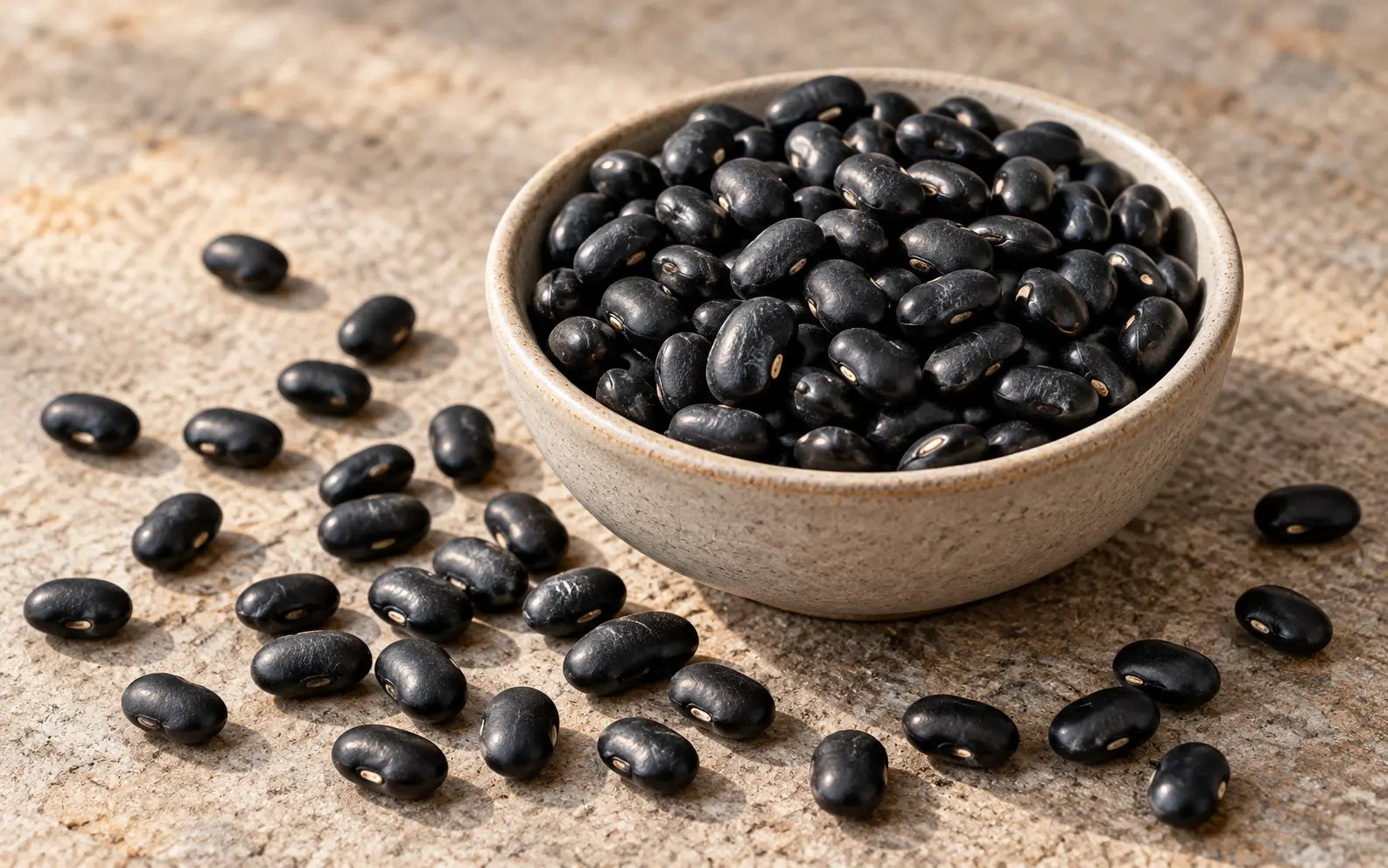
Black common beans, mature dry seeds, uncooked. Scientific identity: Phaseolus vulgaris L.; black-seeded market class. Edible part: Mature dried seeds; pods and immature beans are separate foods. Exact source form: Beans, black, mature seeds, raw, corresponding to USDA FoodData Central FDC 173734.
A dark-skinned common bean that cooks into a creamy interior while holding a savory, earthy flavor.
- Common name
- Black Beans
- Scientific name
- Phaseolus vulgaris
- Family
- Fabaceae
- Edition
- Core Edibles
- Flavor
- Earthy · mild · savory
- Texture
- Creamy when cooked
- Season
- Dry pantry staple
- Best storage
- Dry airtight · cooked chilled
- Great for
- Soup · bowl · mash
- Know this
- Dry beans must be fully cooked
02
Pairings
- Rice
- Corn
- Lime
- Cumin
- Tomato
- Plantain
03
Safety & special considerations
Dry beans must be fully cooked
Safety & special considerations Never eat raw or undercooked common beans. Boil and cook until completely tender; slow cookers alone may not reach a reliable initial boil.
04
Taste, choose & buy
Dry beans should be hard, clean, evenly colored, and free of holes, insects, dampness, or mold.
05
Nutrition
Exact food form · Per 100 g
Beans, black, mature seeds, raw
| Nutrient | Per 100 g |
|---|---|
| Energy | 341 kcal |
| Carbohydrate | 62.4 g |
| Protein | 21.6 g |
| Fat | 1.42 g |
| Fiber | 15.5 g |
| Total sugars | 2.12 g |
USDA FoodData Central · per 100 g. Typical eating portions may be much smaller, especially for spices.
Exact chapter values; per 100 g; no derived calculations; unavailable values remain n.a.
06
Store & preserve
- 1
Dry airtight · cooked chilled
Keep dry beans airtight and dry. Refrigerate cooked beans within two hours and use or freeze promptly.
- 2
Before using
Discard food with mold, pests, leaking decay, or an unmistakably off odor.
07
At a glance
- Flavor
- Earthy · mild · savory
- Texture
- Creamy when cooked
- Uses
- Soup · bowl · mash
- Storage
- Dry airtight · cooked chilled
- Safety
- Dry beans must be fully cooked
- Nutrition form
- Beans, black, mature seeds, raw
08
Grow: start to harvest
Black beans are warm-season common beans. Bush types mature sooner; pole types need a trellis.
- START WITH
- Dry black bean seed sold for planting
- CLIMATE
- Frost-free season with soil at least 60°F
- LIGHT
- 8+ hours of direct sun
- SOIL
- Well-drained soil; avoid heavy nitrogen fertilizer
- 1
Start it
Direct-sow after frost 1 inch deep. Plant bush beans 3–4 inches apart or pole beans 4–6 inches apart beside support.
- 2
Give it room
Leave 18–24 inches between bush rows; give pole rows 30–36 inches and install the trellis before vines climb.
- 3
Water correctly
Give about 1 inch weekly, especially during flowering and pod fill. Water soil, not leaves.
- 4
Care for it
Weed shallowly, do not work plants while wet, and stop watering as dry pods yellow and become papery.
- 5
Harvest
For dry beans, leave pods until brown and crisp. Shell, dry beans another 1–2 weeks, and store only when hard and fully dry.
Most dry black beans mature in roughly 85–110 days.
For dry beans, leave pods until brown and crisp. Shell, dry beans another 1–2 weeks, and store only when hard and fully dry.
09
Prepare & cook
- 1
Sort and rinse
Match the method to the exact food form and intended dish.
- 2
Soak if desired
Match the method to the exact food form and intended dish.
- 3
Boil, then simmer fully
Match the method to the exact food form and intended dish.
- 4
Salt and season when tender
Match the method to the exact food form and intended dish.
Sources
- powo.science.kew.orghttps://powo.science.kew.org/results?q=Phaseolus+vulgaris
- fdc.nal.usda.govhttps://fdc.nal.usda.gov/food-details/173734/nutrients
- extension.usu.eduhttps://extension.usu.edu/preserve-the-harvest/dev/storing-dry-beans-1
- reddit.comhttps://www.reddit.com/r/Cooking/comments/uqi63w/do_you_guys_have_any_recommendations_on_making/
- pmc.ncbi.nlm.nih.govhttps://pmc.ncbi.nlm.nih.gov/articles/PMC3228670/
core-edibles-2026.1 · black_beans