Herb · Lamiaceae
Basil
Ocimum basilicum
A fragrant tender herb that brings peppery sweetness and clove-like aroma to fresh dishes.
Core Edibles · Volume One
01
Meet the food
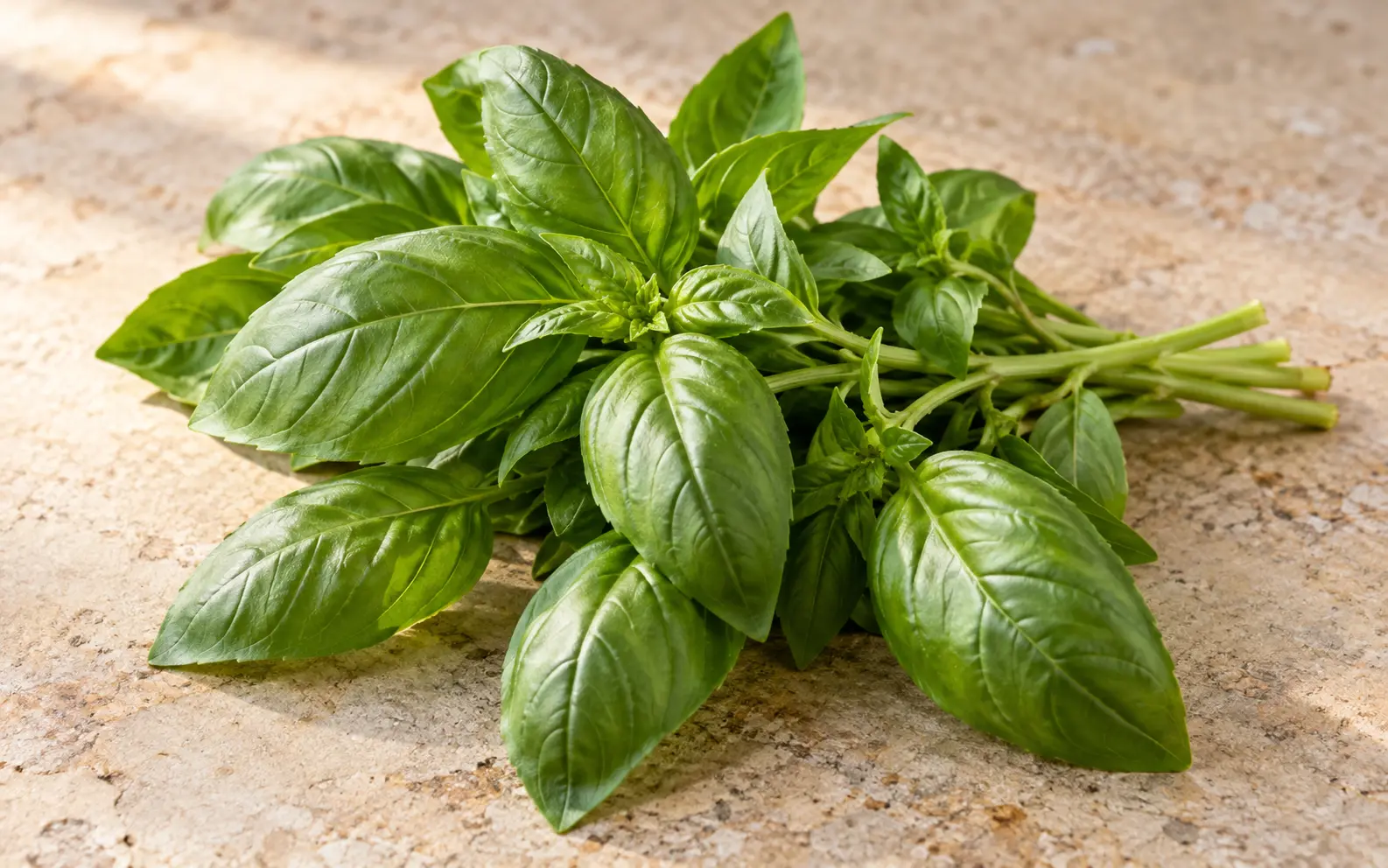
Sweet basil leaves, fresh. Scientific identity: Ocimum basilicum L. Edible part: Fresh leaves and tender culinary stems. Exact source form: Basil, fresh, corresponding to USDA FoodData Central FDC 172232.
A fragrant tender herb that brings peppery sweetness and clove-like aroma to fresh dishes.
- Common name
- Basil
- Scientific name
- Ocimum basilicum
- Family
- Lamiaceae
- Edition
- Core Edibles
- Flavor
- Sweet · peppery · aromatic
- Texture
- Tender leaves
- Season
- Warm weather
- Best storage
- Short-term at cool room temperature
- Great for
- Pesto · salad · sauce
- Know this
- Homemade basil-and-garlic oil is not shelf-stable
02
Pairings
- Tomato
- Garlic
- Lemon
- Strawberry
- Beans
- Olive
03
Safety & special considerations
Homemade basil-and-garlic oil is not shelf-stable
Safety & special considerations Fresh basil is not concentrated essential oil. Homemade pesto or garlic-herb oil must be refrigerated and used promptly or frozen—not stored at room temperature.
04
Taste, choose & buy
Look for fragrant, upright leaves without slime, black decay, or extensive wilting.
05
Nutrition
Exact food form · Per 100 g
Basil, fresh
| Nutrient | Per 100 g |
|---|---|
| Energy | 23 kcal |
| Carbohydrate | 2.65 g |
| Protein | 3.15 g |
| Fat | 0.64 g |
| Fiber | 1.6 g |
| Total sugars | 0.3 g |
USDA FoodData Central · per 100 g. Typical eating portions may be much smaller, especially for spices.
Exact chapter values; per 100 g; no derived calculations; unavailable values remain n.a.
06
Store & preserve
- 1
Short-term at cool room temperature
Keep cut stems in a small glass of water away from cold drafts; refrigerate pesto and use within four days or freeze.
- 2
Before using
Discard food with mold, pests, leaking decay, or an unmistakably off odor.
07
At a glance
- Flavor
- Sweet · peppery · aromatic
- Texture
- Tender leaves
- Uses
- Pesto · salad · sauce
- Storage
- Short-term at cool room temperature
- Safety
- Homemade basil-and-garlic oil is not shelf-stable
- Nutrition form
- Basil, fresh
08
Grow: start to harvest
Basil is an easy warm-season annual. Cold soil slows it and any frost kills it.
- START WITH
- Sweet basil seed
- CLIMATE
- Warm frost-free season; best around 70–90°F
- LIGHT
- 6–8 hours of sun; afternoon shade in extreme heat
- SOIL
- Loose, fertile, well-drained soil
- 1
Start it
After frost and once soil is warm, sow 1/4 inch deep. Or start indoors 4–6 weeks early. Keep moist; sprouts usually appear in 5–10 days.
- 2
Give it room
Thin or transplant 8–12 inches apart.
- 3
Water correctly
Water at soil level when the top inch dries. Avoid repeated wilting and wet leaves overnight.
- 4
Care for it
Pinch above a leaf pair after 6–8 leaves form. Remove flower spikes to prolong leaf production.
- 5
Harvest
Cut leafy tips above a pair of leaves in the morning. Never remove more than about one-third of the plant at once.
Begin light harvest roughly 4–6 weeks after germination.
Cut leafy tips above a pair of leaves in the morning. Never remove more than about one-third of the plant at once.
09
Prepare & cook
- 1
Rinse gently
Match the method to the exact food form and intended dish.
- 2
Dry thoroughly
Match the method to the exact food form and intended dish.
- 3
Tear or slice near serving
Match the method to the exact food form and intended dish.
- 4
Add late to preserve aroma
Match the method to the exact food form and intended dish.
Sources
- powo.science.kew.orghttps://powo.science.kew.org/results?q=Ocimum+basilicum
- fdc.nal.usda.govhttps://fdc.nal.usda.gov/food-details/172232/nutrients
- extension.umn.eduhttps://extension.umn.edu/garden-and-home/yard-and-garden/gardening-in-minnesota/yard-and-garden-problems/growing-basil
- reddit.comhttps://www.reddit.com/r/AskCulinary/comments/1bueio3/how_do_i_keep_my_pesto_green/
- extension.oregonstate.eduhttps://extension.oregonstate.edu/catalog/pub/sp-50-701-herbs-vegetables-oil
core-edibles-2026.1 · basil