Vegetable · Asparagaceae
Asparagus
Asparagus officinalis
A perennial spring vegetable harvested as young spears before they open into ferns.
Core Edibles · Volume One
01
Meet the food
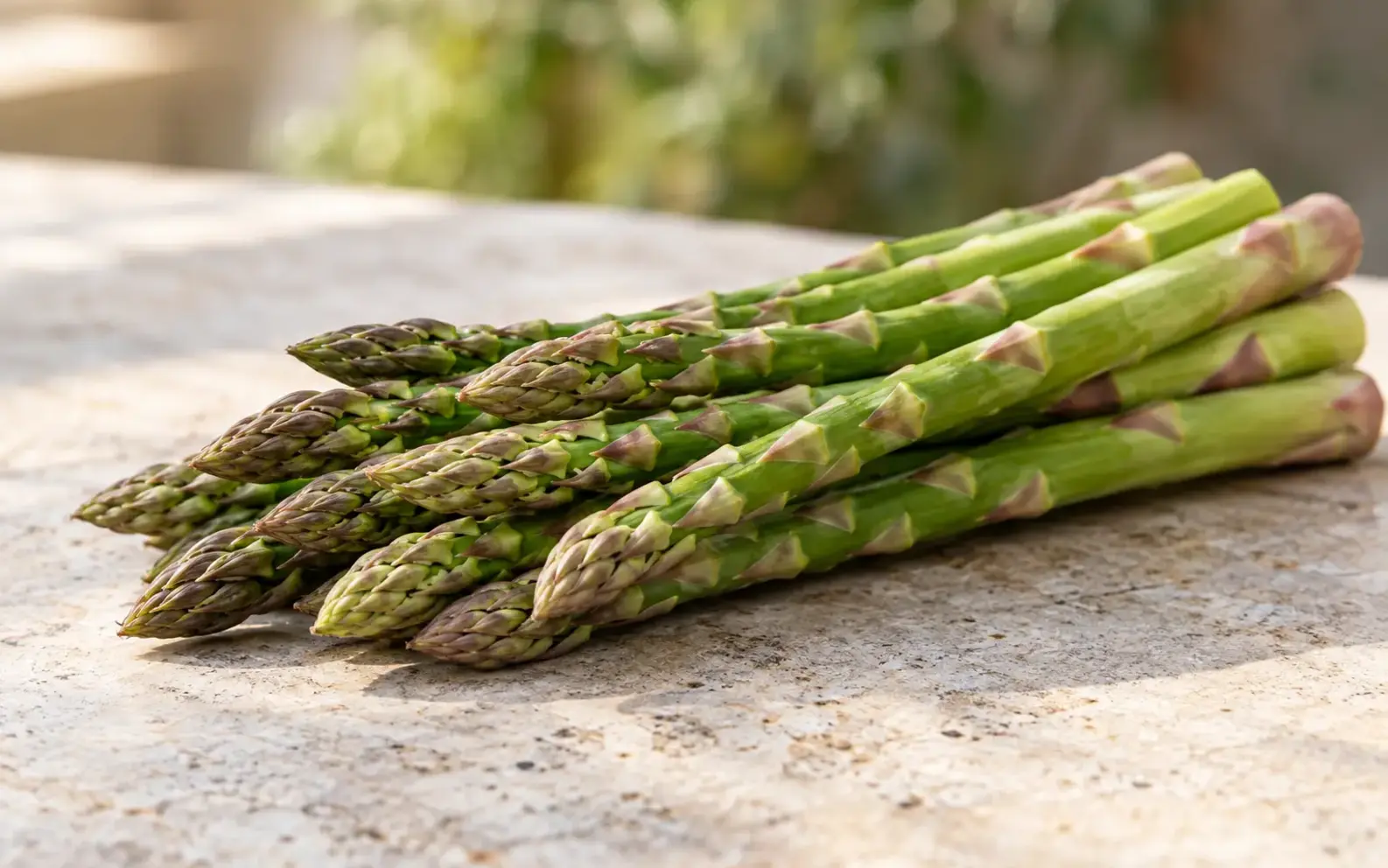
Garden asparagus spears, raw. Scientific identity: Asparagus officinalis L. Edible part: Young above-ground stems called spears; crowns, roots, mature ferns, flowers, and berries are excluded. Exact source form: Raw asparagus corresponding to USDA FoodData Central FDC 168389.
A perennial spring vegetable harvested as young spears before they open into ferns.
- Common name
- Asparagus
- Scientific name
- Asparagus officinalis
- Family
- Asparagaceae
- Edition
- Core Edibles
- Flavor
- Green · grassy · gently sweet
- Texture
- Crisp-tender
- Season
- Spring
- Best storage
- Refrigerate upright or wrapped
- Great for
- Roast · grill · steam
- Know this
- Red berries and mature plant parts are not food
02
Pairings
- Lemon
- Garlic
- Potato
- Dill
- Mustard
- Almonds
03
Safety & special considerations
Red berries and mature plant parts are not food
Safety & special considerations This chapter covers young spears. Do not eat the red berries, roots, or unidentified ornamental asparagus plants.
04
Taste, choose & buy
Choose firm, straight spears with tightly closed tips and moist-looking cut ends.
05
Nutrition
Exact food form · Per 100 g
Asparagus, raw
| Nutrient | Per 100 g |
|---|---|
| Energy | 20 kcal |
| Carbohydrate | 3.88 g |
| Protein | 2.2 g |
| Fat | 0.12 g |
| Fiber | 2.1 g |
| Total sugars | 1.88 g |
USDA FoodData Central · per 100 g. Typical eating portions may be much smaller, especially for spices.
Exact chapter values; per 100 g; no derived calculations; unavailable values remain n.a.
06
Store & preserve
- 1
Refrigerate upright or wrapped
Refrigerate with cut ends wrapped in a damp towel or standing in a little water; use while tips remain tight.
- 2
Before using
Discard food with mold, pests, leaking decay, or an unmistakably off odor.
07
At a glance
- Flavor
- Green · grassy · gently sweet
- Texture
- Crisp-tender
- Uses
- Roast · grill · steam
- Storage
- Refrigerate upright or wrapped
- Safety
- Red berries and mature plant parts are not food
- Nutrition form
- Asparagus, raw
08
Grow: start to harvest
Seed is a real option, but asparagus is a long-lived perennial. Give the bed a permanent location and do not harvest young plants heavily.
- START WITH
- Asparagus seed—or one-year crowns for a faster harvest
- CLIMATE
- Temperate climates with winter dormancy; broadly zones 3–8
- LIGHT
- 8+ hours of direct sun
- SOIL
- Deep, fertile, well-drained soil
- 1
Start it
Start seed 1/2 inch deep indoors 10–14 weeks before the last frost at 70–80°F. After sprouting, provide strong light and harden seedlings off before planting.
- 2
Give it room
Plant after frost 12–18 inches apart in rows 4–5 feet apart, with crowns level at the same depth they grew in the pot.
- 3
Water correctly
Supply about 1 inch weekly during active growth; water deeply and keep the permanent bed weed-free.
- 4
Care for it
Let every spear become fern during years one and two. Cut brown dormant ferns to the ground in late winter and add compost before spring growth.
- 5
Harvest
Begin a light two-week harvest in year three. Snap spears 6–8 inches tall; stop after several weeks and let remaining spears fern out.
Seed-grown asparagus usually gives its first light harvest in year three.
Begin a light two-week harvest in year three. Snap spears 6–8 inches tall; stop after several weeks and let remaining spears fern out.
09
Prepare & cook
- 1
Snap or trim woody ends
Match the method to the exact food form and intended dish.
- 2
Rinse spear tips
Match the method to the exact food form and intended dish.
- 3
Peel thick lower stalks if needed
Match the method to the exact food form and intended dish.
- 4
Cook quickly until crisp-tender
Match the method to the exact food form and intended dish.
Sources
- extension.umn.eduhttps://extension.umn.edu/garden-and-home/yard-and-garden/gardening-in-minnesota/growing-asparagus
- fdc.nal.usda.govhttps://fdc.nal.usda.gov/food-details/168389/nutrients
- reddit.comhttps://www.reddit.com/r/explainlikeimfive/comments/6k16sr/eli5_what_causes_asparagus_pee_and_how_does_it/
- pmc.ncbi.nlm.nih.govhttps://pmc.ncbi.nlm.nih.gov/articles/PMC3002398/
core-edibles-2026.1 · asparagus