Grain & staple · Marantaceae
Arrowroot
Maranta arundinacea
A tropical rhizome best known through its refined starch, which thickens sauces into a clear, glossy finish.
Core Edibles · Volume One
01
Meet the food
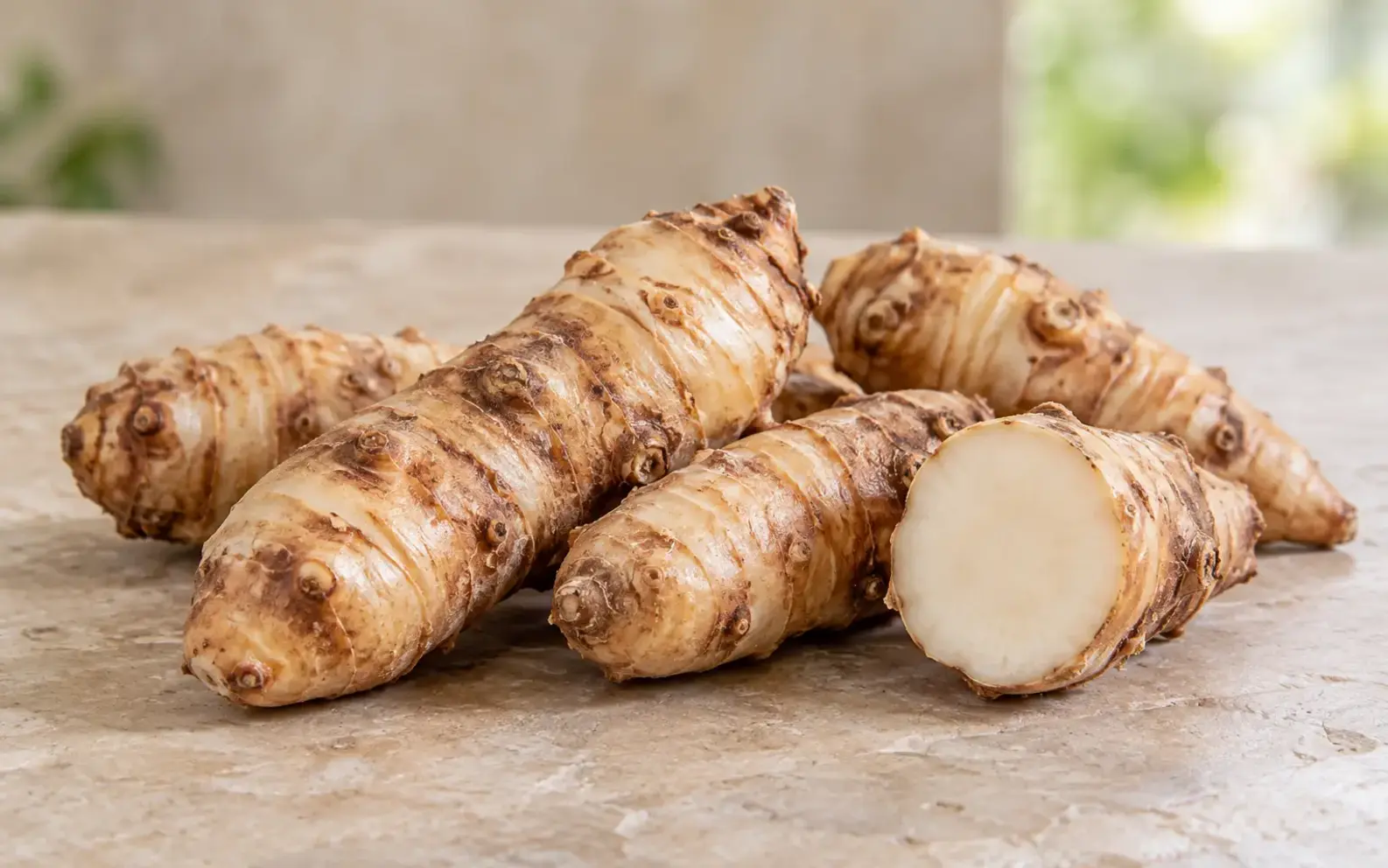
Arrowroot rhizome from Maranta arundinacea, raw. Scientific identity: Maranta arundinacea L. Edible part: Fresh underground rhizome/root portion represented by the raw-food record. Exact source form: Raw arrowroot corresponding to USDA FoodData Central FDC 168490.
A tropical rhizome best known through its refined starch, which thickens sauces into a clear, glossy finish.
- Common name
- Arrowroot
- Scientific name
- Maranta arundinacea
- Family
- Marantaceae
- Edition
- Core Edibles
- Flavor
- Very mild · neutral
- Texture
- Crisp raw rhizome · silky starch
- Season
- Fresh regionally · starch year-round
- Best storage
- Cool fresh · dry starch
- Great for
- Thickening · biscuits · puddings
- Know this
- Fresh rhizome and refined starch are different forms
02
Pairings
- Coconut
- Banana
- Vanilla
- Cacao
- Ginger
- Citrus
03
Safety & special considerations
Fresh rhizome and refined starch are different forms
Safety & special considerations The retained nutrient record describes raw arrowroot, not purified arrowroot starch. Do not transfer values or preparation guidance between them.
04
Taste, choose & buy
Fresh rhizomes should be firm and clean; starch should be dry, fine, and free from clumps or off odors.
05
Nutrition
Exact food form · Per 100 g
Arrowroot, raw
| Nutrient | Per 100 g |
|---|---|
| Energy | 65 kcal |
| Carbohydrate | 13.4 g |
| Protein | 4.24 g |
| Fat | 0.2 g |
| Fiber | 1.3 g |
| Total sugars | n.a. |
USDA FoodData Central · per 100 g. Typical eating portions may be much smaller, especially for spices.
Exact chapter values; per 100 g; no derived calculations; unavailable values remain n.a.
06
Store & preserve
- 1
Cool fresh · dry starch
Refrigerate fresh rhizomes; keep starch airtight and dry in a cool pantry.
- 2
Before using
Discard food with mold, pests, leaking decay, or an unmistakably off odor.
07
At a glance
- Flavor
- Very mild · neutral
- Texture
- Crisp raw rhizome · silky starch
- Uses
- Thickening · biscuits · puddings
- Storage
- Cool fresh · dry starch
- Safety
- Fresh rhizome and refined starch are different forms
- Nutrition form
- Arrowroot, raw
08
Grow: start to harvest
Arrowroot is not practically started from ordinary seed. Its backyard starting piece is a living rhizome—similar to starting potato or ginger.
- START WITH
- A healthy piece of true arrowroot rhizome with at least one visible bud
- CLIMATE
- Warm, humid, and frost-free for 10–12 months; roughly zones 10–12. In colder climates, use a wide container and bring it inside before frost.
- LIGHT
- Morning sun with afternoon shade, or bright filtered light in very hot climates
- SOIL
- Loose, rich, well-drained soil that stays evenly moist
- 1
Start it
Lay the rhizome horizontally 2–4 inches deep with the bud facing upward. Keep above about 70°F and moist until shoots emerge.
- 2
Give it room
Plant pieces 18–24 inches apart, or one vigorous piece in a container at least 16–20 inches wide.
- 3
Water correctly
Water whenever the top inch begins to dry. Do not allow a container to sit in water.
- 4
Care for it
Mulch to hold moisture, feed the soil with compost, and protect foliage from wind and frost.
- 5
Harvest
After roughly 10–12 months, when leaves yellow and decline, loosen the soil and lift the rhizomes. Save healthy pieces with buds for replanting.
Expect a harvest in about 10–12 warm months.
After roughly 10–12 months, when leaves yellow and decline, loosen the soil and lift the rhizomes. Save healthy pieces with buds for replanting.
09
Prepare & cook
- 1
Scrub and peel fresh rhizome
Match the method to the exact food form and intended dish.
- 2
Cook fresh pieces thoroughly
Match the method to the exact food form and intended dish.
- 3
Mix starch with cool liquid
Match the method to the exact food form and intended dish.
- 4
Add slurry near the end
Match the method to the exact food form and intended dish.
Sources
- powo.science.kew.orghttps://powo.science.kew.org/taxon/urn%3Alsid%3Aipni.org%3Anames%3A280408-2
- fdc.nal.usda.govhttps://fdc.nal.usda.gov/food-details/168490/nutrients
- fda.govhttps://www.fda.gov/food/buy-store-serve-safe-food/selecting-and-serving-produce-safely
- reddit.comhttps://www.reddit.com/r/AskCulinary/comments/2risea/arrowroot_starch_as_a_thickener/
- pmc.ncbi.nlm.nih.govhttps://pmc.ncbi.nlm.nih.gov/articles/PMC10559777/
core-edibles-2026.1 · arrowroot