Fruit · Pome · Rosaceae family
Apple
Malus domestica Borkh.
Crisp, fragrant, and remarkably versatile—the everyday fruit that can move from lunchbox to salad, skillet, sauce, or pie.
Core Edibles · Volume One
01
Meet the food
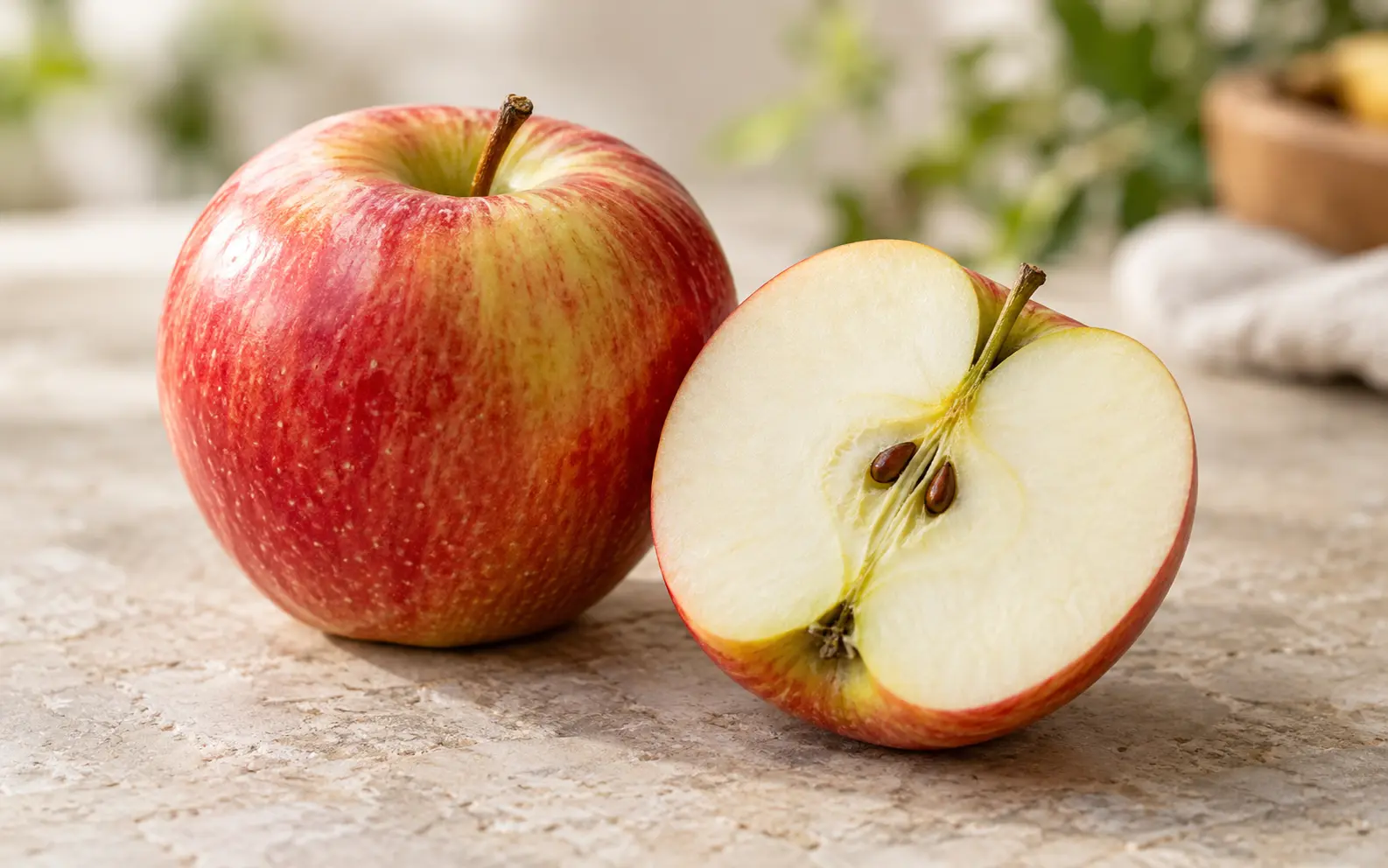
The domestic apple is the fruit of a deciduous tree in the rose family. Botanically it is a pome : much of the juicy flesh develops from tissue surrounding the flower’s ovary.
For this guide, “apple” means the fresh flesh and edible skin. The stem, core, and seeds are excluded from the nutrition calculation. Juice, cider, applesauce, dried apple, vinegar, and apple butter are related foods with their own entries.
- Common name
- Apple
- Scientific name
- Malus domestica
- Family
- Rosaceae · rose family
- Edible part
- Flesh and skin
- Flavor
- Sweet · tart · floral
- Texture
- Crisp · juicy
- Peak season
- Late summer–fall
- Best storage
- Refrigerated
- Great for
- Raw · sauce · baking
- Know this
- Do not intentionally eat crushed seeds
02
Pairings
- Cinnamon, nutmeg, ginger, vanilla, maple, caramel
- Lemon, celery, cabbage, fennel, cranberry, mint
- Walnuts, almonds, tahini, mustard, rosemary, sage
- Oats, barley, granola, sourdough, puff pastry
03
Safety & special considerations
A few accidentally swallowed whole seeds are generally not expected to cause harm.
Safety & special considerations The practical boundary Apple seeds contain amygdalin. Risk is different when many seeds are deliberately crushed or chewed and swallowed. Do not intentionally consume apple seeds. For a large deliberate exposure or symptoms, contact Poison Control in the United States at 1-800-222-1222 . Whole apples and hard chunks can be a choking hazard for young children. Prepare an age-appropriate texture. Apple can cause allergic reactions in some people, including oral symptoms associated with pollen-food allergy syndrome. Discard fruit with visible mold, spreading wet decay, or an off fermented odor rather than cutting around extensive damage.
04
Taste, choose & buy
Taste, choose & buy
05
Nutrition
Exact food form · Per 100 g
The form used for this chapter’s nutrition panel
Nutrition form: Raw, with skin
| Nutrient | Per 100 g |
|---|---|
| Energy | 52 kcal |
| Carbohydrate | 13.8 g |
| Dietary fiber | 2.4 g |
| Total sugars | 10.4 g |
| Vitamin C | 4.6 mg |
| Potassium | 107 mg |
Medium serving calculated at 182 g from USDA’s raw-with-skin record. Numbers are descriptive, not personalized dietary targets.
Exact chapter values; per 100 g; no derived calculations; unavailable values remain n.a.
06
Store & preserve
- 1
Counter
Useful for fruit you plan to eat soon. Warmth speeds softening and aroma loss.
- 2
Refrigerator
Keep whole apples cold in the crisper or a breathable bag. Check and remove damaged fruit.
- 3
Freeze prepared
Freeze peeled or unpeeled slices for cooked dishes; texture will soften after thawing.
- 4
Preserve safely
Dry, freeze, or use a tested canning recipe from a reliable preservation authority.
07
At a glance
- Identity
- Fresh fruit of Malus domestica
- Flavor
- Sweet to tart; cultivar-dependent
- Texture
- Crisp and juicy to soft and tender
- Nutrition form
- Raw, with skin
- Best uses
- Raw, salads, sauce, sautéing, baking
- Storage
- Cold for longer quality
- Pairs with
- Warm spice, nuts, grains, herbs
- Safety
- Do not deliberately eat crushed seeds
08
Grow: start to harvest
A seed-grown tree is genetically new: it will not reliably produce the same apple you ate. It may take 6–10 years or longer to fruit, grow to full size, and need another compatible apple or crabapple nearby for pollination.
- START WITH
- Several clean, undamaged seeds from a ripe apple
- COLD STEP
- 60–90 days refrigerated in barely moist material
- LIGHT
- 8+ hours of direct sun after transplanting
- FINAL SPACE
- Allow roughly 20–25 feet for an ungrafted seedling tree
- 1
Clean the seeds
Remove every trace of apple flesh, rinse, and let the surface dry for a day. Do not crush or eat the seeds.
- 2
Give them an artificial winter
Wrap the seeds in a barely damp paper towel or place them in barely damp seed-starting material. Seal loosely in a labeled bag and refrigerate—not freeze—for 60–90 days. Check weekly; discard moldy seeds and keep the material only slightly damp.
- 3
Plant after a root appears
Place each sprouted seed about 1/2 inch deep in its own small pot of loose, draining soil, with the new root pointing down. Keep it bright, around normal room temperature, and evenly moist.
- 4
Build a sturdy seedling
After leaves appear, give the plant strong direct light. Move it into a deeper pot when roots fill the first one. Before outdoor planting, expose it gradually to sun and wind over 7–10 days.
- 5
Plant in its permanent place
After hard frost danger has passed, choose full sun and well-drained ground. Dig no deeper than the root system, spread the roots, return the native soil, water deeply, and mulch without touching the trunk.
- 6
Care for the young tree
Supply about 1 inch of total water weekly during active growth when rain does not. Keep a 3-foot circle free of grass, protect the trunk from animals, and train one upright main leader.
- 7
Wait for flowering and fruit
Keep another genetically different apple or crabapple flowering within roughly 100 feet. When fruit eventually forms, thin crowded clusters and harvest only after flavor develops and apples release with a gentle upward twist.
- 8
Mark the mature space
Keep the tree away from deep shade, standing water, and low frost pockets. Allow at least as much horizontal room as its expected mature height.
- 9
Dig wide, not deep
Make the hole about twice the width of the roots or root ball and no deeper than the root system.
- 10
Correct the roots
Spread bare roots naturally. Straighten or cut circling woody roots on container-grown trees so they do not girdle the trunk later.
- 11
Set the graft above soil
Keep the swollen graft union about 4 inches above the finished soil line. Do not bury it.
- 12
Backfill mostly with native soil
Hold the tree straight, return the excavated soil, and gently firm it. Do not put fertilizer in the planting hole.
- 13
Water thoroughly
Soak the root zone to settle soil and remove air pockets. Add soil if settling exposes roots.
- 14
Mulch and protect
Add a few inches of mulch over the root zone, keeping it several inches away from the trunk. Stake dwarf trees with a broad, non-abrasive tie and add a trunk guard where animals are a risk.
Harvest by maturity, not just color.
09
Prepare & cook
- 1
Wash
Rinse under cool running water and rub the surface. Dry with a clean towel.
- 2
Core
Quarter and cut away the seed cavity, or use an apple corer for rings.
- 3
Cut
Slice thin for salads and baking; cube for oatmeal, stuffing, or quick sautés.
- 4
Slow browning
Toss cut surfaces with a little lemon juice when appearance matters.
Sources
No source links are supplied in this record.
core-edibles-2026.1 · apple