Grain & staple · Amaranthaceae
Amaranth
Amaranthus spp.
Tiny seeds that cook into a soft porridge, toast with a nutty aroma, or pop into miniature crisp grains.
Core Edibles · Volume One
01
Meet the food
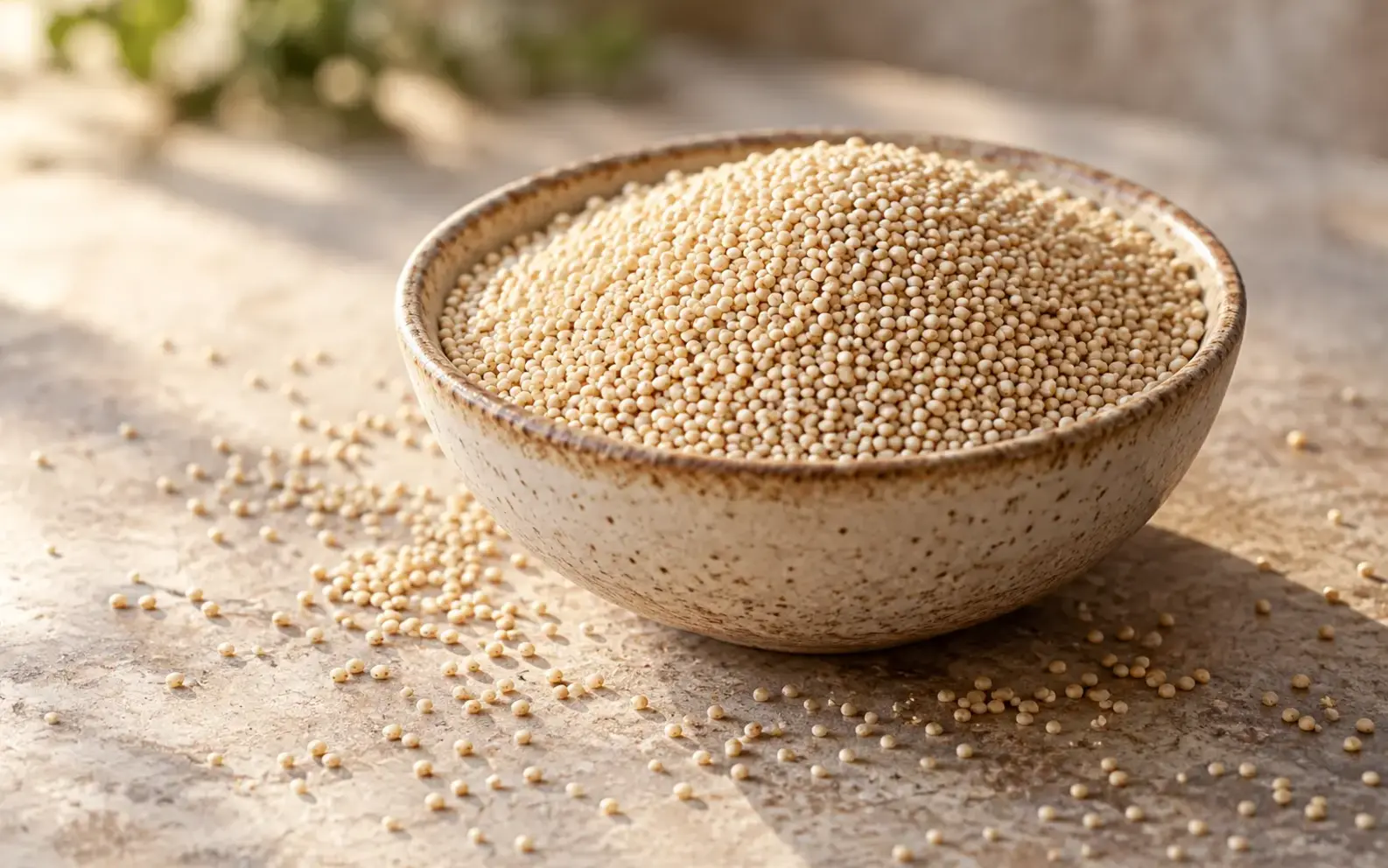
Amaranth grain, uncooked. Scientific identity: Grain amaranths include Amaranthus cruentus L., A. hypochondriacus L., and A. caudatus L.; the USDA record does not name a species. Edible part: Cleaned mature dry seed used as a pseudocereal. Exact source form: Amaranth grain, uncooked, corresponding to USDA FoodData Central FDC 170682.
Tiny seeds that cook into a soft porridge, toast with a nutty aroma, or pop into miniature crisp grains.
- Common name
- Amaranth
- Scientific name
- Amaranthus spp.
- Family
- Amaranthaceae
- Edition
- Core Edibles
- Flavor
- Earthy · nutty · mild
- Texture
- Tiny · creamy when cooked
- Season
- Dry pantry staple
- Best storage
- Airtight · cool · dry
- Great for
- Porridge · pilaf · popping
- Know this
- Seed and leafy amaranth are separate food forms
02
Pairings
- Cinnamon
- Coconut
- Beans
- Tomato
- Lime
- Chili
03
Safety & special considerations
Seed and leafy amaranth are separate food forms
Safety & special considerations Do not merge grain amaranth nutrition with amaranth leaves. Preparation and nutrient values depend on the exact form.
04
Taste, choose & buy
Choose dry, clean seed with no insects, clumping, moisture, or stale odor.
05
Nutrition
Exact food form · Per 100 g
Amaranth grain, uncooked
| Nutrient | Per 100 g |
|---|---|
| Energy | 371 kcal |
| Carbohydrate | 65.2 g |
| Protein | 13.6 g |
| Fat | 7.02 g |
| Fiber | 6.7 g |
| Total sugars | 1.69 g |
USDA FoodData Central · per 100 g. Typical eating portions may be much smaller, especially for spices.
Exact chapter values; per 100 g; no derived calculations; unavailable values remain n.a.
06
Store & preserve
- 1
Airtight · cool · dry
Keep dry seed airtight in a cool cabinet; refrigerate or freeze for longer storage in warm climates.
- 2
Before using
Discard food with mold, pests, leaking decay, or an unmistakably off odor.
07
At a glance
- Flavor
- Earthy · nutty · mild
- Texture
- Tiny · creamy when cooked
- Uses
- Porridge · pilaf · popping
- Storage
- Airtight · cool · dry
- Safety
- Seed and leafy amaranth are separate food forms
- Nutrition form
- Amaranth grain, uncooked
08
Grow: start to harvest
Choose grain amaranth if you want edible seed; ornamental and leafy varieties are not automatically equivalent.
- START WITH
- Seed sold as a grain-amaranth variety
- CLIMATE
- A warm, frost-free growing season of roughly 90–120 days
- LIGHT
- 6–8+ hours of direct sun
- SOIL
- Average, well-drained garden soil
- 1
Start it
After frost, wait until soil is warm. Place the tiny seed on the surface, cover only about 1/8 inch, press gently, and keep the surface moist until sprouts appear—often within 4–10 days.
- 2
Give it room
Thin grain plants to 12–18 inches apart. Leave 18–24 inches between rows for airflow around seed heads.
- 3
Water correctly
Water gently while seedlings are small. Once established, water deeply during long dry spells instead of keeping the surface constantly wet.
- 4
Care for it
Weed early; mature plants shade weeds. Stake tall plants in windy sites. Stop overhead watering as seed heads dry.
- 5
Harvest
When heads feel dry and seeds rub free, cut them into a paper bag. Finish drying, rub out the seed, sift away chaff, and store only when completely dry.
Many grain varieties mature in about 90–120 days.
When heads feel dry and seeds rub free, cut them into a paper bag. Finish drying, rub out the seed, sift away chaff, and store only when completely dry.
09
Prepare & cook
- 1
Rinse if needed
Match the method to the exact food form and intended dish.
- 2
Simmer with water
Match the method to the exact food form and intended dish.
- 3
Toast for nuttiness
Match the method to the exact food form and intended dish.
- 4
Pop small batches in a hot dry pan
Match the method to the exact food form and intended dish.
Sources
- powo.science.kew.orghttps://powo.science.kew.org/results?q=Amaranthus+grain
- fdc.nal.usda.govhttps://fdc.nal.usda.gov/food-details/170682/nutrients
- pmc.ncbi.nlm.nih.govhttps://pmc.ncbi.nlm.nih.gov/articles/PMC10314148/
- reddit.comhttps://www.reddit.com/r/PlantBasedDiet/comments/13ka7x5/has_anyone_had_any_luck_with_amaranth_every_time/
core-edibles-2026.1 · amaranth